
When a loved one faces a life-limiting illness, the search for the "best hospice care near me" becomes a critical and deeply personal journey. This decision is about more than just medical services. It's about finding an organization that provides dignity, comfort, and comprehensive support for both the patient and their family.
The right hospice partner understands the unique needs of your community and delivers care with unwavering compassion. For families across California’s Central Coast, including Monterey County, San Benito County, Santa Cruz County, and South Santa Clara County, this choice is paramount. The goal is to ensure your loved one's final chapter is lived with peace and respect, supported by a dedicated team.
This guide is designed to simplify your search by providing a clear comparison of top-rated hospice providers. We will evaluate each organization based on key differentiators, service highlights, and their unique approach to end-of-life care. This will help you make an informed decision during a profoundly challenging time.
1. VITAS Healthcare: The National Leader in Hospice Services
As a pioneer of the American hospice movement, VITAS Healthcare has established itself as the largest provider of end-of-life care in the United States. Since its founding in 1978, VITAS has built a national model centered on an interdisciplinary team approach. This ensures that every aspect of a patient's physical, emotional, and spiritual well-being is addressed.
Their comprehensive service offerings range from standard in-home medical support to specialized pediatric programs. They also have dedicated inpatient hospice units designed for acute symptom management. For families on the Central Coast seeking a provider with standardized protocols and a vast network, VITAS presents a well-established choice.
Why VITAS Stands Out
VITAS's primary strength lies in its scale and experience. Having served millions of patients, the organization has refined its care delivery processes to maintain consistent quality across numerous locations. This is particularly beneficial for patients with complex medical needs.
The corporate structure of VITAS ensures access to extensive resources, including advanced telehealth services and specialized care programs. This makes them a strong contender for patients with highly specific or acute end-of-life care requirements. However, some families may find a large, national organization feels less personal than a local provider with deep community roots.
These figures underscore their long-standing presence and significant operational capacity in the national hospice landscape. Many of their services, such as managing complex symptoms, align with the goals of palliative care; you can learn more about the benefits of palliative care to see how it complements the hospice philosophy.
Actionable Tips for Families
If you are considering VITAS, it is important to engage proactively to ensure a personalized experience.
- Ask About Specialized Programs: Inquire about their specific programs for conditions like cardiac disease, respiratory illness, or dementia.
- Meet Your Care Team: Request an introductory meeting with the Registered Nurse, Hospice Aide, and Social Worker assigned to your family.
- Confirm Local Response Times: Ask about the location of their nearest office and their standard response times for after-hours needs.
2. Hospice of the Valley: A Nonprofit Community Pillar
As Arizona's largest and one of its most respected nonprofit hospice organizations, Hospice of the Valley has been a community pillar since 1977. They have built their reputation on a deeply patient-centered approach. This ensures every individual's journey is met with dignity, comfort, and comprehensive support.
While primarily serving the Phoenix area, their model provides an excellent benchmark for families on the Central Coast evaluating what makes for the best hospice care near me. Their services extend beyond traditional in-home care, encompassing dedicated inpatient hospice homes and innovative programs tailored to unique patient needs.

Why Hospice of the Valley Stands Out
Hospice of the Valley’s primary strength is its nonprofit, mission-driven philosophy combined with its extensive scale. This unique combination allows them to reinvest resources into pioneering new programs, such as specialized dementia care and extensive grief support services. A nonprofit status often translates into a deeper community focus.
Their commitment to serving the community is evident in their wide array of supportive services, which are often provided regardless of a patient's ability to pay. For those exploring their options, understanding the breadth of services offered can be incredibly beneficial. You can discover more about their approach to hospice care to see how it aligns with your family's needs.
Actionable Tips for Families
If you are inspired by the Hospice of the Valley model, use these tips to find a provider with similar values:
- Inquire About Volunteer Programs: Ask how volunteers are integrated into care for additional family support and companionship.
- Ask About Pet Therapy: If pets are an important part of your family’s life, inquire if the agency offers pet therapy or has protocols to support animals in the home.
- Evaluate Grief Support: Look into the grief counseling services offered. Ask if they have specialized programs for children or unique support groups.
- Consider Inpatient Options: For potential crisis care needs, confirm if they operate their own inpatient facilities or have strong partnerships with local ones.
3. Seasons Hospice & Palliative Care
Seasons Hospice & Palliative Care is a nationally recognized provider known for its strong focus on integrating palliative and hospice services. Operating across multiple states, their model emphasizes early, comprehensive support for patients with serious illnesses. This dual approach makes them a significant choice for families looking for the best hospice care near me.
Their care philosophy is built on personalized plans and strong partnerships with local hospitals and referring physicians. Seasons has a proven track record of successfully transitioning patients from palliative to hospice care. By focusing on expert pain and symptom management protocols, they help maintain high patient satisfaction.
Why Seasons Stands Out
Seasons' key advantage is its expertise in the continuum between palliative care and hospice. Many families are not ready for a hospice diagnosis, and Seasons provides a valuable bridge with its robust palliative programs. This allows patients to receive specialized symptom management and support earlier in their illness.
Seasons excels at managing the often-complex transition from palliative support to end-of-life care. Their integrated teams are trained to guide families through this emotional and clinical shift. This makes them an excellent option for patients who may benefit from an extended period of supportive care before hospice becomes appropriate.
Actionable Tips for Families
When considering Seasons, focus on understanding how their dual-service model can benefit your specific circumstances.
- Discuss Palliative Options: If your loved one is not yet eligible or ready for hospice, ask specifically about their palliative care programs.
- Inquire About Transition Protocols: Ask how the team manages the shift from palliative to hospice care.
- Verify Local Team and Response Times: Confirm the location of their nearest Central Coast office and their typical response times for routine and urgent needs.
- Review Family Communication: Discuss their standard procedures for keeping family members informed, especially those who may live out of the area.
4. Compassus: A Personalized Approach with National Support
Compassus operates on a model that blends national resources with local, community-based care. As one of the largest hospice providers in the U.S., they strive to deliver a personalized experience that respects patient dignity. Their philosophy focuses on providing care that is close to home, managed by local teams who understand the community.
This structure allows them to offer a high degree of personalization while maintaining rigorous quality standards. For families looking for the best hospice care near me that combines reliability with individual focus, Compassus presents a compelling option. Their integration with major health systems ensures a high level of clinical excellence.
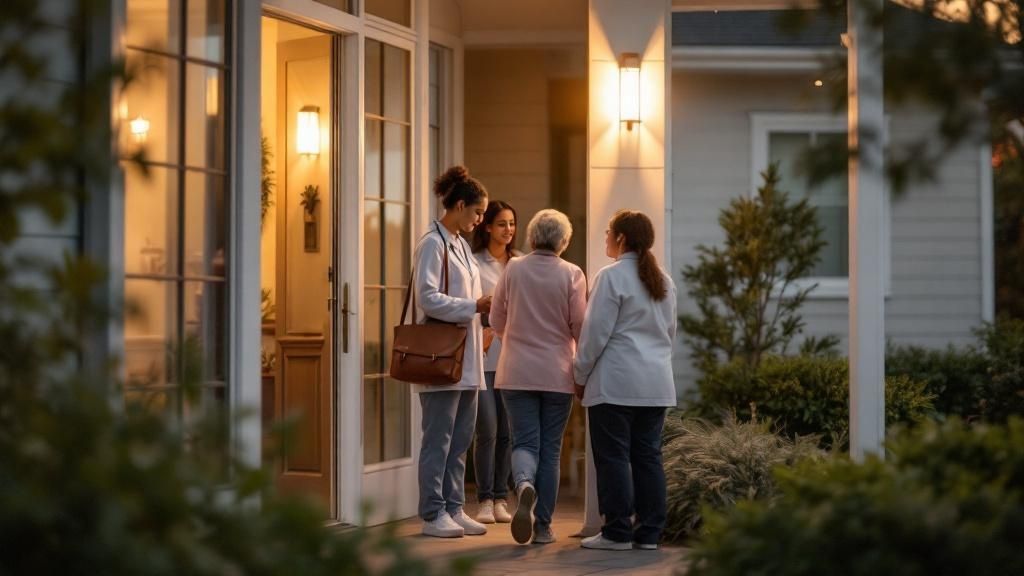
Why Compassus Stands Out
The key strength of Compassus is its "local-first" approach within a national framework. While they have extensive resources, care decisions are driven by local clinical teams who are familiar with the communities they serve. This can lead to a more personalized and responsive care experience.
Compassus emphasizes maintaining high quality scores through Medicare reporting and invests heavily in comprehensive staff training. Their model aims to give families the best of both worlds. This includes the assurance of a nationally recognized provider and the comfort of care from local professionals.
Actionable Tips for Families
When evaluating Compassus, focus on understanding their local team and care planning process to ensure it aligns with your family’s values.
- Ask About Local Staff Tenure: Inquire about the experience and longevity of the local Registered Nurses, Hospice Aides, and Social Workers to gauge team stability.
- Discuss Physician Collaboration: Ask how they will coordinate with your loved one's current doctors to create a seamless care plan.
- Request Quality Metrics: Ask for their specific quality and family satisfaction scores for the local branch.
- Explore Care Personalization: Discuss their process for developing a personalized care plan that reflects the patient’s unique wishes and goals.
5. Kindred Hospice: A Focus on Integrated Care
As a significant part of the Kindred Healthcare network, Kindred Hospice provides comprehensive end-of-life care services across the nation. Their model is built upon delivering comfort and enhancing the quality of life for patients. This connection offers a potential continuum of care that many families find reassuring.
Kindred’s services are designed to support both patients and their families through a difficult journey. By developing partnerships with local hospitals and medical communities on the Central Coast, they aim to facilitate smooth transitions. This helps patients move from curative treatment to compassionate hospice care at home or in a facility.
Why Kindred Stands Out
Kindred's main advantage is its connection to a broader healthcare ecosystem. For patients who may have already received care from other Kindred services, the transition to hospice can feel more seamless. This established relationship helps ensure continuity and a deeper understanding of the patient's medical history.
Kindred’s integration within a larger network allows for well-defined care protocols and effective coordination. Their structured approach is beneficial for families who value consistency and established processes. The organization's emphasis on pain management and symptom control is a cornerstone of their philosophy.
Actionable Tips for Families
If you are considering Kindred Hospice, taking these steps can help you make an informed decision.
- Discuss Care Transitions: Ask how they coordinate the transition from a hospital or another care facility to their hospice service.
- Inquire About Staffing: Request information about their local staff, including the medical director's involvement and standard after-hours response times.
- Understand Family Support: Inquire about the resources and support they provide for loved ones. These tips for family caregivers can offer additional valuable guidance.
6. Brookdale Hospice: Integrated Care for Senior Living Communities
Brookdale Hospice operates as a specialized branch of Brookdale Senior Living, one of the nation’s largest senior living providers. Their model is uniquely designed to deliver end-of-life care within assisted living, memory care, and independent living communities. This integration provides a seamless transition for residents who need hospice services.
For families seeking the best hospice care near me for a loved one already in a senior community, Brookdale offers a highly convenient option. Their services are built on a deep understanding of geriatric care. While their primary focus is on serving Brookdale residents, their hospice services are often available to the wider community.
Why Brookdale Stands Out
Brookdale's key advantage is its expertise in delivering hospice care within a senior living setting. Their clinical teams are adept at coordinating with facility staff, ensuring care plans are harmonized. This eliminates many logistical challenges families face when bringing an outside agency into a residential community.
The integrated nature of Brookdale Hospice means care is delivered by a team that understands the daily routines of a senior living environment. This can lead to a more comfortable and less disruptive experience for the patient. You can learn more about our continuum of care to see how different levels of support work together.
Actionable Tips for Families
If you are considering Brookdale Hospice, especially for a loved one in a senior living facility, here are some practical steps to take.
- Inquire About Geriatric Specialization: Ask about the specific training their Registered Nurses, Hospice Aides, and Social Workers have in geriatric and dementia care.
- Discuss Coordination with Facility Staff: Clarify how their hospice team will communicate and coordinate with the assisted living or memory care staff.
- Check Availability for Non-Residents: If your loved one does not live in a Brookdale community, confirm if they provide services in private homes in your area.
- Understand Family Involvement: Ask how they facilitate family participation and communication, particularly if you are managing care from a distance.
7. Central Coast VNA & Hospice: Your Local, Nonprofit Partner
For over 74 years, Central Coast VNA & Hospice (CCVNA) has been deeply embedded within the communities it serves. As the region's trusted nonprofit provider, CCVNA offers a uniquely personalized and community-centric approach to care. This makes them a premier choice for families looking for the best hospice care near me.
Their model is built on strong local connections and long-standing relationships with regional hospitals, physicians, and community resources. For families in Monterey County, San Benito County, Santa Cruz County, and South Santa Clara County, CCVNA offers the assurance of care from a team that understands the local landscape and is invested in the community's well-being. This local focus translates into highly responsive and adaptable care.
Why Central Coast VNA & Hospice Stands Out
The primary strength of CCVNA lies in its nonprofit, mission-driven philosophy and deep community integration. Unlike national for-profit chains, CCVNA reinvests its resources directly into patient care, staff training, and community-benefit programs. This structure fosters a culture of compassion and allows for a more personalized patient experience.
CCVNA also has robust and dedicated volunteer programs that enhance patient quality of life. These volunteers provide companionship, respite for family members, and specialized support, adding a layer of care that is a hallmark of a true community-based provider. To better understand the criteria for different levels of care, you can explore the eligibility requirements for home health and hospice to see how these services align.
Actionable Tips for Families
When considering Central Coast VNA & Hospice for your loved one, it is beneficial to explore its community-specific advantages.
- Research Their Local History: Ask about their 74+ year history in the area and their long-term community involvement.
- Inquire About Volunteer Support: Learn about their volunteer programs and how they integrate volunteers into the care team.
- Ask About Local Partnerships: Request information on their relationships with local hospitals, clinics, and other healthcare providers.
- Confirm Service Area: Ensure your location is well within their primary service areas of Monterey, San Benito, Santa Cruz, or South Santa Clara Counties.
Making the Right Choice for Your Family on the Central Coast
Choosing a hospice provider is a deeply personal decision, one that requires careful thought and a clear understanding of what matters most to your family. This guide has reviewed several well-known hospice organizations, but the search for the "best hospice care near me" often leads families back to one essential truth: local, community-focused care makes all the difference.
Navigating this journey with a provider that is woven into the fabric of the Central Coast means you receive more than just medical support. It means partnering with a team that understands the local healthcare landscape and community spirit of Monterey County, San Benito County, Santa Cruz County, and South Santa Clara County.
Key Takeaways for Your Hospice Search
As you reflect on the options, keep these critical factors at the forefront of your decision-making process:
- Nonprofit Mission vs. For-Profit Model: A nonprofit agency, like Central Coast VNA & Hospice, reinvests its resources directly into patient care and community programs. This mission-driven focus ensures patient well-being is the ultimate priority.
- A True Continuum of Care: A provider offering a seamless continuum from home health nursing to palliative care and finally to hospice ensures consistency and trust. This means a familiar team can support your family every step of the way.
- Deep Community Roots: An organization with a long-standing history, like CCVNA’s 74+ years of service, has built lasting relationships with local physicians and hospitals. This deep integration translates to better-coordinated, more responsive care.
- Comprehensive Support Services: Superior hospice care includes a holistic team of professionals: Registered Nurses for expert symptom management, Chaplains for spiritual support, Social Workers for emotional guidance, and dedicated Hospice Aides for personal care.
Actionable Next Steps for Your Family
Making the right choice starts with asking the right questions. Here is a practical checklist to guide your conversations with potential providers:
- Inquire About the Care Team: Ask specifically about the roles on their team. Who will be visiting the home? How often?
- Understand Their Service Area: Confirm they serve your specific town and ask about their staff's familiarity with local resources.
- Discuss After-Hours Support: How does the agency handle calls and visits on nights and weekends? Is a Registered Nurse available 24/7?
- Ask About Their Nonprofit Status: Inquire about their mission and how their organizational structure benefits patients and families.
Choosing hospice care is not about giving up; it is about embracing a philosophy of care that prioritizes comfort, dignity, and quality of life. By selecting a provider that aligns with your family’s values and has a proven legacy of compassionate, local service, you are making a powerful choice to ensure your loved one’s final chapter is lived with peace and respect.
Frequently Asked Questions (FAQs)
1. What is the difference between hospice and palliative care?
Palliative care can be provided at any stage of a serious illness, often alongside curative treatments, to manage symptoms and improve quality of life. Hospice care is a specific type of palliative care for individuals with a life expectancy of six months or less who are no longer seeking curative treatment.
2. Who is on the hospice care team at Central Coast VNA & Hospice?
Our team includes a Registered Nurse, Medical Social Worker, Hospice Aide, Chaplain, and trained volunteers. This interdisciplinary group works together under the supervision of our Medical Director to provide comprehensive physical, emotional, and spiritual support.
3. Does Central Coast VNA & Hospice provide care in facilities?
Yes, our compassionate hospice services can be provided wherever a patient calls home. This includes private residences, assisted living communities, and skilled nursing facilities throughout Monterey County, San Benito County, Santa Cruz County, and South Santa Clara County.
4. How is hospice care paid for?
Hospice care is covered by Medicare, Medi-Cal, the Veteran’s Administration (VA), and most private insurance plans. As a nonprofit organization, Central Coast VNA & Hospice is committed to providing care to all eligible patients, regardless of their ability to pay.
5. How do I know when it’s the right time to start hospice care?
It may be time to consider hospice when curative treatments are no longer effective or desired, and the focus shifts to comfort and quality of life. A conversation with your physician and a hospice provider like Central Coast VNA & Hospice can help determine if it is the right time for your family.
When searching for the best hospice care near you, turn to the trusted, nonprofit leader on the Central Coast. For over 74 years, Central Coast VNA & Hospice has provided unparalleled, compassionate care to local families. To learn how our dedicated team can support you, visit Central Coast VNA & Hospice or contact us today to start the conversation.