
Direct Answer: Home health for COPD or diabetes means a nurse visits your home to monitor symptoms, review medications, teach warning signs, and report changes to your physician, all under a doctor’s order.
Your dad spent three days at Salinas Valley Health after a COPD flare. He is home now, breathing better, and the discharge folder is sitting unopened on the counter. Nobody explained what happens next.
Or your mother’s blood sugar has been swinging for months. She lives alone in King City, checks it when she remembers, and her last A1C worried her doctor enough that he mentioned home health.
Families across Monterey County call with a version of the same question: does a nurse coming to the house actually do anything for a condition that is not going away? This article walks through what those visits look like for COPD and diabetes, and how coverage usually works.
Chronic Illness Is One of the Most Common Reasons Home Health Starts
Most people picture home health as something that follows a hip replacement or a heart surgery. That is a real use of it, but it is not the whole picture.
Across Monterey County and the Salinas Valley, chronic disease management is one of the most frequent reasons a physician orders home health at all. It is also the least understood.
A patient does not need stitches to qualify. What matters is whether there is a skilled clinical need that requires a licensed professional. That can include:
- A COPD exacerbation that landed someone in the emergency department at Community Hospital of the Monterey Peninsula
- Blood sugar readings that have become unstable enough to be dangerous
- A new insulin regimen the patient has never managed before
- A diabetic foot wound that needs assessment and dressing changes
- Repeated falls or a clear drop in strength tied to a chronic condition
The purpose is teaching and monitoring, not permanent hands-on help. Home health is intermittent care, usually one to three visits a week for a few weeks, with the goal of handing the knowledge back to the patient and family. If you want the day-to-day picture, this piece on what a skilled nurse actually does on a home visit covers it.
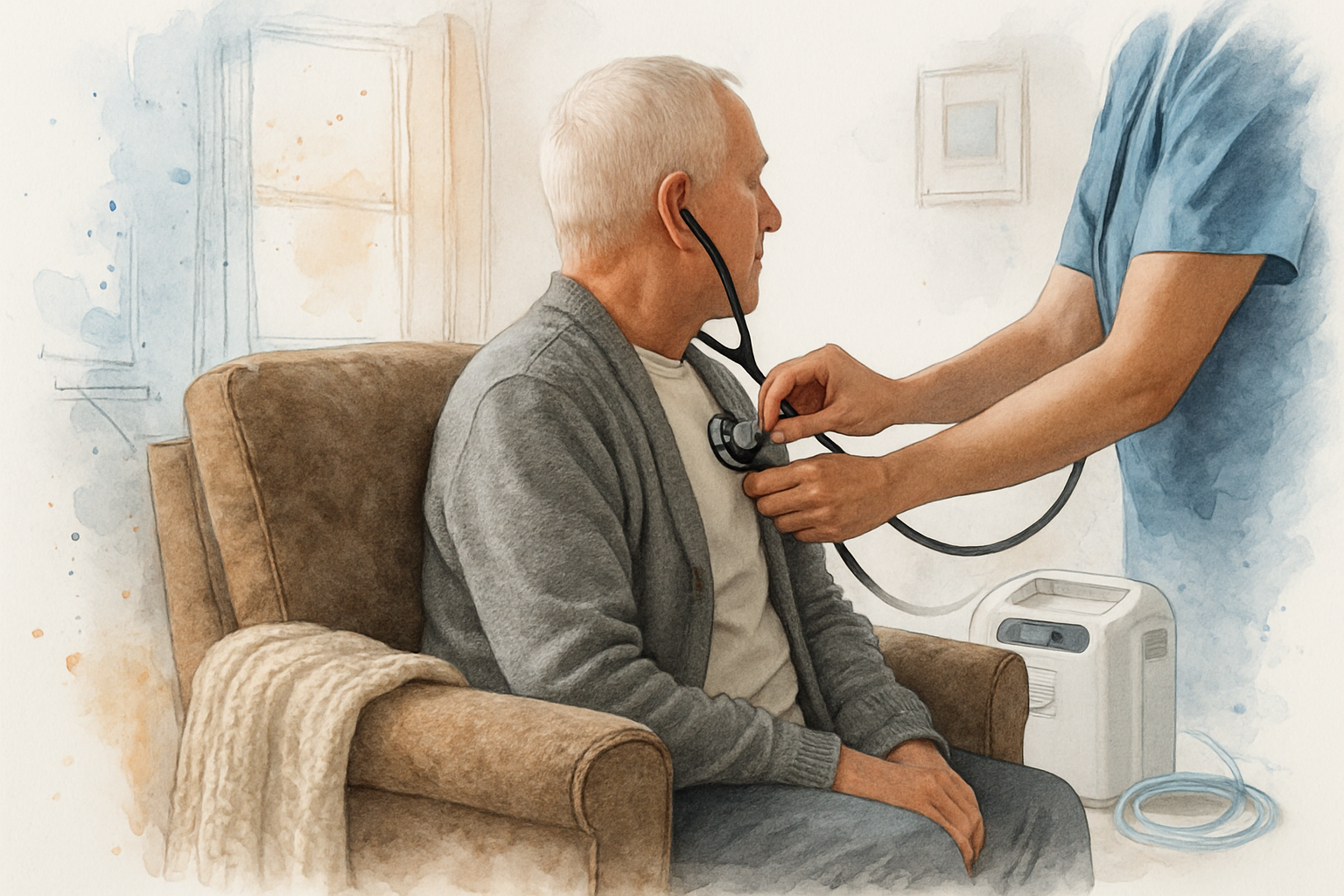
What a Nurse Does for a COPD Patient at Home
A COPD visit is far more than a quick check-in. The nurse is building a picture of whether this patient is stable, sliding, or heading back toward the hospital.
At each visit, a Registered Nurse or Licensed Vocational Nurse typically:
- Listens to breath sounds and records oxygen saturation
- Watches the patient use their inhaler and corrects technique, which is wrong far more often than people expect
- Reviews every medication, including the ones prescribed by a different specialist
- Teaches the early warning signs of an exacerbation: more sputum, a change in its color, needing the rescue inhaler more than usual, sleeping upright
- Checks oxygen equipment and tubing for safe setup
- Calls the physician when something has shifted, so the plan can change before a crisis
That last item is where a lot of the value sits. A nurse who notices a subtle change on a Tuesday can get an order adjusted before Saturday night in the ER.
Location matters here too. In Salinas, King City, and the farming communities in between, agricultural dust and summer air quality can push respiratory patients backward quickly. Wildfire smoke drifting into the valley has the same effect. There is more on that in this guide to summer heat and smoke for home patients on the Central Coast.
What a Nurse Does for a Diabetes Patient at Home
Diabetes management at home involves a lot more than reading a number off a meter.
A nurse visiting a patient with Type 1 or Type 2 diabetes is assessing the whole system around that number:
- Whether the patient truly understands their medication and insulin schedule, not just whether they say they do
- Foot health, checked at nearly every visit, looking for early neuropathy, redness, cracking, or a small wound the patient cannot feel
- Glucometer technique, including whether the strips are expired and the meter is coded correctly
- What the person is actually eating, based on what is in their kitchen, not a printed diet sheet
- When a reading means call 911, when it means call the doctor, and when it means eat something and recheck
That last distinction is the one families ask about most. Knowing the difference between a number that is worrying and a number that is an emergency changes how the whole household sleeps at night.
For an elderly patient living alone in rural San Benito County or south Monterey County, where the nearest clinic might be a long drive, that weekly visit may be the only consistent clinical set of eyes they get. Medication confusion is often the real trigger, and that overlaps heavily with medication management when memory becomes a safety issue.
COPD and Diabetes Visits Side by Side
Both conditions get skilled nursing, but the focus of each visit is different. Here is a general comparison of what tends to get attention.
| Visit Element | COPD Focus | Diabetes Focus |
|---|---|---|
| Primary assessment | Breath sounds, oxygen saturation, work of breathing | Blood sugar patterns, foot and skin condition |
| Equipment reviewed | Inhalers, spacers, oxygen concentrator, tubing | Glucometer, test strips, insulin pens or syringes |
| Main teaching goal | Recognize an exacerbation early | Know when a reading needs action versus a phone call |
| Environmental factor | Dust, smoke, and summer air quality inland | Meal routines, food access, and activity at home |
| Common added service | Physical Therapy for breathing tolerance and stamina | Wound care for a diabetic foot ulcer |
| Typical trigger for referral | Recent flare or hospital visit | Unstable readings, new insulin, or a non-healing wound |
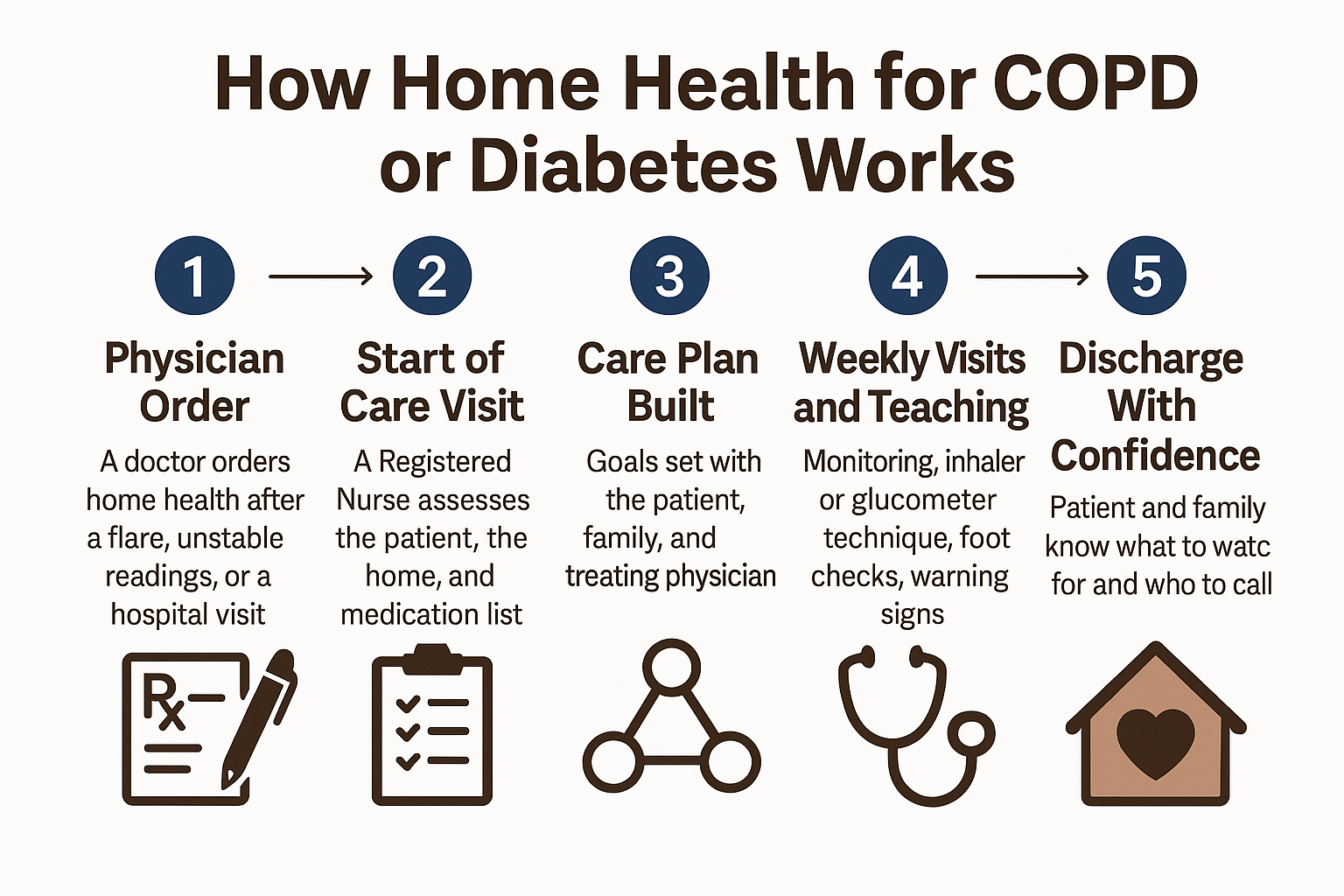
How a Chronic Disease Home Health Episode Unfolds
Families often want to know what the sequence looks like from the first phone call to the last visit. This breaks it into five steps.
The Medicare Rule Families Miss
One of the most common questions on the phone is some version of: does Medicare cover this, and do we need the doctor first?
The answer to the second part is yes. A physician order is required before any visit can be scheduled, and that surprises a lot of families who assume they can arrange it themselves. The physician referral process is worth understanding before you make calls.
Here is the part that gets missed. Many families, and honestly some physicians, assume home health only follows a hospital discharge or surgery. It does not.
An acute flare of a chronic condition counts as a qualifying event. A doctor who just treated a COPD exacerbation in clinic, or who is looking at a diabetic foot wound that is not healing, can order home health right from that appointment. No inpatient stay required.
Under Medicare, the patient generally needs to be considered homebound, meaning leaving home takes considerable effort, and needs intermittent skilled care. When those conditions are met, Medicare’s home health benefit typically covers the visits with no cost to the patient for the covered services. Coverage details vary by plan and situation, so confirm specifics with the provider and your physician. Medi-Cal and Veterans benefits are also accepted by many home health agencies in the region.
Knowing to ask at the clinic visit, rather than waiting for the next hospitalization, can close the gap by days or weeks.
What This Is Actually Trying to Achieve
The point of skilled chronic disease management is not to cure anything. COPD and diabetes are lifelong conditions.
The point is to stretch out the time someone can safely stay in their own home, cut down on emergency room trips, and give the family the ability to catch decline early instead of late. Research on structured home-based education and monitoring for COPD, diabetes, and heart failure consistently points toward fewer hospitalizations.
It is rarely a nurse working alone. Depending on the plan of care, the team can include Registered Nurses, Licensed Vocational Nurses, Physical Therapists, Occupational Therapists, Speech Therapists, Medical Social Workers, Hospice Aides, Chaplains, Volunteers, and other clinicians.
One Monterey Peninsula family described exactly that after their 91-year-old mother moved in: a nurse who came weekly and checked vitals, a Physical Therapist who built an exercise plan, and a Medical Social Worker who tracked down community resources. That mix is common when a chronic condition touches mobility, safety, and daily life at once.
If you are still weighing whether the timing is right, when it is time to think about getting help at home walks through the signals worth paying attention to.
Frequently Asked Questions About Home Health for COPD and Diabetes
How often does a nurse come for chronic disease management?
It depends on how unstable things are. A common pattern is one to three visits per week at the start, tapering as the patient and family get more confident. The physician sets the frequency and adjusts it as status changes.
We need someone there every day. Is this what we want?
Probably not on its own. Home health is intermittent skilled care, not daily hands-on help with bathing, meals, and errands. Many Monterey County families pair home health with a private-duty agency for the daily hours, using the nursing visits as the clinical anchor. A good intake team will tell you this honestly and point you to local options.
Does my parent have to have been in the hospital first?
No. A hospital stay is one path, but a physician can order home health straight from a clinic visit after a COPD flare, a wound, or blood sugars that have gotten out of control. This is the single most common thing families do not know to ask about.
What does it cost?
For patients who meet Medicare’s homebound and skilled-need criteria, covered home health visits generally come at no out-of-pocket cost. Medi-Cal and Veterans benefits also cover home health for eligible patients. Coverage varies by plan, so the reliable move is to confirm with the agency and your doctor before care starts.
How fast can visits start after the doctor sends the order?
Often within a day or two of the order arriving, sometimes the same day for a post-discharge patient. If someone came home from the hospital this week, say so when you call, because that changes how the referral gets prioritized.
Still Not Sure If Home Health Fits Your Situation?
If you are looking at a parent’s COPD flare or unstable blood sugars and trying to figure out the next step, a conversation with a care coordinator can sort out whether a physician order makes sense and what coverage would look like. Central Coast VNA & Hospice has been visiting homes in Monterey County, the Salinas Valley, San Benito County, and South Santa Clara County since 1951. You can reach the team at 831-372-6668 or read more at ccvna.com whenever you are ready.