
When you and your family are navigating end-of-life decisions, the cost of care should be the last thing on your minds. A question we often hear is: how is hospice care funded? The answer is that care is typically paid for by several sources, but for most individuals, the Medicare Hospice Benefit covers nearly all costs.
This comprehensive support ensures families can focus on what truly matters—comfort, dignity, and quality time together.
Understanding How Hospice Care Is Paid For
Hospice is not a physical place; it is a philosophy of care that prioritizes comfort and quality of life for individuals with a life-limiting illness. As a nonprofit provider with over 74 years of local service, Central Coast VNA & Hospice believes everyone in our community deserves this compassionate support.
Understanding how this specialized care is paid for can provide tremendous peace of mind. This guide will walk you through the funding process, step by step, so you can feel confident that comprehensive care is available for your family in Monterey County, San Benito County, Santa Cruz County, and South Santa Clara County.
Primary Funding Sources
Most hospice care in the United States is supported by a few key sources. This infographic gives a clear picture of the primary payers for hospice services.
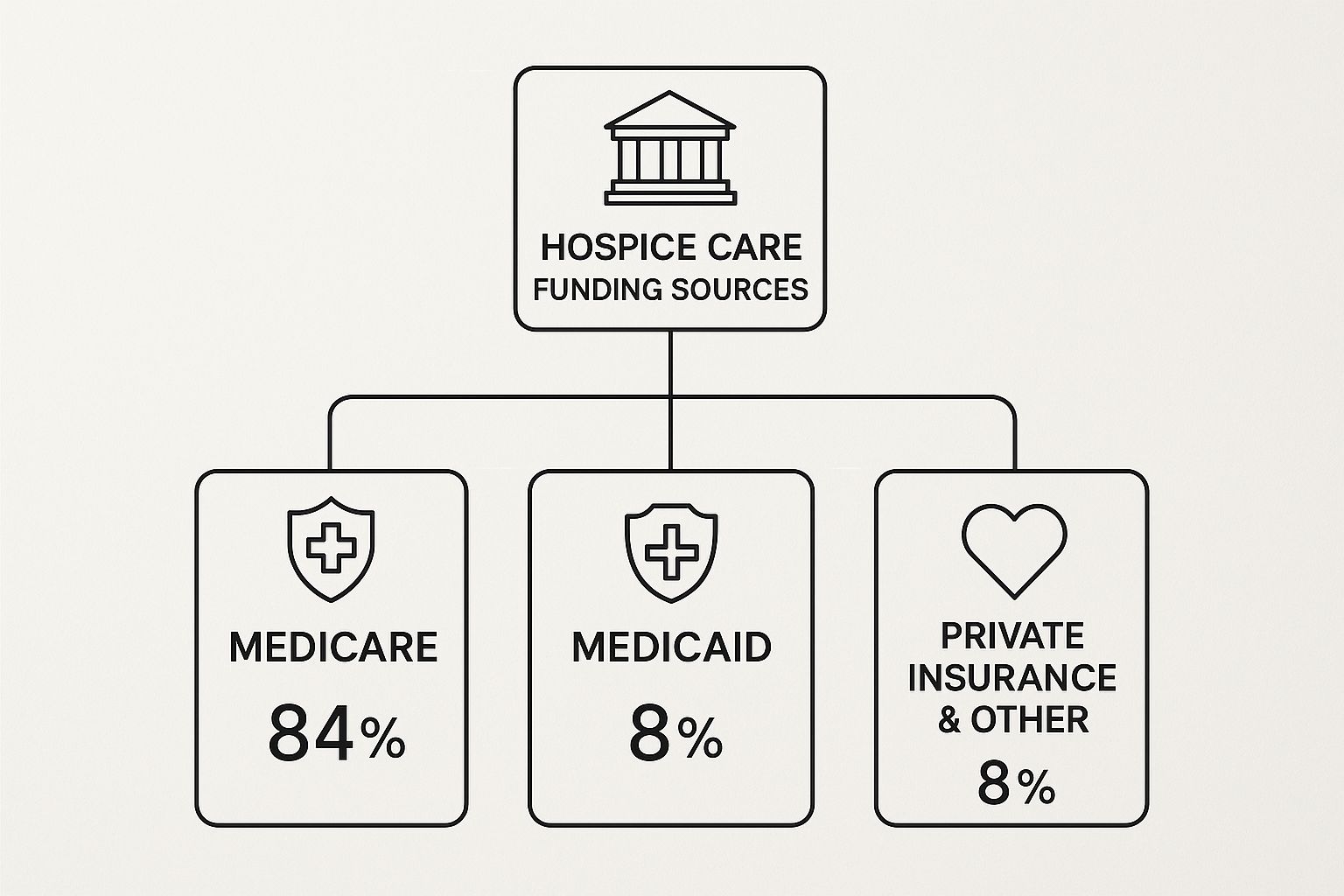
As you can see, Medicare is the largest payer for hospice services. This reflects a national commitment to supporting individuals and their families through the end-of-life journey.
To help you quickly see which options might apply to your family, here is a simple breakdown of the main funding sources.
Primary Hospice Funding Sources at a Glance
| Funding Source | Who It Covers | Primary Payer |
|---|---|---|
| Medicare Hospice Benefit | Individuals 65+ or those with qualifying disabilities | Federal Government |
| Medi-Cal / Medicaid | Low-income individuals and families | State/Federal Government |
| Private Insurance | Individuals with employer-sponsored or private health plans | Insurance Companies |
| Community Support & Grants | Uninsured or underinsured patients | Nonprofit Organizations |
| Out-of-Pocket | Individuals who do not qualify for other sources or prefer to pay directly | The Patient or Family |
This table provides a high-level overview. Let's explore the details of each so you can feel fully informed about your options.
Globally, the need for hospice is growing, with the market projected to reach $5.33 billion in 2025. This reflects a worldwide shift toward recognizing hospice as essential for managing chronic illnesses and supporting aging populations.
Beyond government programs and insurance, nonprofit hospices like Central Coast VNA & Hospice depend on community generosity to bridge care gaps. For those curious about how this works in the wider medical world, this is a complete guide to healthcare grants.
Exploring the Medicare Hospice Benefit

For most American families, the conversation about how hospice care is funded begins with the Medicare Hospice Benefit. This program is the bedrock of end-of-life care in our country, designed with a powerful goal: to lift the financial burden so patients and families can focus on comfort and quality of life.
The purpose of this benefit is to cover everything related to a person’s terminal diagnosis. This marks a shift away from treatments aimed at a cure and toward managing symptoms and providing whole-person support. For over 74 years, our team at Central Coast VNA & Hospice has guided countless families through this process.
Who Is Eligible for the Medicare Benefit?
Eligibility for the Medicare Hospice Benefit is refreshingly straightforward. It is designed to ensure people who need this specialized care can access it without navigating complex requirements.
To qualify, a person must meet a few conditions:
- Be enrolled in Medicare Part A (the part that covers hospital stays).
- Have two physicians certify a terminal illness. This means their physician and the hospice medical director agree that, if the illness runs its natural course, life expectancy is six months or less.
- Formally choose comfort care over curative treatment by signing an election statement.
It is important to understand that choosing hospice is not "giving up." It is an empowered decision to prioritize dignity and comfort, putting the goals of what is advance care planning into action.
What Comprehensive Services Are Covered?
The Medicare Hospice Benefit is truly all-inclusive for the terminal diagnosis. It covers a wide range of services to meet a patient’s physical, emotional, and spiritual needs, all delivered by a dedicated, interdisciplinary team.
This benefit is about more than just medical care; it’s about wrapping a complete system of support around the patient and their family. The goal is to manage symptoms, reduce stress, and allow for meaningful moments during a difficult time.
Here’s a look at what’s included:
- Expert Clinical Team: All visits from the hospice team are covered, including a Registered Nurse, Hospice Aide, Medical Social Worker, and Chaplain.
- Medical Equipment and Supplies: Any equipment needed for safe and comfortable care at home is included, such as a hospital bed, oxygen, walker, or wound care supplies.
- Medications: Prescription drugs for pain relief and symptom management related to the terminal illness are fully covered.
According to the National Hospice and Palliative Care Organization (NHPCO), over 1.72 million Medicare beneficiaries received hospice services in 2020 (NHPCO, 2021). This reliable funding ensures that organizations like Central Coast VNA & Hospice can provide exceptional care without passing the cost on to those we serve in Monterey and Santa Cruz counties.
How Are Medi-Cal and Private Insurance Used for Hospice?

While the Medicare Hospice Benefit is the most common path for funding, it is not the only one. Other vital resources are available, including Medi-Cal and private health insurance plans.
At Central Coast VNA & Hospice, our nonprofit mission is to ensure everyone in our community can access compassionate end-of-life care. We have decades of experience guiding families in San Benito County and South Santa Clara County through these different payment options.
Understanding the Medi-Cal Hospice Benefit
For many Californians, Medi-Cal (the state's Medicaid program) acts as an essential safety net. The Medi-Cal hospice benefit mirrors the comprehensive coverage offered by Medicare, ensuring people who qualify based on income can receive the same high-quality hospice care.
This benefit is designed to support both the patient and their family with a wide range of services, including:
- An Interdisciplinary Team: This core group includes care from a Registered Nurse, a Hospice Aide, a Medical Social Worker, and a Chaplain.
- All Medical Necessities: All medical equipment, supplies, and medications related to the terminal illness are fully covered.
- 24/7 On-Call Support: Patients and families have around-the-clock access to clinical support.
This ensures a person's income never stands in the way of receiving compassionate care. Our team helps families verify Medi-Cal eligibility and coordinates all details to make the process as smooth as possible.
Navigating Private Health Insurance
Most private health insurance plans offered through an employer or the marketplace include hospice coverage. However, the specifics can vary significantly from one provider to another.
While most private plans cover hospice, the details are in the fine print. Understanding your specific policy—including deductibles, copayments, and any pre-authorization rules—is key to avoiding surprises.
It is important to contact your insurance company to get a clear picture of your hospice benefits. The experienced team at Central Coast VNA & Hospice can help with this process. We regularly work with insurance companies to verify benefits and manage the necessary paperwork, allowing your family to focus on what matters most.
How Community Support Funds Nonprofit Hospice

While insurance programs create the foundation for how hospice care is funded, they don't tell the whole story. What sets a nonprofit hospice apart is its mission, driven by community care rather than profit margins. This is where philanthropy plays an essential role.
For organizations like Central Coast VNA & Hospice, our nonprofit status is a promise to our community. It means we are committed to providing care to everyone who needs it, regardless of their ability to pay. This has been our guiding principle for over 74 years of service on the Central Coast.
Bridging the Financial Gap
Generous donations, grants, and local fundraising are the lifeline that allows us to fulfill this promise. These funds bridge the financial gap when a patient's insurance is not enough or when they are uninsured altogether.
This community-funded model allows us to go beyond what standard insurance reimbursements cover. Sound nonprofit financial management is key to ensuring we can deliver on our mission for years to come.
Funding Care Beyond the Basics
The generosity of our community allows us to offer programs that enhance a patient's quality of life in profound ways. These services often fall outside the scope of what traditional insurance will pay for, but they are central to our philosophy of compassionate care.
A nonprofit’s mission is to serve the community’s needs first. Donations directly translate into more comprehensive support, allowing us to care for the entire family and honor each patient's unique wishes with dignity and respect.
This support allows us to provide:
- Specialized Grief Support: We offer bereavement services to families for up to 13 months after a loved one’s passing.
- Enhanced Therapies: Community funds can support services like music or art therapy that bring comfort and joy.
- Volunteer Programs: Donations support the extensive training and coordination of our dedicated volunteers, who provide priceless companionship and respite for families.
This deep connection reinforces our local roots in Monterey County and beyond, showing how neighbors can support neighbors. To better understand the different types of care available, you can explore our detailed comparison of palliative vs hospice.
What Services Hospice Funding Typically Covers
When a family begins hospice, understanding what is covered provides tremendous peace of mind. Whether funded by Medicare, Medi-Cal, or private insurance, the hospice benefit is designed to be all-inclusive for the terminal illness.
The goal is to create a complete support system that addresses a patient's physical, emotional, and spiritual well-being. This approach allows patients to remain comfortably and safely in the place they call home.
The Interdisciplinary Care Team
At the core of hospice is a dedicated team of professionals who work together to create a personalized care plan. This team effort ensures every need is met with expertise and compassion.
The core members of this team include:
- Registered Nurse (RN): The RN is the main point of contact, managing medical care with a focus on pain and symptom control.
- Hospice Aide: Aides provide hands-on personal care, such as assistance with bathing and dressing, with a constant focus on comfort and dignity.
- Medical Social Worker: The social worker provides emotional support and helps families navigate practical challenges, from financial questions to community resources.
- Chaplain: A chaplain offers non-denominational spiritual support that honors the patient's and family's beliefs.
- Trained Volunteers: These dedicated individuals offer companionship for the patient and provide respite for family members.
Medical Equipment, Supplies, and Medications
Beyond the care team, the hospice benefit also covers all physical items needed to keep a patient comfortable at home. For any item related to the terminal diagnosis, there should be no out-of-pocket costs.
This comprehensive coverage is a cornerstone of how hospice care is funded. The aim is to remove any financial barriers to receiving necessary medical equipment, supplies, or medications for symptom management.
This includes:
- Durable Medical Equipment (DME): This covers items like a hospital bed, oxygen concentrator, walker, or wheelchair, delivered directly to the home.
- Medical Supplies: All necessary day-to-day supplies are provided, such as bandages, catheters, or skin care products.
- Medications: All prescriptions for pain relief and managing symptoms related to the hospice diagnosis are fully covered.
Research shows a significant emphasis on nursing services within hospice, highlighting the demand for skilled, professional care at home. You can read the full research about hospice services to see more on this trend.
Sometimes, a patient's condition may stabilize. In those cases, it is helpful to learn more by understanding long-term hospice and how care can adapt.
Taking the First Steps to Arrange Hospice Care
If you and your family are considering hospice, getting started is often the most important part of the journey. The process is designed to be supportive and straightforward.
First, talk with your loved one’s doctor. A physician’s referral is the first step to confirm that hospice care is medically appropriate and is a crucial requirement for how hospice care is funded. You can review the specific hospice care eligibility guidelines to learn more.
Contacting Central Coast VNA & Hospice
Once you have a referral, or even if you are just exploring your options, the next step is to reach out to us. Our team at Central Coast VNA & Hospice offers a no-obligation consultation for families throughout Monterey County, San Benito County, and our other service areas.
We believe every family deserves clear, honest guidance. Our dedicated team is here to walk you through every step—from verifying insurance benefits to creating a personalized plan of care that honors your loved one’s wishes.
As your partners in care, we are here to help you make sense of insurance coverage, answer all your questions, and lift some of the weight from your shoulders.
Ready to learn more? Contact us today to start the conversation. Our team is ready to provide the compassionate support your family deserves.
Frequently Asked Questions About Hospice Funding
Navigating hospice care can bring up many questions for families. We have gathered some of the most common ones to provide clear, compassionate answers.
1. Is hospice care only for the last few days of life?
This is a common myth. A patient is eligible for the Medicare Hospice Benefit when a physician certifies a life expectancy of six months or less, if the illness runs its natural course. Starting care sooner allows patients and families to receive the full benefit of support, which dramatically improves quality of life.
2. Does choosing hospice mean we are giving up hope?
Choosing hospice is not about giving up; it is about shifting what you hope for. The focus turns toward living the rest of life as fully and comfortably as possible. Hope becomes about quality of life, peaceful days, and meaningful moments with family.
3. Will we have to pay anything for hospice care?
For most patients covered by the Medicare Hospice Benefit, there are no out-of-pocket costs for care related to the terminal illness. In rare cases, a small copayment of around $5 might apply for certain prescriptions. As a nonprofit, Central Coast VNA & Hospice is committed to caring for everyone in our community, regardless of ability to pay.
4. Can a patient receive hospice care in a nursing home?
Yes. Hospice care follows the patient wherever they call home, including a private residence, an assisted living community, or a nursing home. The hospice benefit covers all services provided by our team, while room and board at a facility is a separate expense.
5. What if a patient's health improves on hospice?
It happens! Sometimes, with focused comfort care, a patient’s condition stabilizes. If they no longer meet the six-month life expectancy criteria, they can be discharged from hospice and are free to return to curative treatments. They can re-enroll in hospice later if their health declines again.
The team at Central Coast VNA & Hospice is here to answer any other questions you may have about hospice care, eligibility, or the funding process. Contact us today to learn how we can support your family with compassionate, expert care.