
Direct Answer: When advanced dementia causes someone to stop eating and drinking, it is usually the illness reaching a later stage, not a feeding failure. Appetite and swallowing signals fade, and comfort becomes the goal.
Your dad is in a rehab bed in Salinas with a discharge date coming. The staff mention he is not eating much. Then someone says the word dementia in the same sentence as the words not eating or drinking, and your stomach drops.
One family wrote to a local home care team twice in about a week. The first message asked practical questions about a father with moderate dementia and a new pacemaker coming home. The second said, “My dad has multiple health challenges, one of which is dementia, which is causing him not to eat or drink.”
That shift from a practical question to a frightened one is common on the Central Coast, and it usually happens in the days right before discharge. This article stays with what the change actually means, what to ask before you leave the building, how swallowing gets handled at home, and what the feeding tube decision really involves.
When Dementia Stops Eating and Drinking, It Is the Illness, Not the Food
Families read appetite loss as a problem to solve. Clinicians usually read it as the disease moving into a later stage.
In late dementia, the parts of the brain that manage hunger, thirst, chewing, and the timing of a swallow stop working the way they used to. The body also needs less fuel as activity drops. This is expected, and it is not a sign that you failed to feed your parent properly.
What that looks like at the table:
- Turning the head away or keeping the mouth closed
- Holding food in the cheek without swallowing
- Coughing or a wet, gurgly voice after thin liquids like water, coffee, or juice
- Falling asleep partway through a meal
- Eating two bites of a favorite food and being finished
Families often respond by pushing harder. More snacks, more coaxing, a bigger plate. That usually raises the stress in the room and increases the chance of food going down the wrong way.
It helps to separate two different worries. One is whether your parent is uncomfortable right now. The other is whether their intake matches a number someone wrote on a chart. The first one matters at home. The second one rarely changes the course of advanced dementia.
The Days Between the Rehab Room and the Front Door
This short window is where families in Monterey County lose the most time. Roughly a third of the calls home care teams here field each month come from people whose loved one was discharged days, or sometimes hours, earlier. Several call back just to ask whether a referral their doctor sent ever arrived.
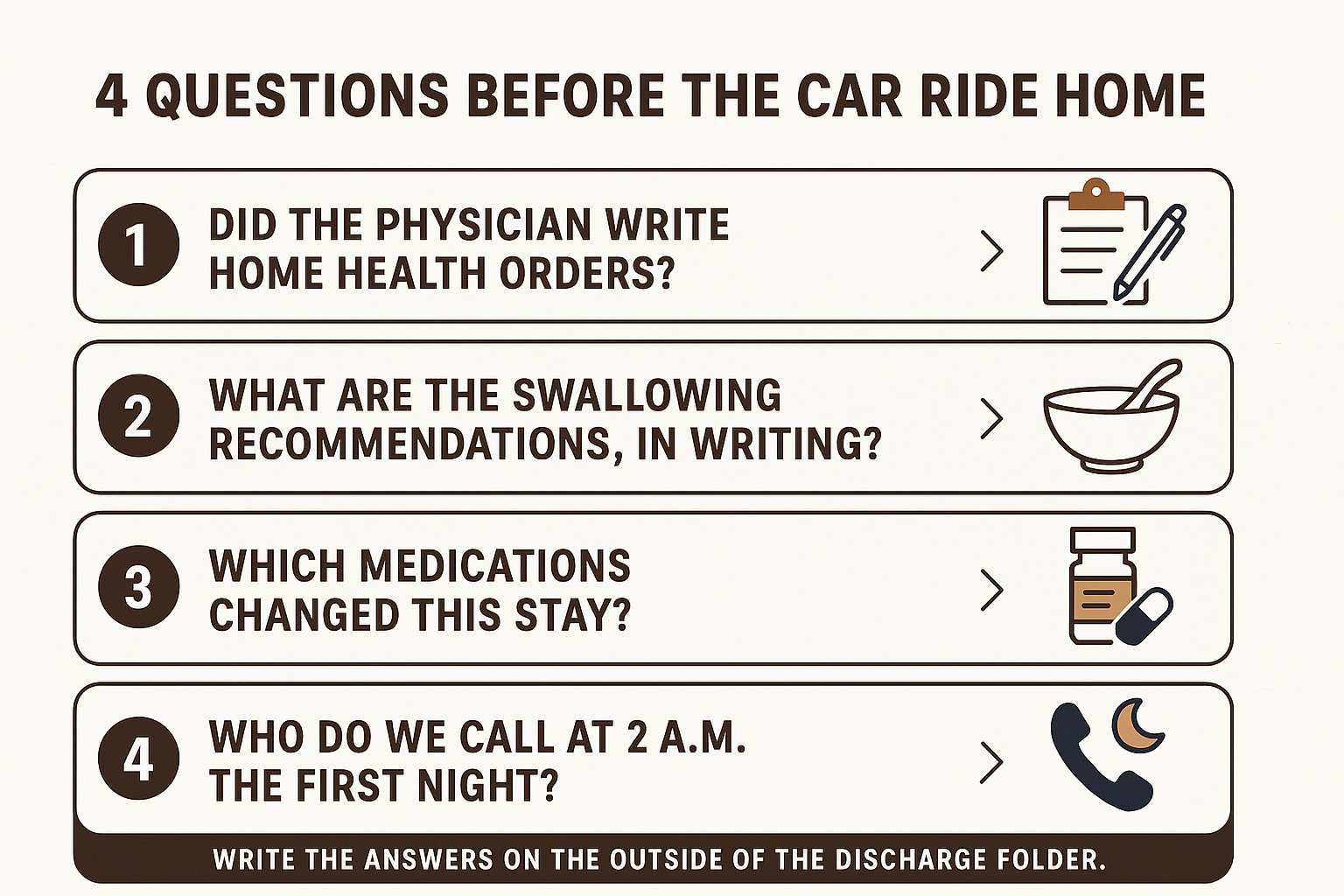
So picture yourself in that hallway in Salinas, or at a rehab in Seaside or Hollister, with a folder you have not opened yet. While staff are still standing in front of you, ask these four things out loud:
- Has the physician written orders for home health? This is the piece that starts skilled care at home. Without an order, nothing moves. Why a physician referral is required for home health explains how that paperwork travels.
- What are the swallowing recommendations, in writing? Ask for the exact food textures and liquid consistency, not a verbal summary you will try to remember in the car.
- What medications changed during this stay? Doses get adjusted in rehab constantly, and the list you had at home is probably out of date.
- Who do we call at 2 a.m. the first night? Get a real number and a real name, not a general line.
Write the answers on the outside of the folder. The drive home from King City or Greenfield is long enough that details slip, and the first night is usually the hardest one. What the first 72 hours of home health look like covers what should happen once the car is in the driveway.
Who Does What When Eating and Drinking Change
Families often say they do not know which professional handles which part. Here is how the roles break down when swallowing is the issue.
| Role | What they work on | What you see at home |
|---|---|---|
| Speech Therapist | Evaluates swallowing, recommends food textures and liquid thickness, coaches pacing and positioning | Sits with you through an actual meal and adjusts what is on the plate and how it is offered |
| Registered Nurse | Watches hydration, skin condition, mouth care, and medication timing around meals | Checks for dryness, pressure areas, and whether pills can still be swallowed safely |
| Occupational Therapist | Works on the mechanics of getting food from plate to mouth | Brings adapted utensils, adjusts chair and table height, simplifies the setup |
| Medical Social Worker | Connects benefits, community programs, and family decision support | Helps sort out coverage questions and family disagreement about what to do next |
Swallowing Is the Part Almost Nobody Explains
A Speech Therapist is not coming to the house to help your father talk. In this situation, their job is to help him swallow without food or liquid slipping into his lungs.
That evaluation happens at the kitchen table, not in a clinic. The therapist watches a real meal, listens to his voice after a sip, and then makes concrete recommendations:
- Which liquids need thickening, and how thick
- Whether food should be soft, minced, or pureed
- How upright he needs to sit, and for how long after eating
- How long to wait between bites, and how to cue a swallow
- Which foods are high risk and which are easiest
A Registered Nurse works the other side of it, tracking hydration, mouth care, and whether medications still go down safely. Dry mouth alone can make eating miserable, and it is one of the easiest things to improve. An Occupational Therapist handles the mechanics, from the weighted spoon to the height of the chair.
Care at home is delivered by a team, and that is the point. Nurses, therapists, social workers, chaplains, volunteers, and other clinicians can be in the same house around the same plan. Speech therapy at home and who qualifies goes deeper on that specific service.
Callers here often put it simply. They just need someone to come to the house and help them figure out what to do next. That is a reasonable thing to want, and it is what an in-home evaluation is for.
Four Questions to Ask Before You Leave the Rehab Building
Ask these while staff are still in front of you. Each answer saves a phone call later.
The Feeding Tube Question, Answered Plainly
At some point a clinician may raise the option of a feeding tube. Families are asked to decide fast, often while exhausted, and almost nobody explains the tradeoffs honestly.
So here it is. For people with advanced dementia, research summarized in the medical literature has not shown that tube feeding extends life, prevents pneumonia from food going down the wrong way, heals pressure wounds, or improves comfort. Tubes also bring their own problems, including agitation and attempts to pull at them.
Declining a feeding tube is not withdrawing care. The alternative has a name, and it is comfort feeding.
Comfort feeding looks like this:
- Small amounts of favorite foods, offered for pleasure rather than a calorie target
- Ice chips, cold liquids, or a spoonful of ice cream when he wants them
- Stopping when he turns away, and trying again later
- Steady mouth care so dryness does not cause discomfort
- No clock, no quota, no forcing
This is a values conversation as much as a medical one. Your parent’s physician and the home team should be in it with you, and what you decide should be written down so it holds at 2 a.m. when someone new is on the phone.
Families who choose comfort feeding are still feeding. They are still present, and they are still caring for their parent.
What Actually Drives the Cost of Help at Home
The same family that asked about their father’s eating also asked what things cost. That question comes up constantly, and insurance is the single most common gateway question on local phone lines.
The honest answer starts with a category, not a number. There are two very different kinds of help, and they are paid for in different ways:
- Intermittent skilled visits, ordered by a physician and delivered by Registered Nurses and therapists. Medicare generally covers this when a patient meets the qualifying criteria, and Medi-Cal and Veterans benefits are commonly involved too.
- Hourly personal help with meals, bathing, and household tasks. This is not skilled medical care, and it is usually paid through programs like In-Home Supportive Services in Monterey County, long term care insurance, or private hire.
The cost difference between those two categories is large. One local reviewer described a situation where someone had personally hired help at a cost they put near $8,000 a month, and noted that different coverage would have changed that picture entirely. That is one family’s account of their own arrangement, not a published rate, and your situation may look nothing like it.
What shifts your number: how many hours a day someone needs to be present, whether the need is medical or hands-on daily help, and which benefits your parent already has. How IHSS, home health, and private duty differ sorts those lanes out, and what home health costs families in Monterey County walks through the Medicare side. For anything specific to your parent, a care coordinator can check coverage against their actual plan.
Frequently Asked Questions About Dementia and Appetite Loss at Home
Is my parent starving if they stop eating and drinking?
It does not feel to them the way it would feel to you. In advanced illness, the body’s hunger and thirst signals fade, and discomfort usually comes from dry mouth rather than an empty stomach. Steady mouth care, ice chips, and small sips often do more for comfort than a full plate.
Does a parent who stops eating automatically need hospice?
No. Appetite loss is one change among many, and it does not sort a person into a single program. Some families start with skilled home health for nursing and therapy, some add palliative care for symptom management while treatment continues, and some are ready for hospice. The right starting point depends on your parent’s overall condition and what their physician recommends.
Can a speech therapist really come to the house for swallowing?
Yes, and it is one of the most useful visits a family can get in this situation. The therapist watches an actual meal in your kitchen, then gives you specific textures, positioning, and pacing to use. It is physician-ordered, like other skilled home health services.
What if we bring him home and it turns out we cannot handle it?
That fear is extremely common among families on the Peninsula and in the Salinas Valley, and bringing someone home is not a locked door. Care plans get adjusted, visit frequency changes, equipment comes and goes, and a Medical Social Worker can help you look at other options if the situation shifts. You are allowed to change course.
Who do we call if something changes overnight?
Get this answer before discharge and write it down. Home health and hospice patients should have an after-hours number that reaches a clinician, not a general voicemail. If your parent is in acute distress, chest pain, or cannot breathe, call 911 first.
If You Are Weighing What Comes Next
Central Coast VNA & Hospice has been a nonprofit serving Monterey County since 1951, now in its 75th year, with home based teams reaching Salinas, King City, Greenfield, the Monterey Peninsula, Hollister, and South Santa Clara County. Because the Speech Therapist, the Registered Nurse, and the Medical Social Worker come from one organization, families do not have to explain the same situation to three different agencies. A care coordinator can talk through what your parent’s situation calls for at 831-372-6668 or at ccvna.com.