
Direct Answer: Medicare pays home health agencies for a 30-day period of care, not by the hour. If a parent qualifies, covered nurse and therapy visits usually cost the family nothing out of pocket.
A parent is being discharged from a hospital in Salinas on Friday. Somebody hands you a list of home health agencies, and the first question in your head is not a clinical one. It is what this is going to cost.
Asking about money before anything else does not make you a bad son or daughter. It makes you the person handling it, usually with very little time to think it through.
So let’s take it in the order families actually think about it: what Medicare covers, what it does not, and what drives the difference for a household on the Central Coast.
The cost question is the gate, not a side issue
In a recent review of calls coming into a local home health and hospice line, insurance and referral questions were the single most common thing standing between a family and a first visit. Roughly 8 percent of calls led with it, and uncertainty there often ended the conversation before intake ever started.
One caller put it as plainly as it gets: “Do you work with Medicare and does insurance cover this?”
Another family wrote in about a father coming home from rehab after a pacemaker. They said they could not physically care for him, they needed to know what services were offered and the approximate cost, and they did not yet know whether he needed 24 hour care.
That is the real shape of the worry. Not just the bill, but the fear of a gap where nobody is helping and you are the one who decided to bring him home.
Three things settle most of it:
- Whether the need counts as skilled care under Medicare rules
- Whether a physician has certified and ordered that care
- What happens during all the hours when no clinician is in the house
Why the hourly price you found online answers a different question
Search home health in Monterey and the map results fill up with nonmedical companion care agencies. They quote an hourly rate, and that number becomes the anchor in your head.
But that rate is answering a different question. Those agencies provide help with cooking, cleaning, bathing and rides to appointments, which is real and valuable work that Medicare’s home health benefit does not pay for.
Skilled home health is billed in a completely different way. CMS documents that Medicare pays home health agencies for a 30-day period of care rather than by the visit or the hour.
What that means in practice: when a parent qualifies, the family usually does not see a bill for the Registered Nurse, the Physical Therapist, or the Medical Social Worker who comes to the house.
The factors that actually move your cost are these:
- Whether the need is skilled and intermittent, not round-the-clock custodial help
- Whether a doctor has signed the orders, since a physician referral is required before home health can start
- Your plan type and its network rules
- Any nonmedical hours you add on top
- Equipment like a walker, hospital bed, or oxygen concentrator
For anything exact, the only reliable answers come from a direct conversation with the agency and with your plan.

Covered, Not Covered, and Who Usually Pays
This is the line families most often misunderstand. Coverage depends on your plan and your parent’s certified needs, so treat this as general context rather than a quote.
| Type of help | Under Medicare home health | Who usually pays |
|---|---|---|
| Skilled nursing visits, wound care, medication management | Typically covered when a physician certifies the need | Medicare, Medi-Cal, or VA benefits |
| Physical, occupational, and speech therapy at home | Typically covered under the same benefit | Medicare |
| Home health aide help with bathing, short visits | Sometimes covered, limited hours, only alongside skilled care | Medicare, limited |
| Cooking, cleaning, laundry, rides to appointments | Not covered | Family, IHSS, long-term care insurance, private pay |
| Overnight or 24 hour supervision at home | Not covered | Private pay, certain Medi-Cal programs, VA benefits |
| Walker, wheelchair, hospital bed, oxygen | Often covered in part under Part B with cost sharing | Medicare plus patient share, or rental |
The real exposure is the hours in between visits
Medicare-covered home health is intermittent by design. A nurse may come a few times a week, a therapist once or twice, and each visit may last under an hour.
That schedule is built around recovery and stabilization, and it works. But it is not a substitute for someone being in the house all day, and that is where families get blindsided.
One public review from a local family described a patient paying out of pocket for her own personal aides at around $8,000 a month on top of her hospice care. The reviewer noted the situation would have looked very different with Medicaid coverage in place. That is one household’s experience, not a standard rate, but it shows how fast uncovered hours add up.
Families fill that gap in a handful of ways:
- IHSS and Medi-Cal programs, which can pay for personal care hours for eligible residents of Monterey County
- Veterans benefits, which many families never think to ask about
- Private pay aides, usually billed hourly with a visit minimum
- Family rotation, often the invisible default, and the one that burns out fastest
If you want the breakdown of which program does what, we covered that separately in IHSS, home health, or private duty and in the benefits most veterans’ families do not know to ask about.
Families who learn this in week one plan better than families who learn it in week three.
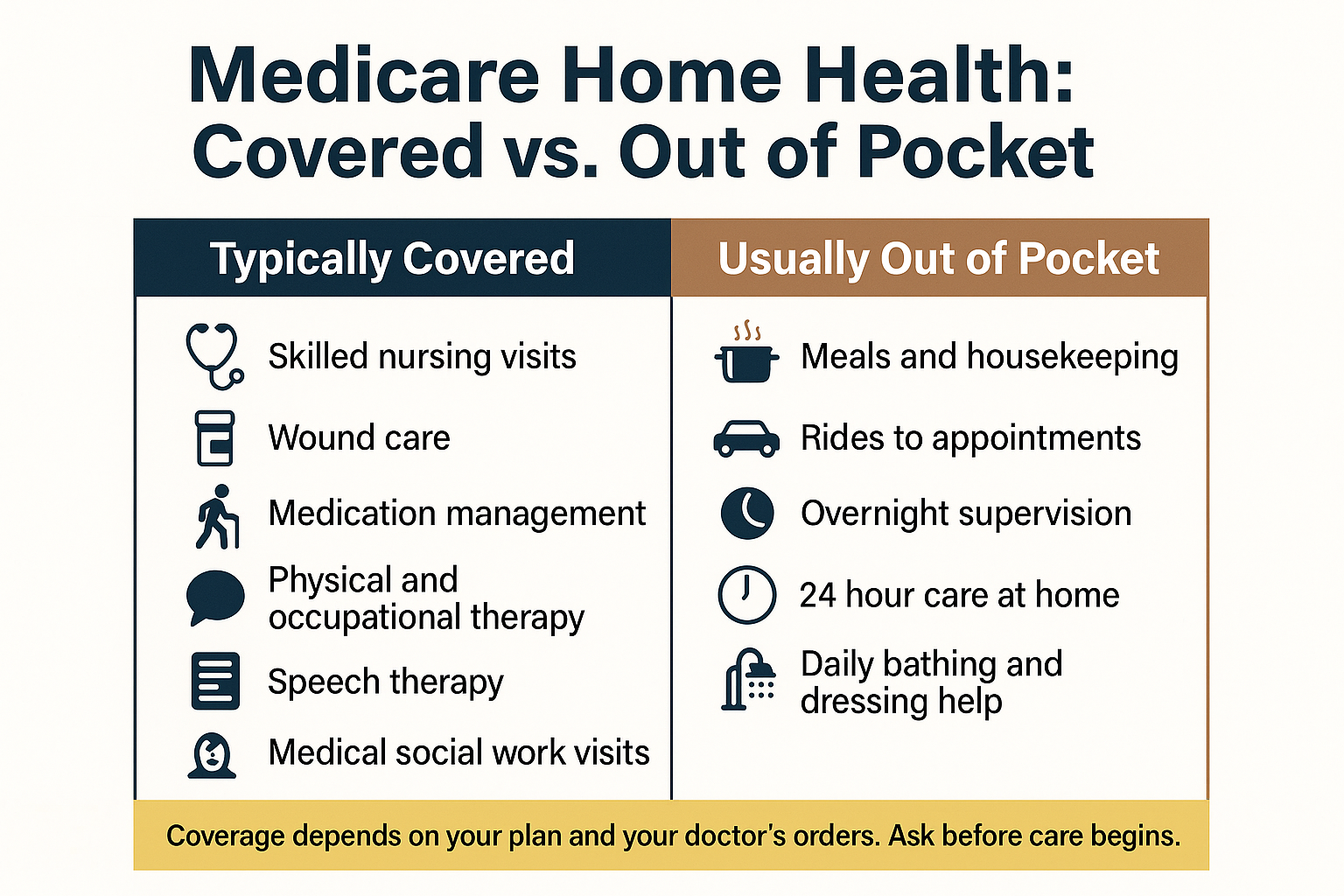
What Medicare Home Health Pays For, and What It Does Not
A quick visual on where the covered line falls, so you know which part of the week you still need a plan for.
What this looks like on a Central Coast fixed income
The covered-versus-uncovered line lands differently in King City or Greenfield than it does in a national article.
Monterey County has roughly 437,613 residents, and about 14.9 percent are 65 or older. Median household income sits near $97,230 countywide, but closer to $81,991 for households headed by someone over 65, and about 9.5 percent of families are below the poverty line.
For a lot of local parents, that fixed income has no room in it for a surprise monthly expense. Even small changes matter. The standard Medicare Part B premium is set to rise to about $202.90 a month in 2027, up from $185.
There is also a timing piece most families miss. The Annual Enrollment Period runs October 15 through December 7, with changes effective January 1.
The plan a parent picks in the fall shapes the home health options available to them in the spring, because Medicare Advantage networks can limit which agency is allowed to serve them. We walk through that in picking a Medicare plan before December 7 and in what happens when your plan limits which agency you can use.
Five questions that prevent a surprise bill
Ask these of any home health agency on the Central Coast, from the Monterey Peninsula to Hollister. A good one will answer all five without hesitating.
- Do you accept my parent’s specific plan? Not “we take Medicare,” but the actual plan name, including Medi-Cal plans like Central Coast Alliance.
- Who authorizes care under a Medicare Advantage plan, and how long does that take? Authorization delays are a common reason a first visit slips by several days.
- Will I get written notice before any service that is not covered begins? You should never find out from a bill.
- What happens to the schedule when the skilled need ends? Visits taper and then stop. Know that date before it arrives.
- Who is my named contact, and when will they call me back? Local call records show families phoning back repeatedly just to find out whether a referral ever went through.
Write the answers down. If an agency cannot give you a name and a timeframe, that tells you something useful too.
Why a nonprofit talks about money differently
On a cost topic, the structure of an organization matters more than any claim it makes about quality.
Central Coast VNA & Hospice has operated as a nonprofit since 1951, accepts Medicare, Medi-Cal and Veterans benefits, and holds a 4-Star Home Health rating from CMS. A portion of 2025 community giving was directed specifically to home health.
There is also a longstanding fund that supports patient needs insurance does not reimburse, which exists because community donations pay for it rather than shareholders expecting a return.
None of that changes what Medicare covers. It changes who is sitting across from you when the money conversation gets complicated.
Frequently Asked Questions About Home Health Care Cost With Medicare
Does Medicare pay for home health by the hour?
No. Medicare pays the agency for a 30-day period of care, not per hour or per visit. That is why the hourly rates you see advertised online are usually coming from nonmedical companion care companies, which are a different service entirely.
If my mom qualifies, will I get a bill for the nurse visits?
Usually not for the covered skilled visits themselves. You may still have cost sharing for durable medical equipment under Part B, and anything outside the certified plan of care is your responsibility. Confirm with both the agency and your plan before the first visit.
What does homebound actually mean?
It generally means leaving home takes a considerable and taxing effort, and that your parent needs help or a device to do it. It does not mean bedbound. People who get out for medical appointments, church, or short outings can still qualify.
What if we need someone there all day?
Medicare-covered home health will not provide that. Families in Monterey County typically combine covered skilled visits with IHSS, Medi-Cal programs, Veterans benefits, or private pay hours. Start those applications early, because approval can take weeks.
My dad is coming home from rehab this week. Is there time to sort out coverage?
Yes, but move now. The discharge planner can start the referral, and most agencies verify benefits the same day they receive it. The first 72 hours after a hospital stay are when the plan of care gets set, so that is the window to ask your coverage questions.
Still Working Out What Your Family’s Coverage Looks Like?
Coverage questions are easier to answer out loud than on a website, especially when a discharge date is already on the calendar. Families across Monterey County, from the Peninsula to Salinas and King City, are welcome to call a care coordinator at VNA at 831-372-6668 and talk through what their plan covers and what it does not. There is no obligation attached to the conversation.