
Direct Answer: In-home speech therapy covers more than speech clarity. A Speech Therapist also treats swallowing problems, memory and thinking changes, and communication loss after a stroke, head surgery, or serious illness.
Most families picture the same thing when they hear speech therapy: someone practicing words that came out wrong. That picture is only a small slice of what a Speech Therapist actually does in the home.
After a stroke, a head or neck surgery, or a long hospital stay, the harder problems are often invisible from across the room. Trouble swallowing safely. Forgetting the steps of a task. Losing the thread of a conversation halfway through.
Families across Monterey County call about this after a discharge from Community Hospital of the Monterey Peninsula, Salinas Valley Health, or Natividad, usually with two questions: does Medicare cover it, and do we need a doctor’s order first. This guide answers both, and explains what speech therapy at home actually covers after a stroke or surgery.
What speech therapy at home actually covers after a stroke or surgery
A Speech Therapist, also called a speech-language pathologist, works on three broad areas in the home. Speech is only one of them.
- Swallowing safety (dysphagia). Coughing during meals, a wet or gurgly voice after drinking, food that seems to stick, or unexplained weight loss.
- Communication. Slurred words, trouble finding the right word, difficulty understanding what others say, or a voice that has gone weak and quiet.
- Thinking and memory (cognition). Losing track of medications, repeating questions, trouble sequencing daily tasks, poor safety awareness after a fall or a head surgery.
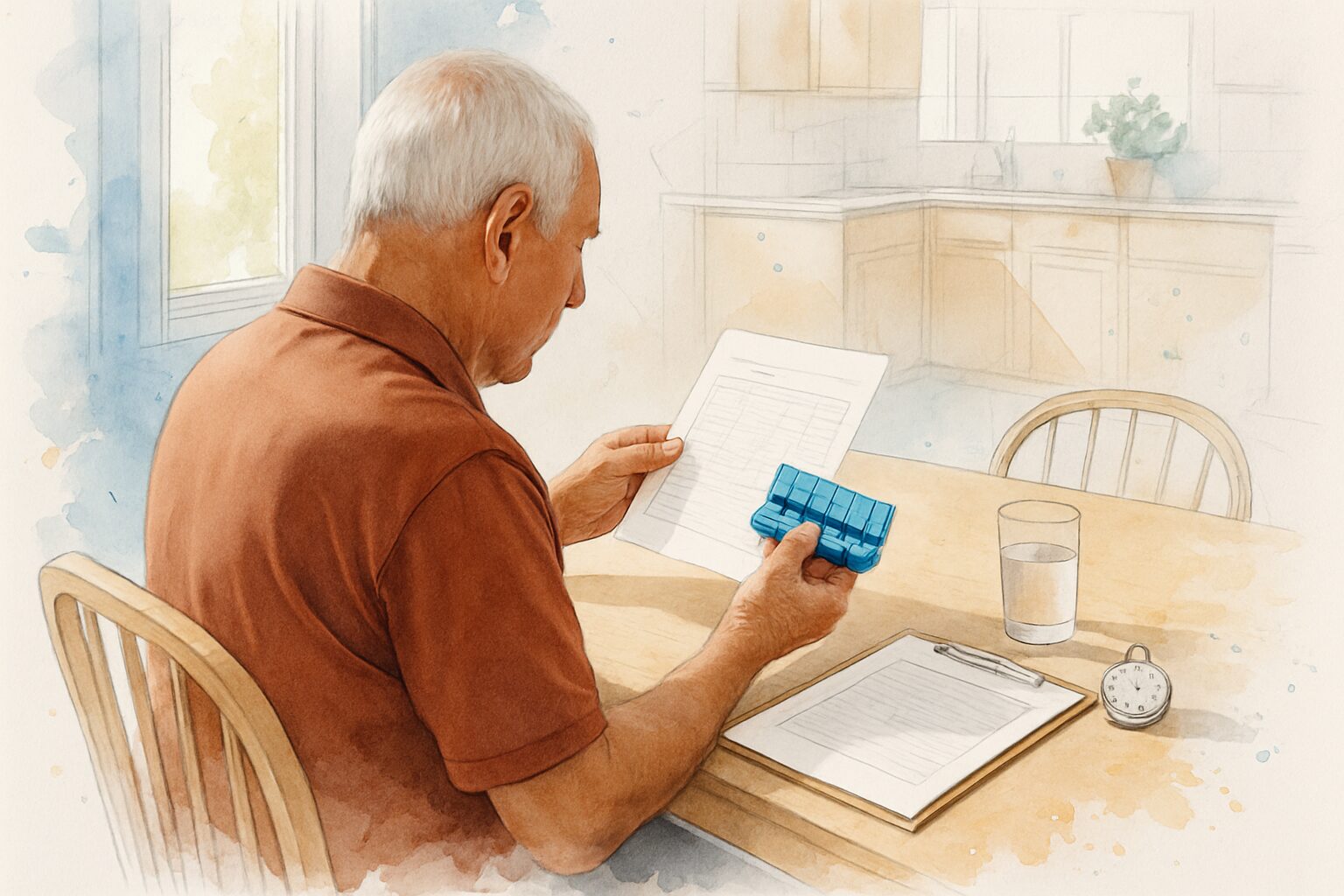
That third one surprises people. A patient in Pacific Grove who can hold a normal conversation may still be unable to reliably remember whether they took their morning pills.
That is a speech therapy problem, and it is also a safety problem. It is one reason therapy visits are usually coordinated with a Registered Nurse who is already managing medications in the home.
Speech therapy in the home is part of a physician-directed plan, the same way skilled nursing care at home works. Visits are intermittent, goal-based, and reassessed as the patient improves.
The swallowing problem families almost never see coming
Of everything a Speech Therapist handles at home, swallowing difficulty carries the highest stakes. When food or liquid goes down the wrong way, it can settle in the lungs and cause aspiration pneumonia, which sends patients right back to the hospital.
It often shows up quietly. A parent starts eating less. Meals take twice as long. They stop drinking water because it makes them cough. According to the National Institute on Deafness and Other Communication Disorders, swallowing problems commonly follow stroke and other nervous system conditions, and they can lead to poor nutrition and dehydration.
What a Speech Therapist does about it in the home:
- Evaluates how the patient handles different food textures and liquid thicknesses
- Teaches positioning and swallowing techniques that reduce risk
- Recommends diet changes, cup types, and pacing that the family can actually follow
- Trains family members on what warning signs mean a call to the nurse
Families frequently do not realize this is a skilled clinical concern at all. They treat it as picky eating, and then the pneumonia arrives three weeks later.
What Families Notice vs. What a Speech Therapist Is Looking At
The same everyday observation can point to a very different clinical issue. Here is how common household signs line up.
| What the family notices | What it may actually be | What therapy addresses |
|---|---|---|
| Coughing or throat clearing during meals | Unsafe swallow, aspiration risk | Swallow techniques, texture and liquid changes, positioning |
| “He just doesn’t talk much anymore” | Weak voice or word-finding difficulty after stroke | Voice strength, language exercises, communication strategies |
| Missed or doubled medications | Memory and sequencing changes | Cognitive strategies, written routines, safety cues |
| Repeating the same question | Short-term memory loss after surgery or illness | Memory supports the family can maintain between visits |
| Eating less, losing weight | Fear of choking, fatigue while chewing | Meal pacing, calorie-dense soft foods, endurance work |
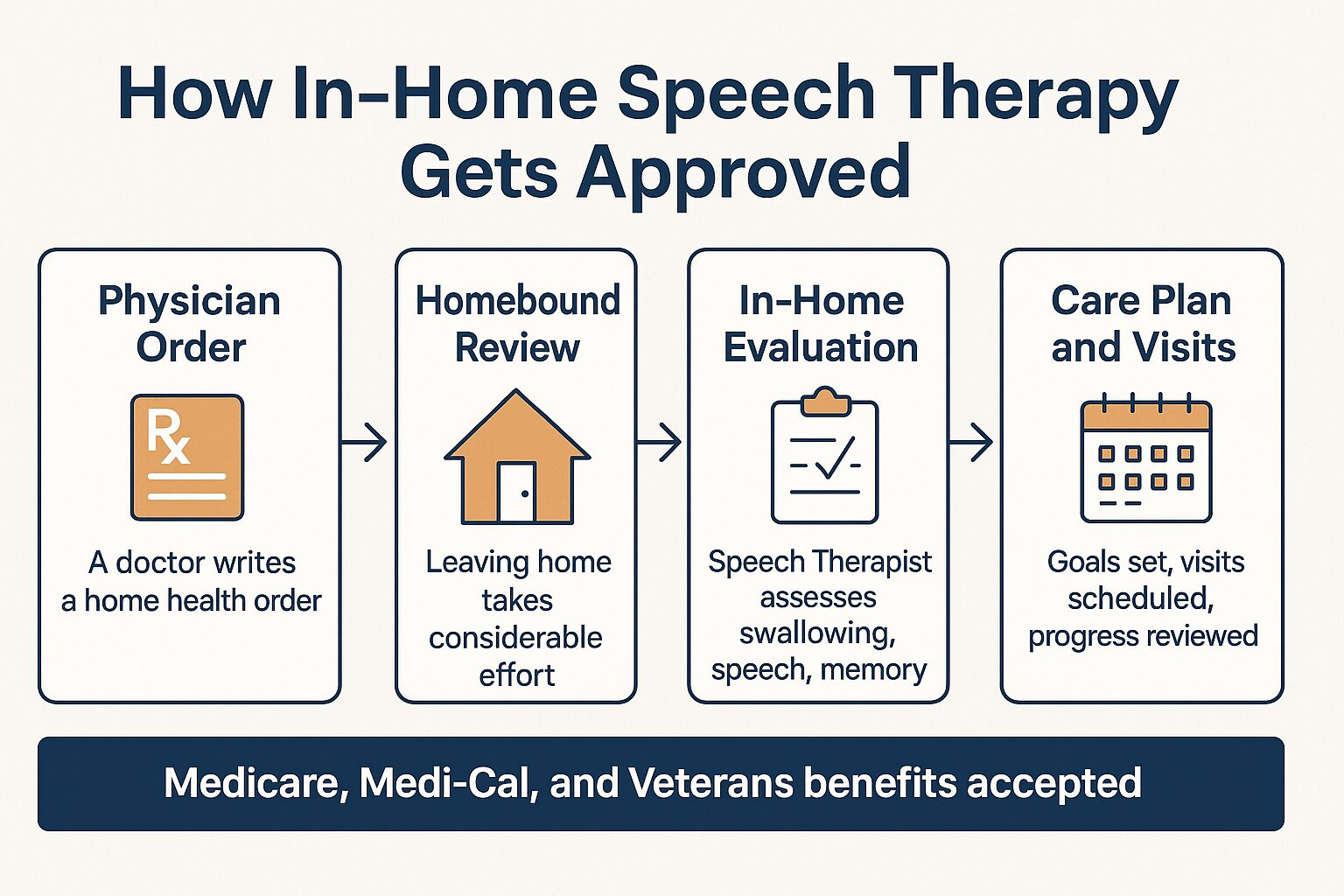
The Qualifying Path in Four Steps
Most families get stuck on the referral step. This is the order things actually happen in.
Who qualifies, and what “homebound” really means
To get speech therapy at home under Medicare, a patient generally needs two things: a physician order and to meet the homebound requirement. Those are the same conditions that apply to skilled nursing and physical therapy.
The homebound standard is where families count themselves out too early. It does not mean the patient can never leave the house. It means leaving takes a considerable and taxing effort, or that they need help or a device to do it.
Someone in Salinas who can get to a Sunday church service with a walker and a family member’s arm may still qualify. Someone recovering from head and neck surgery who tires after twenty minutes upright may qualify too.
A few practical notes:
- Medicare, Medi-Cal, and Veterans benefits are all accepted for home health services here
- The order can come from the hospital physician at discharge or from the primary care doctor later
- Home health does not cover ages 0 to 21, maternity diagnoses, or primary behavioral health conditions
If the rules feel murky, a Registered Nurse or care coordinator can walk through the specific situation. The guidelines are more flexible than most families assume, which is also true of Medicare coverage for physical therapy at home. And if you are unsure how the order gets written, this explanation of the physician referral process covers it step by step.
Why the kitchen beats the clinic room
A clinic can simulate a meal. A home does not have to.
When a Speech Therapist sits down in a patient’s own King City or Hollister kitchen, they are working with the actual cups in that cupboard, the actual chair height, the food that family actually cooks. Swallowing strategies get practiced with dinner, not with a demonstration.
The same holds for memory work. Cues get placed on the real pill organizer, on the real calendar, in the room where the patient will use them at 7 a.m. tomorrow.
One family on the Peninsula described the team that came to their home as nurses, physical therapists, and a Medical Social Worker who each evaluated a different piece of the picture, then built one plan. That coordination between nurses, therapists, social workers, chaplains, volunteers, and other clinicians is the point of home-based care.
Progress made in the room where the patient lives tends to stick. There is no gap between the exercise and real life.
Asking for an evaluation is not a commitment
Plenty of families wait because they are not sure the problem is “serious enough” to bother anyone about. That hesitation costs weeks.
A formal evaluation gives you information, not an obligation. A Speech Therapist can tell you what is present, what is not, which goals are realistic, and roughly how many weeks a course of therapy might run.
Sometimes the answer is that no therapy is needed and the family can stop worrying. Sometimes the answer changes the meal plan that night. Either outcome is better than guessing.
If a discharge is coming up soon, it is worth reading what families often miss when planning a hospital discharge to home, because the speech therapy question is one of the most commonly skipped items on the list.
Frequently Asked Questions About In-Home Speech Therapy
Does Medicare cover speech therapy at home, and what will we pay?
Medicare covers speech-language pathology as part of the home health benefit when the patient meets the homebound requirement and has a physician order. For eligible patients, the covered home health visits themselves typically come with no coinsurance, though durable medical equipment is usually billed separately at a percentage. Coverage details depend on the plan, so ask a care coordinator to review the specific situation before assuming anything.
Do we need a doctor’s order first, or can we just call and schedule?
A physician order is required before a visit can be scheduled. This is the single most common point of confusion on incoming calls. The hospital physician can write it at discharge, or the primary care doctor can write it afterward.
My mother’s speech is fine. Is speech therapy still relevant?
Often yes. Swallowing difficulty and memory or sequencing problems fall under speech therapy even when the patient speaks clearly. If she is coughing at meals, losing weight, or mixing up medications, an evaluation is worth requesting.
How many visits does in-home speech therapy usually involve?
It varies with the diagnosis and goals. Home health is intermittent, meaning scheduled visits rather than daily coverage, and the plan is reassessed as the patient progresses. A Speech Therapist can give a realistic estimate after the initial evaluation.
We need someone in the house every day. Is that what this is?
No, and this comes up often. Home health provides skilled clinical visits, not around-the-clock personal care. Many families pair home health with a private-duty agency for daily hands-on help, and a care coordinator can point you toward local options for that piece.
Still Unsure Whether a Speech Therapy Evaluation Makes Sense?
If someone you love is coughing at meals, forgetting medications, or struggling to be understood after a stroke or surgery, a conversation costs nothing but a few minutes. Central Coast VNA & Hospice has provided home-based care across Monterey County and the surrounding Central Coast since 1951, and a care coordinator can talk through whether an in-home evaluation fits your situation. You can reach the team at 831-372-6668 or read more at ccvna.com.