
Direct Answer: Anticipatory grief is the mourning that begins before a death, while someone is still living. It is a normal response to decline, and support does not require a hospice decision first.
You pull into the driveway after an appointment and sit there with the engine off. Your mother is still alive. She is inside, or back at her own place in Salinas, and you are already crying about losing her.
Nothing is wrong with you. What you are feeling has a name, and clinicians have studied it for decades. It is called anticipatory grief, and it is the grief that starts while the person is still here.
This piece walks through what it looks like in ordinary daily life, why it gets louder around the holidays on the Central Coast, and who families can lean on long before a death ever happens.
Anticipatory Grief: Mourning Someone Who Is Still in the Next Room
Most people think grief is something that starts after a funeral. For families watching a parent decline, it rarely works that way.
Anticipatory grief is a response to a loss that has already begun. Not the death, which has not happened. The losses that come first.
Those early losses are real, even when nobody names them out loud:
- The parent who used to drive themselves over Highway 68 and now cannot
- The father who knew every story about the family and now repeats one
- The future you pictured, with holidays and grandchildren and more time
- Your own role, shifting from son or daughter into something closer to a manager
Researchers who study end-of-life care have documented this pattern for a long time. The National Cancer Institute’s overview of grief and bereavement describes grief that begins during a serious illness, well before a death, as a recognized and common experience.
Feeling it does not mean you have given up on your parent. It does not mean you want this over with. It means you are paying attention to something that is genuinely changing.

What It Actually Looks Like, Week to Week
Families usually recognize the behavior long before they recognize the term. Here is what anticipatory grief tends to look like from the inside:
- Snapping at a sibling over the phone about something small, like who called the doctor last
- Dreading the Sunday drive to King City or Carmel, then feeling guilty the whole way there
- Rehearsing the funeral in your head at a red light, and being horrified that you did
- Relief, followed immediately by shame for feeling relieved
- Losing sleep the night before an appointment, not after it
- Crying at something unrelated, like a song in the Safeway parking lot
- Pulling back from friends because explaining it takes energy you do not have
- Fixating on logistics, because logistics are the one part you can control
One family reaching out this past summer described a father with several health problems, including dementia that was keeping him from eating or drinking. He was still in rehab, not yet home. They were already asking what came next.
That is the shape of it. The harder chapter has not arrived, and you are already carrying it.
Is It Too Early to Call Anyone?
This is the question people are most afraid to ask out loud. Two fears usually sit on either side of it.
The first is reaching out too soon and being told it is not time yet. The second is waiting too long and missing the window where help would have mattered.
So, plainly: grief support and symptom-focused support do not require a death or a hospice decision first.
Two things are true that many Central Coast families do not know:
- Bereavement and grief counseling are open to anyone grieving a loss. That includes people whose loved one is still living, and people who have never used hospice at all.
- Palliative care does not require giving up treatment. It focuses on symptom relief, care planning, and emotional support while a patient continues seeing their own physicians.
A review of inquiry calls this past summer found a small but steady group of people asking whether services could begin before hospice. Several were surprised to hear the answer was yes. One caller said something close to, I did not know you offered that here.
Asking a question is not the same as enrolling in anything. A first phone call can be exactly one conversation, and nothing more. If paperwork is part of what is weighing on you, advance care planning is a separate track you can start whenever you are ready.
The Ordinary Signs Families Miss
Anticipatory grief rarely announces itself. It shows up in small behaviors that are easy to blame on stress or exhaustion.
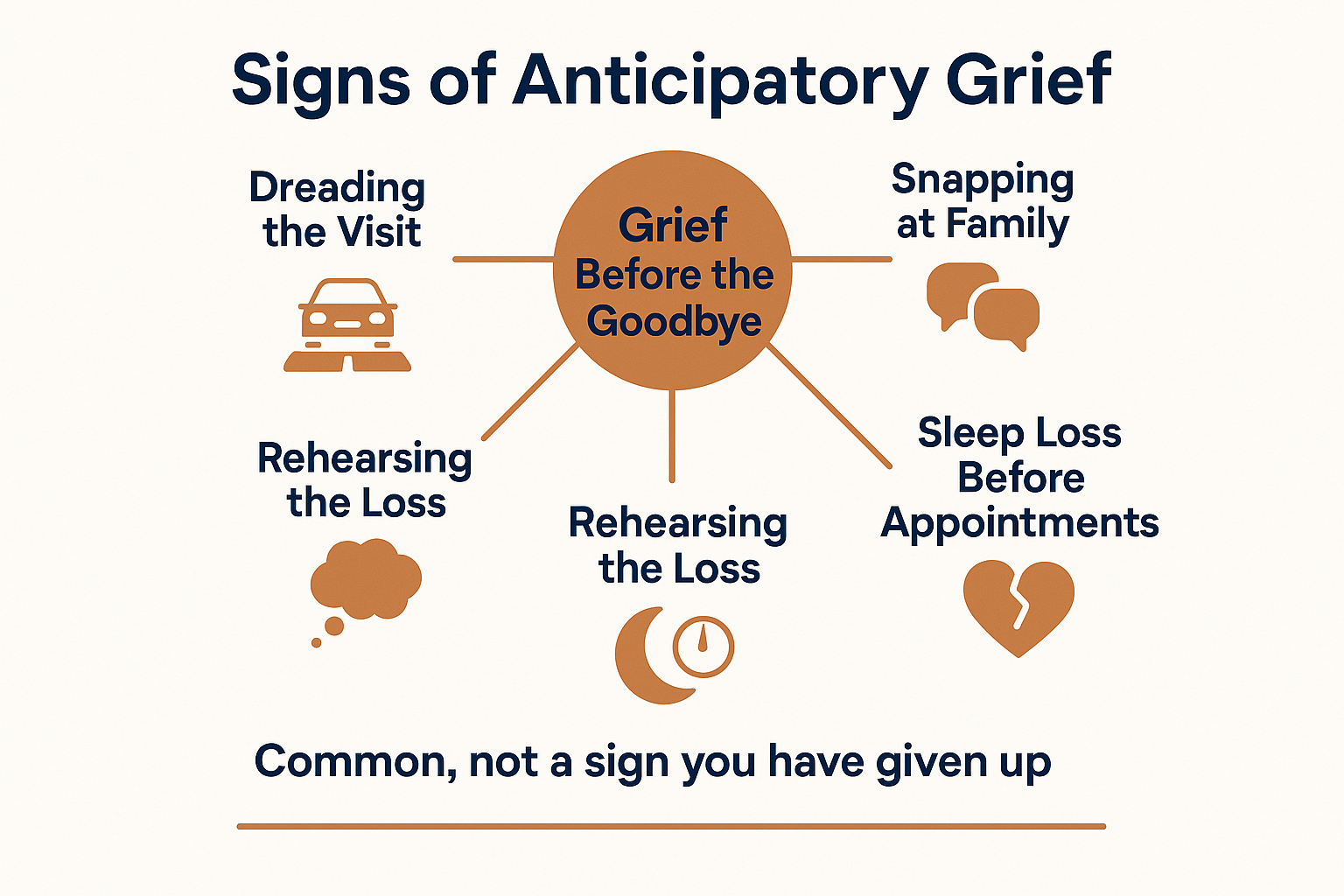
Why November and December Hit Hardest Here
On the Central Coast there is no freeze season or storm season pushing families into care decisions. What moves people here is the calendar of family gatherings.
An adult child who lives in Monterey, Carmel, or out of the area visits for a weekend and sees the full picture for the first time. Not a phone call. Four days in the house.
You notice the mail stacked up. The expired food. The way your father holds the railing now. And you are grieving in the middle of setting the table.
Demand data for grief support follows this exactly. Searches climb sharply from their quiet summer levels through the fall, peak in December, and then fall off again by mid January. Family decision making tends to follow the same curve, with a wave of calls arriving in the weeks right after the holidays.
If you are dreading Thanksgiving because you suspect it may be the last one, you are allowed to feel both things at once. You can be present at the table and be mourning at the same table. Families who have been through it describe something similar about the first holiday season after a loss, and the anticipation can carry its own weight.
Who You Can Lean On Before a Death
Most people assume grief support only exists after a funeral. In practice, several roles on a home-based care team are built to help families during the decline itself.
A Medical Social Worker is often the one who connects families to community resources, sorts out insurance confusion, and helps siblings who disagree find a workable plan. A Bereavement Specialist provides grief counseling and ongoing emotional support. A Chaplain offers spiritual care for people of any faith background, or none.
They work alongside the rest of the team: nurses, therapists, social workers, chaplains, volunteers, and other clinicians.
One Monterey area family who used Central Coast VNA & Hospice during a mother’s final months described getting “information on how to cope with a deteriorating health situation to who to contact 24/7 if more assistance was needed.” That is the kind of help available while someone is still living.
One practical note for Monterey County. Many families here speak Spanish at home, and asking what language a counselor or support group works in is a fair and common question. Ask it on the first call. For a wider look at local options, including groups that meet in person, see finding grief support in Monterey County.
Who Does What Before a Death
Families often do not know which role to ask for. This is a rough guide to who handles what during a serious illness, before hospice is ever on the table.
| Role | What they help with before a death | When families usually reach out |
|---|---|---|
| Medical Social Worker | Community resources, insurance questions, family conflict, planning the next step | After a hospital discharge or a sudden decline |
| Bereavement Specialist | Grief counseling and ongoing emotional support, including while a loved one is still living | When the sadness starts interfering with sleep, work, or relationships |
| Chaplain | Spiritual and emotional support for patients and families of any background | When the questions turn from medical to meaning |
| Registered Nurse or Nurse Practitioner | Symptom relief, medication questions, explaining what is happening and why | When pain or symptoms are not under control at home |
| Volunteer | Companionship, reading aloud, sitting with a patient so family can rest | When the primary family member has not had a break in weeks |
Frequently Asked Questions About Anticipatory Grief
Is it normal to grieve someone who is still alive?
Yes. Anticipatory grief is a recognized and common experience, especially for adult children watching a parent decline from dementia, heart failure, cancer, or general frailty. It is not a sign you have given up, and it does not predict how you will feel later.
Can grief counseling start before my parent dies?
It can. Bereavement and grief counseling on the Central Coast are generally open to anyone processing a loss, which includes anticipated loss. You do not need a hospice referral, a diagnosis, or a death certificate to ask about it.
What is the difference between palliative care and hospice?
This is one of the most common questions families here ask. Palliative care focuses on symptom relief and quality of life while a patient keeps pursuing treatment. Hospice begins when the patient, family, and physician agree the goal has shifted from curing disease to comfort and time well spent. Palliative care can start years earlier.
Does Medicare cover any of this?
Coverage depends on the service and the patient’s situation. Under the Medicare Hospice Benefit, bereavement support for the family is generally included and continues for roughly a year after a death. Home health visits are covered when a physician orders them and the patient meets the criteria. Private grief therapy outside of a hospice program is a different story and costs vary widely by provider, so it is worth asking about sliding scale or no-cost community groups. Call for specifics on your own situation rather than relying on a general figure.
Do I have to be a hospice family to join a grief support group here?
No. Community grief groups in Monterey County are typically open to anyone who has lost someone, regardless of where or whether their loved one received care. Here is what grief support after hospice actually looks like if you want a sense of the format before calling.
If You Want to Talk to Someone
Bereavement and grief counseling on the Central Coast are open to anyone carrying a loss, including families whose loved one is still living and families who have never used hospice. Support like this has been available to Monterey County families through a community nonprofit for 75 years. If you would like to ask a question, the number is 831-372-6668, or you can read more at ccvna.com.