
Direct Answer: A Medical Social Worker is part of a physician-ordered home health team. They handle the practical side of illness: benefits and coverage problems, paperwork, local referrals, family disagreements, and planning as needs change.
The discharge planner runs through who will be coming to the house. A nurse. Maybe a physical therapist. And then, almost in passing, a Medical Social Worker.
That last one is where families get quiet. Does this mean someone thinks something is wrong at home? Are we being checked up on?
No. Medical social services are a standard, physician-ordered part of home health, written into the plan of care right alongside skilled nursing and therapy. One family calling about a parent put the reason for the visit better than any brochure could: they just needed someone to come to the house and help them figure out what to do next.
Why a Medical Social Worker Is on the Order in the First Place
Home health exists because a doctor decided a patient needs skilled care at home. The nurse handles wounds, medications, vital signs. The therapists handle strength, balance, safety, speech.
But the problems that actually keep a family up at night are usually not clinical. They are practical. Who pays for this. Who drives Mom to her cardiology appointment in Salinas. What happens when the eight weeks of visits end.
That gap is the Medical Social Worker’s job. Medicare lists medical social services among the covered home health services when a doctor orders them as part of the plan of care, which is why the role shows up on the roster without anyone requesting it.
It is not a welfare check. It is not an evaluation of your housekeeping. The visit exists because illness drags a pile of paperwork, money questions, and family decisions into the house along with it, and somebody on the team should be trained to deal with that pile.
If you are still sorting out how the order itself got written, the physician referral process explains who sends what to whom.

What Does a Medical Social Worker Do in Home Health? The Real List
This is the part almost nobody spells out, so here it is plainly. A Medical Social Worker handles the pieces that sit outside the nursing visit:
- Benefits and coverage problems. Denied claims, plans that do not match, an old policy nobody has touched in years.
- Applications and paperwork. Medi-Cal, county programs, forms that ask questions a tired family cannot answer alone.
- Community referrals. Hourly help, meals, transportation, support groups, equipment.
- Family disagreements. Two adult siblings who want different things for the same parent is one of the most common reasons this visit matters.
- Care planning conversations. What the family wants care to look like if things change, and what they want it to look like if they do not.
One Monterey Peninsula family described it concretely in a public review: “She helped us find the right agency to cancel her mom’s Medicaid in FL and recommended additional resources in the community.”
That is the shape of the work. An out-of-state plan nobody knew how to close, plus a short list of places to call next.
The Local Referral List Is the Most Useful Thing in the Bag
Home health is intermittent skilled care. Visits, not shifts. So when a family needs hourly help with bathing, meals, or overnight supervision, that need falls outside the home health benefit.
The Medical Social Worker is usually the person who points the family somewhere real. IHSS, county aging programs, private duty agencies, food support, transportation help. Intake staff do a version of this on the phone every week, handing callers two or three local options when the request does not fit what home health covers.
Geography is the whole reason this matters here. Roughly 65,000 Monterey County residents are 65 or older, about 14.9% of the population, and households headed by someone over 65 report a median income well below the county overall, with close to one in ten families below the poverty line.
And those households are not evenly spread. A family in King City, Greenfield, or Hollister is working with a much thinner set of nearby options than a family in Monterey or Pacific Grove. A current local referral list beats a printed brochure every time in that situation.
If you are trying to sort out which kind of help you actually need, IHSS, home health, and private duty each cover different ground.
Bring These Up in the First Visit or Two, Not the Last
A home health episode is measured in weeks of intermittent visits, not months. The paperwork questions need to surface early, while there is still time to act on them.
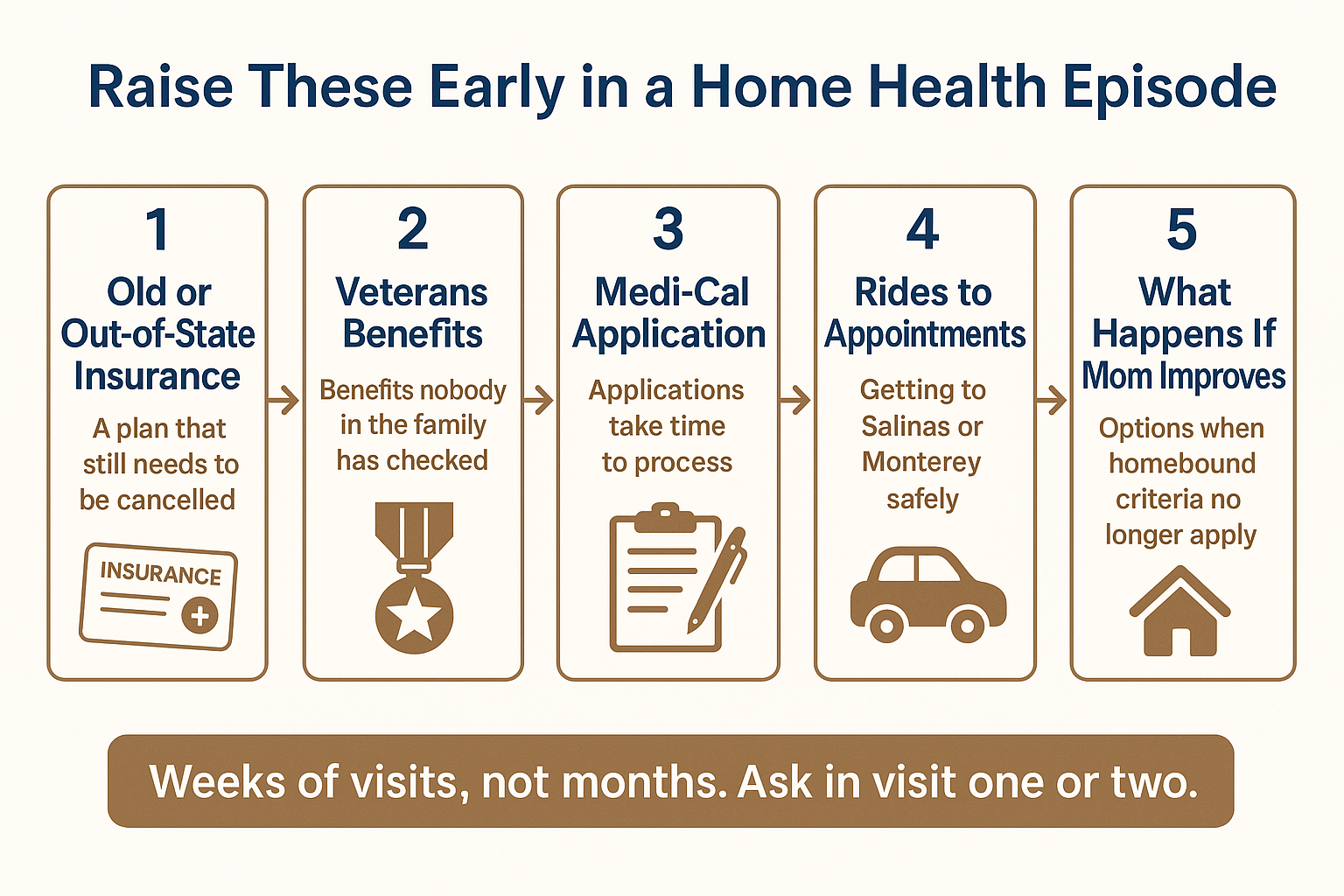
The Three Money Buckets Families Confuse
Insurance and referral questions come up in roughly 8% of incoming calls, often before anyone describes the patient’s condition at all. One family wrote in about a father coming home from rehab after a pacemaker with moderate dementia and asked, straightforwardly, what services were offered and roughly what they cost. The honest answer starts with separating three different buckets.
| Bucket | What It Generally Applies To | What to Ask |
|---|---|---|
| Medicare | Skilled visits under a physician-ordered home health plan, which can include nursing, therapy, and medical social services for eligible patients | Whether your specific plan limits which agency you may use |
| Medi-Cal | May reach services and supports Medicare does not, including certain county and in-home support programs | Eligibility rules and how long an application takes |
| Veterans benefits | Home-based care and supports many families never think to look into | Which programs the veteran is already enrolled in |
| Private pay | Hourly non-medical help, overnight supervision, long stretches of personal care | Hourly rate, minimum hours, and how a month actually adds up |
Why Nobody Should Quote You a Price Over the Phone
Costs vary widely depending on what kind of help is needed, how many hours, and which coverage a household already has. Two families in the same Salinas neighborhood can land in completely different places.
So the useful move is not a number. It is a map. The Medical Social Worker is frequently the person who sits down and sorts a specific household into those buckets, then tells the family which doors are actually open to them.
For exact figures, your provider and your plan are the only reliable sources. Anyone giving you a firm dollar amount before they know the diagnosis, the coverage, and the hours is guessing.
Families planning a discharge often miss these questions entirely in the rush home. What gets overlooked when a hospital discharge is being planned is worth reading before the car pulls into the driveway. And if a veteran is involved, the benefits most families do not know to ask about can change the whole picture.
Frequently Asked Questions About Medical Social Workers in Home Health
Is the Medical Social Worker there to check up on us?
No. The visit is ordered by the physician as part of the home health plan of care, the same way nursing or therapy visits are. The focus is the practical problems around the illness, not a judgment about the household.
Does the visit cost extra?
Medical social services are generally included within the physician-ordered home health benefit for eligible patients rather than billed as a separate add-on. What your household owes depends on your coverage, so check with your plan or the agency’s intake team for specifics.
Can they arrange hourly help with bathing and meals?
They do not provide that care themselves, because home health is intermittent skilled care. What they do is connect you to IHSS, county programs, and private duty agencies that handle hourly and overnight support, and help you understand which ones your parent may qualify for.
What if my parent lives in King City, Greenfield, or Hollister?
Service area questions come up constantly on the phone, and distance genuinely changes which resources are realistic. Fewer nearby options makes the referral list more valuable, not less, since the worker keeps track of what is actually running in south county and San Benito County right now.
What happens when home health ends?
That is exactly the conversation to start early. If a parent improves enough that they no longer meet homebound criteria, or the episode simply runs its course, the Medical Social Worker can lay out what community supports, private options, or other programs could carry things forward.
Questions About How Home Health Works on the Central Coast
Central Coast VNA & Hospice is a nonprofit founded in 1951 and marking 75 years in 2026, with Medical Social Workers working alongside Registered Nurses, Licensed Vocational Nurses, Physical Therapists, Occupational Therapists, Speech Therapists, Chaplains, Bereavement Specialists, and Volunteers across Monterey County, San Benito County, South Santa Clara County, and parts of Santa Cruz County. Medicare, Medi-Cal, and Veterans benefits are accepted. Families with questions are welcome to call 831-372-6668 or visit ccvna.com to speak with a care coordinator.