
Direct Answer: Under Original Medicare, a hospital bed falls under Part B equipment. After the yearly deductible, patients generally pay 20 percent of the approved amount. On hospice, related equipment is part of the benefit.
A discharge planner at Community Hospital of the Monterey Peninsula or Salinas Valley Health says the words hospital bed, and then the conversation moves on to medications. Nobody stops to explain who orders the bed, who brings it, or when it shows up at the house.
Families across Monterey County call about home care on that same compressed clock. A parent is coming home tomorrow, the living room still has a couch in it, and someone has to figure out where an oxygen concentrator plugs in.
This is the practical sequence: how equipment gets ordered, who pays for what, how hospice changes the math, and whether the bed will even fit through the front door of a 1920s house in Pacific Grove.
Who Orders the Equipment and Who Delivers It
Home medical equipment does not come off a store shelf. For it to be covered, it generally needs a physician order documenting why the item is medically necessary for use inside the home, and it has to come from a supplier enrolled in Medicare.
The person who spots the need is often not the doctor. It is frequently a Registered Nurse or Physical Therapist on the first in-home visit, watching how someone actually moves through their own hallway, their own bathroom door, their own bedroom.
That visit catches things a hospital room never will:
- A bathroom doorway too narrow for a standard walker
- A bed too low for someone to stand up from safely
- A second-floor bedroom with no realistic way to get a hospital bed upstairs
- No outlet near the chair where the person actually sits all day
When a physician orders a pre-surgery home assessment, a lot of these decisions get made weeks early instead of in a scramble after discharge. One local patient put it plainly in a review: “The nurse that assess my environment prior to surgery left me with useful information.”
If the equipment need surfaces after discharge instead, expect the order, the supplier, and the delivery to move on separate tracks. That is exactly where families get stuck, and it is worth reading up on what comes next after a hospital discharge before the day arrives.

Who Pays for a Hospital Bed at Home
Here is where families get surprised. Home health visits and home medical equipment are paid for in two different ways, even when both are happening in the same house on the same week.
Under Original Medicare, durable medical equipment falls under Part B. Per Medicare’s own coverage rules for durable medical equipment, the item must be ordered by your provider for use in the home, must come from a Medicare enrolled supplier, and the patient is generally responsible for 20 percent of the Medicare approved amount after the annual Part B deductible when the supplier accepts assignment.
A few things change that picture:
- Deductible and approved amounts change every year, so last year’s numbers are not this year’s numbers
- Medicare Advantage plans set their own networks, prior authorization rules, and cost sharing
- Medi-Cal and Veterans benefits work on different rules entirely
- A Medigap policy may absorb part of the coinsurance
The practical trap worth knowing: a supplier that is not enrolled in Medicare, or one that does not accept assignment, can bill more than the approved amount. That difference lands on the family.
Confirm the numbers with the plan and the supplier before anything is delivered, not after. If a plan restricts which providers can be used at all, Medicare plan network limits are worth understanding early.
Hospice Changes the Equipment Math Completely
This is the piece families tend to learn late, often after weeks of worrying about bills.
Under the Medicare hospice benefit, equipment and supplies related to the terminal illness are part of the benefit itself. The hospice team arranges the bed, the wheelchair, the oxygen concentrator, and the supplies, and those items are not billed separately to the family the way Part B equipment is.
That means the calculation for a family weighing hospice at home in Salinas or Carmel Valley is different from the calculation for a family arranging equipment after a knee replacement. Same bed, same living room, different rules.
It does not cover everything. Room and board in a facility is a separate question, and one that trips up plenty of families, which is why who pays for hospice room and board is worth reading on its own.
But for equipment inside the house, the difference is real, and it is one of the more common surprises people mention once they finally understand how the benefit is built.
How Equipment Coverage Differs by Situation
A quick side by side of how the same hospital bed gets handled depending on which program a patient is under. Always confirm specifics with your own plan.
| Situation | Who arranges the equipment | What the family typically handles |
|---|---|---|
| Home health under Original Medicare | Physician order plus a Medicare enrolled supplier | Part B deductible, then generally 20 percent of the approved amount |
| Home health under Medicare Advantage | Plan network supplier, often with prior authorization | Plan-specific copay or coinsurance, network rules apply |
| Hospice under the Medicare hospice benefit | Arranged through the hospice team | Equipment related to the terminal illness is part of the benefit |
| Medi-Cal or Veterans benefits | Program-specific authorization process | Different cost sharing rules, confirm before delivery |
The Path From Order to Delivery
The sequence most families never get explained to them at discharge, laid out step by step.
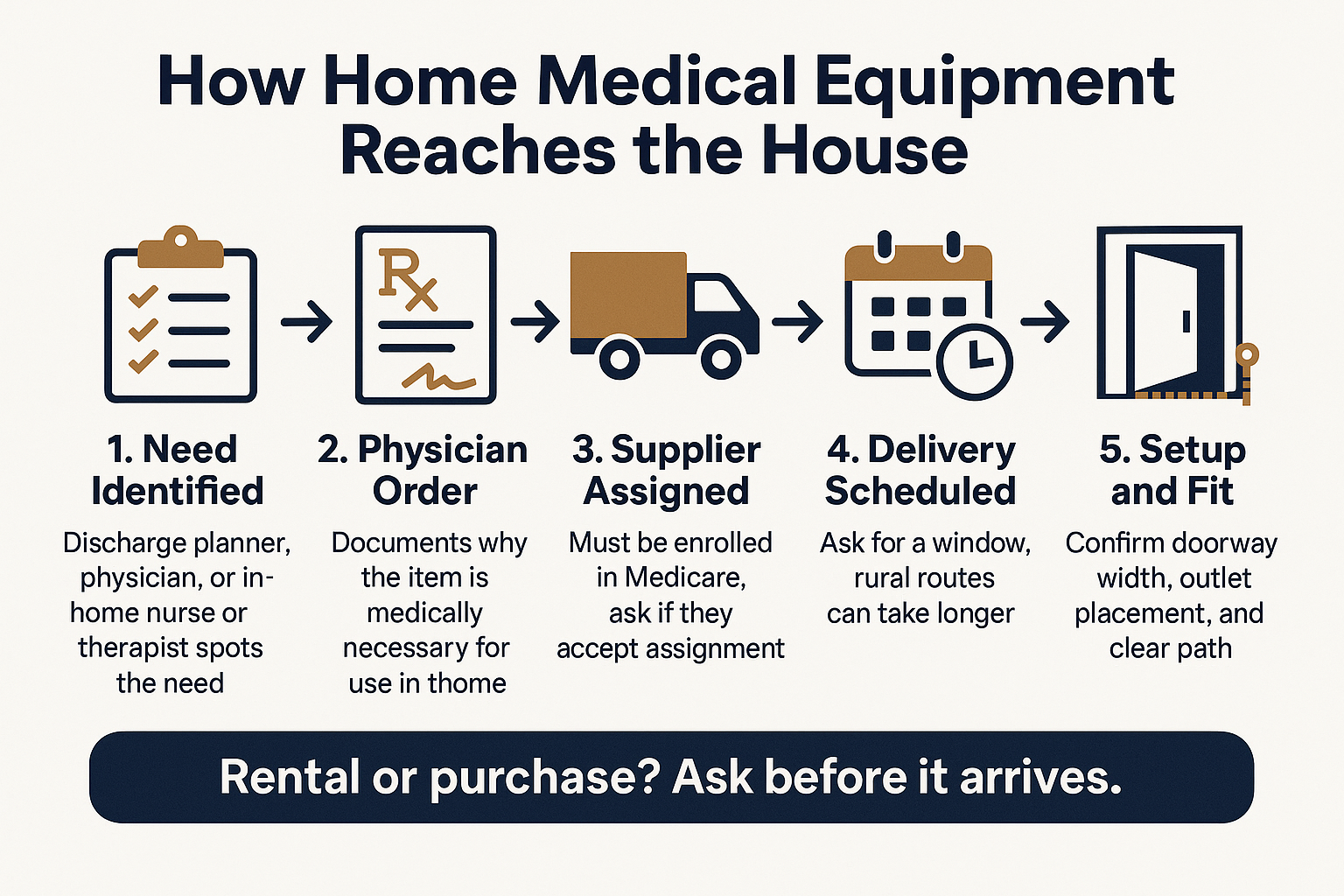
Will It Actually Fit the House?
Almost nobody addresses this until the delivery driver is standing in the doorway with a bed frame.
Older homes on the Monterey Peninsula are charming and tight. Cottages in Pacific Grove, houses tucked into the hills in Carmel, bungalows in old Monterey. Many have doorways under 30 inches, sharp turns at the top of a staircase, and bedrooms on a second floor that a hospital bed is never getting to.
Walk the house before delivery day and check:
- Doorway width at every door the equipment must pass through, including the bathroom
- Turning space in hallways and at the top or bottom of stairs
- Whether the living room becomes the bedroom, which is the answer more often than families expect
- Where an oxygen concentrator can sit near an outlet without running a cord across a walking path
- A clear path wide enough for a walker, which usually means moving a rug, a side table, or both
Delivery timing matters too. Routes out to King City, Hollister, and the south county can stretch beyond a same-day window, so ask what the actual timeframe is rather than assuming the bed arrives the afternoon of discharge.
A safe layout is a big part of what makes staying home possible over the long run, not just for the first week.
Rent or Buy? It Comes Down to How Long the Need Lasts
The honest question is not which is cheaper. It is how long this equipment will be needed.
Recoveries after orthopedic surgery, a stroke, or a fall often run weeks, not years. Renting keeps a family from buying a hospital bed in March that sits in the garage by September.
And needs move in both directions. A walker becomes a wheelchair. A wheelchair becomes a hospital bed. Sometimes a person improves and the bed goes back.
Being able to swap or return items keeps the house matched to the person’s condition right now instead of their condition last month. That flexibility matters most in the first few weeks, when things change fast. The first 72 hours of home health tend to reveal needs nobody predicted from a hospital bed.
Questions Worth Asking Before Anything Is Delivered
Families repeatedly describe being handed a plan at discharge and then having nobody to call when the pieces do not arrive. These are the questions that prevent that.
Ask the discharge planner, the supplier, or a plan representative:
- Who is the supplier, by name, and what is their direct phone number?
- Are they enrolled in Medicare, and will they accept assignment?
- Is this a rental or a purchase?
- Who services it if a motor fails or a rail sticks?
- Who picks it up when it is no longer needed, and is there a charge?
- What will we owe, and when will we see a bill?
Write the answers down. Get a name attached to each one.
If a physician referral is part of the picture, how the referral process actually works explains the paperwork side that often runs in parallel with the equipment order.
Frequently Asked Questions About Home Medical Equipment
Can I just buy a hospital bed online instead of going through all this?
You can, but Medicare will not pay for it. Coverage requires a provider’s order and a Medicare enrolled supplier. If you buy retail, the full cost is yours, and you also give up service, swaps, and pickup when the need ends.
How fast can equipment show up after discharge?
It depends on the order, the supplier, and where you live. Homes on the Peninsula and in Salinas usually see faster routes than King City or Hollister. Ask for a specific delivery window rather than assuming same day, and confirm someone will be home to accept it.
Does the home health nurse bring the equipment?
No. Clinicians identify what is needed and document it, but delivery comes from the supplier. Those are two separate visits, often on different days, which is why families sometimes think something went missing when nothing actually did.
What if my parent’s condition changes and the equipment no longer fits the need?
That is normal, and it is the main argument for renting. Equipment can often be swapped or returned as needs shift in either direction, so the house stays matched to the person’s current condition.
Are supplies like bed pads and gloves covered the same way as the bed?
Not always. Disposable supplies are handled differently from durable equipment under Part B, and the rules shift again under the hospice benefit, where related supplies are included. Ask the supplier and your plan to spell out which specific items are covered before they arrive.
Still Sorting Out What Your Parent’s House Needs?
Central Coast VNA & Hospice rents home medical equipment directly, including hospital beds, wheelchairs, walkers, crutches, scooters, and oxygen concentrators, with items that can be swapped or returned as a patient’s condition changes. Home health teams across Monterey County include Registered Nurses, Licensed Vocational Nurses, Physical Therapists, Occupational Therapists, Speech Therapists, Medical Social Workers, chaplains, and volunteers who look at the home itself, not just the diagnosis. A care coordinator can walk through how equipment and coverage would work for your specific situation at 831-372-6668 or ccvna.com.