
Direct Answer: When someone stops dialysis, they usually become eligible for hospice at home. Medicare Part A still covers care. A physician’s order starts it, and comfort-focused visits often begin within a day or two.
Families often call and say some version of the same thing: he wants to stop dialysis and focus on comfort at home. It comes out in one sentence, and behind that sentence is usually a week of hard conversations at the kitchen table.
For a lot of families in Monterey County, that call is also the first time anyone has really thought about hospice. Roughly one in sixteen first-time callers asks what hospice even is and whether their family member qualifies, and many are mixing up hospice, home health, and palliative care because nobody has slowed down to explain the difference.
This guide walks through what actually happens after a dialysis decision: the timeline, how Medicare handles it, who starts the referral, and what care at home looks like day to day.
The Decision Belongs to the Patient, and the Timing Matters More Than With Other Illnesses
Stopping dialysis is a decision for the patient, the family, and the treating physicians. Nobody else gets a vote, and there is no wrong answer when someone has weighed years of treatment and decided they want their remaining time to look different.
But the timeline is different here than with most other conditions, and families deserve to hear that plainly. Research published through the National Institutes of Health notes that nearly all patients who depend on dialysis die within about one to two weeks of stopping treatment.
That single fact changes how much the timing of a hospice referral matters. With cancer or heart failure, a family that waits a few weeks to make the call usually still has time. After a dialysis decision, waiting can cost the exact days at home the family was hoping to protect.
So the practical advice is simple:
- Bring up hospice with the nephrologist during the same visit where stopping dialysis is discussed, not afterward
- Ask the dialysis center’s social worker what the referral process looks like before a final decision is made
- Understand that asking questions is not the same as committing to anything
This is information, not pressure. Knowing how fast things can move lets a family choose on purpose instead of by default.

How Medicare Actually Works When Dialysis Stops
This is where most of the confusion lives. Families assume that because dialysis was covered under one part of Medicare, stopping it somehow puts coverage at risk. It does not.
Hospice is covered under Medicare Part A. According to the National Kidney Foundation, choosing to stop dialysis generally makes a person eligible for hospice care, and Medicare coverage does not end when dialysis stops.
There is one wrinkle worth understanding before someone signs anything:
- If kidney failure itself is the terminal diagnosis, dialysis is considered treatment for that condition and is generally not continued under the hospice benefit
- If the terminal diagnosis is something else, such as an advanced cancer, a patient may be able to keep receiving dialysis while on hospice
- Ask the hospice team to spell out which situation applies before enrollment, in plain language
Two more points families rarely know. A person can change their mind and return to dialysis. And hospice does not expire at six months; if someone lives longer than expected, care continues as long as they still meet eligibility.
Cost should not be the reason a family delays asking a question. Medicare, Medi-Cal, and Veterans benefits are all accepted pathways for hospice care on the Central Coast.
Hospice, Home Health, and Palliative Care Are Not the Same Thing
Callers mix these three up constantly, which is understandable since all three happen at home. Here is the short version.
| Type of care | What it is for | How it fits a dialysis decision |
|---|---|---|
| Home health | Skilled nursing and therapy to recover strength or stabilize a condition, ordered by a physician | Usually the right fit before a decision to stop treatment, not after |
| Palliative care | Symptom relief alongside ongoing curative treatment, no six-month requirement | Often a good fit while someone is still on dialysis and weighing options |
| Hospice | Comfort-focused care when curative treatment is no longer the goal | The standard path once dialysis has been stopped |
The Referral Is Where Most Families Get Stuck
About one in ten callers does not realize that a physician’s order is required before any home visit can be scheduled. Some hit that wall and stop trying, assuming the family missed a step or is not eligible.
No hospice agency in California can send a nurse to a house without that order. It is not a screening tool or a hurdle, it is how the system is built.
In practice, the referral can be started by:
- The nephrologist managing dialysis care
- The social worker at the dialysis center, who does this regularly
- A hospital discharge planner, if the decision happened during an admission
- The primary care physician, if they are the one coordinating care
Here is the part families do not expect: you are allowed to ask for the referral yourself. You do not have to wait until a physician brings it up. Social workers and care coordinators at dialysis centers, hospitals, and medical groups across Monterey County place patients this way every week.
If you want more on the mechanics, why a physician referral is required and how it works breaks the process down step by step. And if the family is still deciding between service types, home health vs. hospice compares them side by side.
What the First 48 Hours at Home Usually Look Like
Once the order is in place, things move quickly. This is the general sequence families can expect.
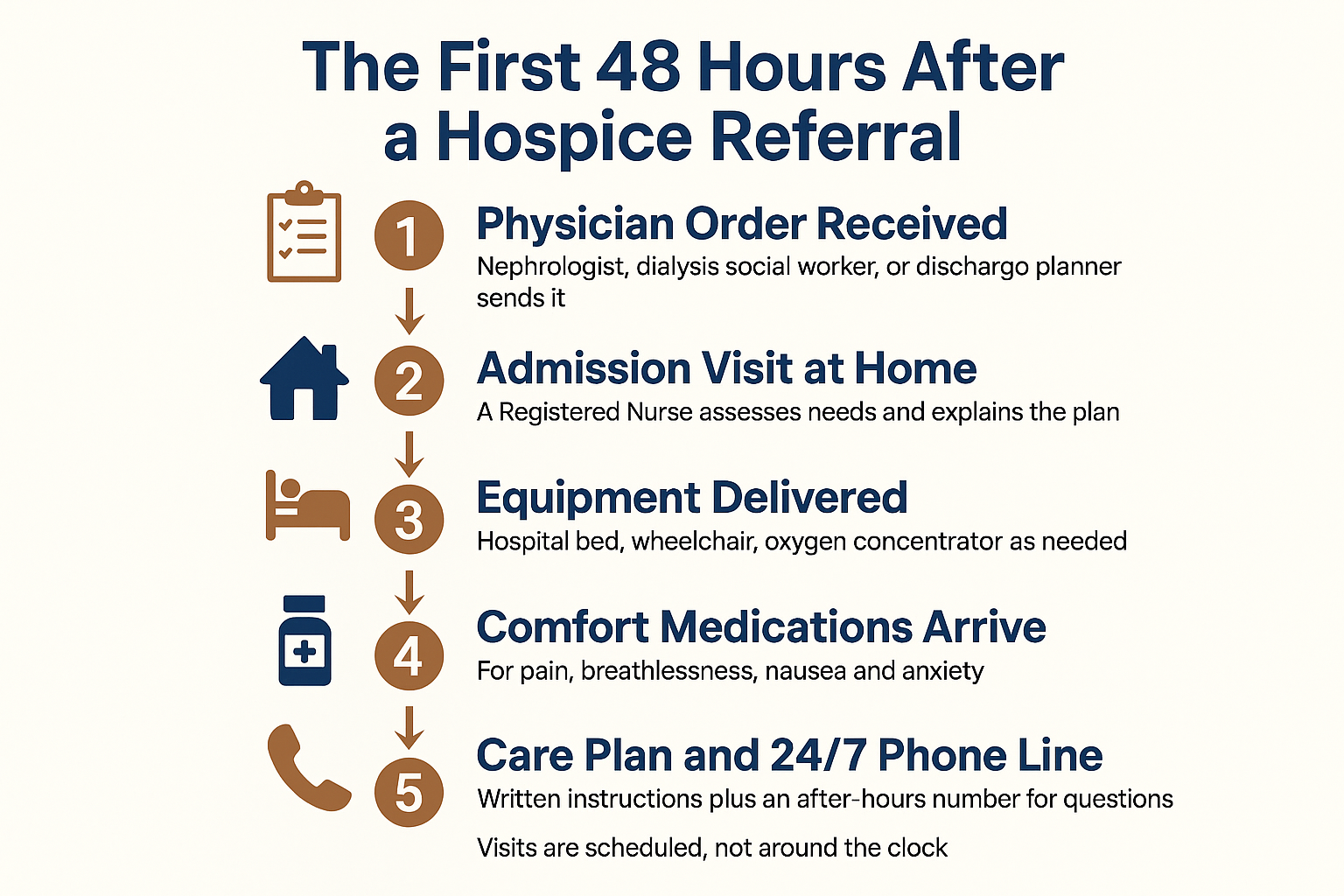
What Hospice at Home Really Looks Like Day to Day
This is the expectation gap that causes the most disappointment. Families often picture round the clock staffing in the house, and that is not what hospice is.
Hospice is built on scheduled visits from a team that includes Registered Nurses, Licensed Vocational Nurses, Hospice Aides, Medical Social Workers, Chaplains, and trained Volunteers, backed by a 24/7 phone line for after-hours questions. A nurse might come several times a week and more often as needs change, but nobody lives at the house.
One of the most common objections families raise is that they need daily hands-on help, not a few visits a week. That is an honest concern with an honest answer: private duty help is a separate arrangement some families add alongside the clinical team. Hourly rates vary widely by agency and by how many hours a day are needed, and monthly totals can climb fast, so it is worth getting a written quote from a private duty agency before assuming.
After dialysis stops, visits focus on symptoms that show up as fluid and waste build up:
- Pain and general discomfort
- Breathlessness and fluid in the lungs
- Nausea, poor appetite, and itching
- Swelling in the legs, hands, and face
- Confusion or sleepiness that increases over days
A large part of the work is coaching. The nurse teaches the family what changes to expect, which ones are normal, and exactly when to pick up the phone. That single piece of preparation is what keeps families out of a 2 a.m. emergency room trip they did not want.
Why Ending the Drive Matters So Much on the Central Coast
There is a practical layer to this decision that people outside the region tend to miss. For a family in King City, Greenfield, or Hollister, three dialysis treatments a week can mean hours behind the wheel on top of the four hours in the chair.
Add Highway 101 traffic, a family member taking time off work to drive, and the recovery time after each session, and the week is essentially gone. For many patients, ending that travel is a real part of why home care feels right.
What replaces it is quieter. A rented hospital bed, sometimes a wheelchair or oxygen concentrator, a small kit of comfort medications in the refrigerator, and a written plan the family can actually follow.
If you want a fuller picture of the shift in mindset, what comfort-focused care really means is a useful companion read, and hospice care is not what most families think it is addresses the assumptions that hold families back from asking sooner.
Frequently Asked Questions About Stopping Dialysis and Hospice Care at Home
Can my father change his mind and go back to dialysis after starting hospice?
Yes. A patient can revoke hospice and return to dialysis if they change their mind. It is not a one-way door, and knowing that often makes the first decision less frightening.
Does Medicare stop paying for anything once dialysis ends?
No. Hospice is covered under Medicare Part A, and coverage does not end because dialysis stopped. The hospice benefit generally covers the nursing visits, comfort medications related to the terminal diagnosis, and rented equipment like a hospital bed.
How fast can hospice start once we decide?
Often within a day or two of the physician’s order, sometimes the same day. Given that most patients live only about one to two weeks after stopping dialysis, this is the reason to ask early rather than waiting to see how things go.
Do we need to be the ones to ask the doctor, or will they bring it up?
Either works, but do not assume it will be offered. A family member is allowed to request a hospice referral directly, and dialysis center social workers help with these requests routinely.
What if we need someone in the house all day?
Hospice provides scheduled visits, not continuous staffing. Families who need daily hands-on help usually arrange private duty care separately and keep the hospice team as the clinical anchor. Ask the hospice social worker for local agency referrals, since they know which ones cover your area.
Does hospice end automatically after six months?
No. Hospice does not expire at six months. If a person lives longer than expected, care continues as long as they still meet eligibility, with periodic recertification by the physician.
If You Want Your Family’s Situation Explained Plainly
Central Coast VNA & Hospice has cared for families across Monterey County, San Benito County, and neighboring communities since 1951, and 2026 marks 75 years of that work as a nonprofit. Worth knowing if you are comparing providers: bereavement support from the team’s Bereavement Specialists continues for the family after a death, and it is open to community members who were never patients. If you would like someone to walk through your specific situation, a care coordinator can be reached at 831-372-6668 or at ccvna.com.