
Direct Answer: An Occupational Therapist visits your home to see whether you can safely bathe, dress, cook, and move between rooms after surgery, then adjusts your home and habits to make those tasks possible.
Your mother is discharged from Community Hospital of the Monterey Peninsula after a knee replacement. The paperwork includes a referral for home health, and you assume that means a nurse will come check the incision.
Then someone calls to schedule an Occupational Therapist. Most families have no idea what that visit is for, and almost nobody expects how practical it turns out to be.
This is a look at what occupational therapy at home actually does after surgery, what the therapist is watching for in your parent’s house, and how Medicare coverage works for these visits in Monterey County.
What an Occupational Therapist Is Actually Evaluating
An Occupational Therapist who comes to the house is answering one question: can this person safely do the ordinary activities of daily life in their real environment?
That sounds simple until you break down what a single morning requires. Getting out of bed, standing at the sink, stepping over a tub wall, reaching a shelf, buttoning a shirt, carrying a plate from the stove to the table. Surgery disrupts the strength, balance, and sometimes the mental focus that all of those tasks quietly depend on.
So the therapist watches the patient do them. Not describe them. Actually do them.
Common areas an Occupational Therapist works on after a hospital stay:
- Bathing and toileting, including how someone gets in and out of a shower or tub
- Dressing, especially lower-body dressing after hip or knee surgery when bending is restricted
- Meal preparation, from standing tolerance at the counter to safely handling hot pans
- Moving between rooms, including the path from bed to bathroom at 2 a.m.
- Energy management, so a patient does not spend all their strength before lunch
The plan that comes out of this is built around that specific house. The layout, the furniture, the height of the bed, the habits of the person living there. A clinic gym cannot tell you whether the hallway in a Pacific Grove cottage is wide enough for a walker. The home visit can.

The Home Safety Assessment Catches What a Hospital Room Never Will
A hospital room is flat, wide, and built for medical equipment. Almost no home on the Central Coast looks like that.
Under the Orthopedic Program at Central Coast VNA & Hospice, a home safety assessment can happen before surgery when a physician orders it, and care can begin within 24 hours of a patient returning home. Either way, the therapist is looking for the same things.
What gets flagged during a home safety review:
- Fall risks like throw rugs, extension cords, low lighting, and pets underfoot
- Bathroom access, which is where a large share of household falls happen
- Stair navigation, including the short entry steps common in older Monterey and Seaside homes
- The bed to bathroom path, walked at night, in the dark, half asleep
- Whether a walker or wheelchair actually fits through the doorways it needs to clear
These are not hypothetical hazards. Older homes in Carmel, Pacific Grove, and the older Salinas neighborhoods often have narrow hallways, raised thresholds, tubs with high walls, and stairs with a handrail on only one side.
If you want the wider picture of what a discharge plan should include, it is worth reading what families often miss when planning a hospital discharge to home.
Occupational Therapy vs. Physical Therapy at Home
Families often assume these are the same service with different labels. They overlap, but the focus is different. Many patients receive both.
| Focus Area | Physical Therapist | Occupational Therapist |
|---|---|---|
| Main question | Can this person move, walk, and build strength safely? | Can this person carry out daily tasks in this home? |
| Typical work | Gait training, balance, strengthening exercises, endurance | Bathing, dressing, meal prep, transfers, energy pacing |
| Equipment role | Walkers, canes, assistive devices for mobility | Grab bars, shower chairs, dressing aids, reachers |
| Environment focus | Movement patterns and physical capacity | Room layout, furniture height, bathroom setup, daily routine |
| Common after | Joint replacement, stroke, fall, general deconditioning | Joint replacement, stroke, hand surgery, cognitive changes |
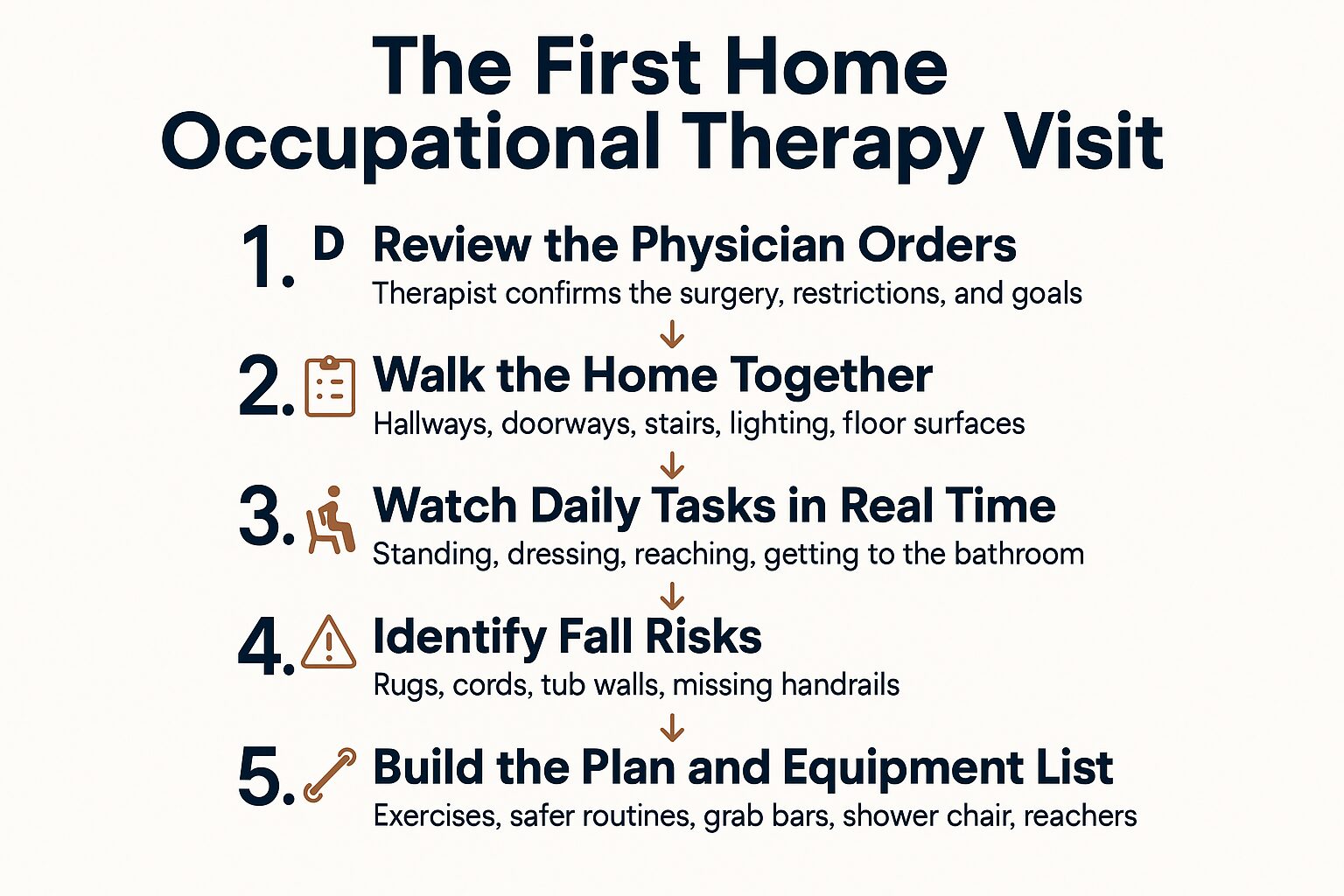
What Happens During the First Home OT Visit
Most first visits follow a similar shape. Here is what families can expect in the hour or so after the therapist arrives.
How Medicare Coverage Works for Home Occupational Therapy
Medicare covers Occupational Therapy visits at home when a physician orders them as part of a home health plan of care and the patient meets the homebound standard. Homebound does not mean bedbound. It generally means leaving the house takes real effort or help.
The part that surprises families most is the referral. A doctor’s order has to come first before visits can be scheduled. Callers ask about this constantly, usually some version of does Medicare cover this, and do we need a referral from the doctor first. The answer to both is yes.
You can read the specifics on covered home health services directly from Medicare’s own coverage page, and we cover the order process in more detail in why a physician referral is required for home health.
Families in Pacific Grove, Carmel, and Seaside helping a parent recover from a hip or knee replacement often do not learn this coverage exists until a nurse or a Medical Social Worker mentions it during an intake call. Ask about it at the time of discharge, not after the first fall.
Coverage for therapy at home also comes up constantly with physical therapy, and the rules are similar. That is walked through in does Medicare cover physical therapy at home.
The Equipment Conversation Is Worth Having Early
An Occupational Therapist will usually recommend adaptive equipment, and this is where a lot of the practical value shows up. Grab bars, shower chairs, raised toilet seats, long-handled shoe horns, sock aids, reachers.
These are modest changes that often decide whether someone can manage at home without full-time help. Costs vary quite a bit by item and supplier, but many of the smaller aids fall in the low double digits, while durable items like hospital beds and wheelchairs are more commonly rented than bought. The therapist can tell you what typically falls under Medicare’s durable medical equipment provisions and what usually does not, so families know what to ask for and what to budget.
One local patient wrote in a review that the nurse who assessed her home before surgery “left me with useful information” for staying safe during recovery, and that the therapy team “encouraged me to do more than I could imagine possible so soon after surgery.” That combination, a safer house plus steady pushing, is the whole point.
For the longer view on making a home work over years rather than weeks, see what actually makes staying home as you age possible.
Frequently Asked Questions About Occupational Therapy at Home After Surgery
How many occupational therapy visits will my parent get at home?
It depends on the surgery, the recovery, and what the physician orders. Home health is intermittent care, so visits are typically a few times per week for a stretch of weeks, not daily. The therapist reassesses progress and the plan changes as the patient improves.
Is this the same as having someone come help with bathing and meals every day?
No, and this trips up a lot of families. Home health occupational therapy is skilled, physician-ordered clinical care on a visit schedule. If your family needs daily hands-on help with personal care, that is private-duty home care, and it is usually paid for out of pocket. Many families use both, with the home health team as the clinical anchor.
My mom refuses to use a walker or a shower chair. Can the therapist help with that?
Often, yes. Refusal usually comes from pride or from equipment that was never fitted properly. An Occupational Therapist can adjust the height, show why a particular setup helps, and sometimes find a less obtrusive option that a patient will actually accept.
Does insurance other than Medicare cover home occupational therapy?
Medi-Cal, Veterans benefits, and most private insurance plans cover home health services, though the requirements and visit limits differ. Coverage details are worth confirming during the intake call rather than assuming.
Do you serve areas outside the Monterey Peninsula?
Home health service across the Central Coast covers Monterey County, including Salinas and King City, along with San Benito County including Hollister, parts of Santa Cruz County, and South Santa Clara County. Coverage by exact address is worth confirming by phone before a discharge date is set.
Questions About Therapy at Home After a Hospital Stay?
If a parent is coming home to Monterey, Salinas, Pacific Grove, or anywhere else in Monterey County after surgery and you are not sure what the home health referral covers, it is a fair question to ask out loud. A care coordinator can walk through what the physician ordered, what Medicare or Medi-Cal typically covers, and what an Occupational Therapist would look at in that specific house. Central Coast VNA & Hospice has been visiting homes in this region since 1951, and the phone number is 831-372-6668.