
Direct Answer: Advance care planning is the ongoing process of talking through your wishes, values, and fears with family and a care team, the signed documents are just the record of those conversations.
Most families in Monterey County think they have handled advance care planning the moment someone signs an advance directive. The form gets filed away, and the subject gets dropped. Then a health crisis arrives, and no one in the room, including the person holding the form, actually knows what the patient would want.
The document was never the hard part. The conversation was.
Advance care planning as a real process means something much deeper than filling out paperwork. It means that a patient and the people they trust have actually talked through what kind of life is worth sustaining, what they fear most about serious illness, and who they want making decisions if they cannot speak for themselves. This article is about that process, and about who can help families get through it before a crisis makes it impossible.
The Difference Between a Signed Form and a Real Plan
An advance directive tells medical staff what interventions a patient does or does not want in a medical emergency. That matters. But a form that no one has talked through is a document no one fully understands.
Consider what happens in practice. A patient arrives at Community Hospital of the Monterey Peninsula after a stroke. The family is asked whether their loved one would want aggressive intervention. There is a signed advance directive somewhere, but the adult children remember the conversation differently, or there was no real conversation at all. The form says something, but no one can explain the reasoning behind it.
Advance care planning as a process changes that. It means the patient has answered harder questions with the people who will carry those answers:
- What does a good day look like to me, and would I still value life if that changed significantly?
- Who do I trust to make decisions when I cannot?
- What do I fear most, pain, loss of independence, being a burden, something else?
- Are there conditions under which I would want care to focus on comfort rather than treatment?
When those conversations have happened, the signed form becomes a reflection of real choices. Without them, it is just a document. As one reviewer of an existing article on this topic put it, the guidance was clear but they wished someone had explained what to do with the form after signing it. That gap, between documentation and understanding, is what advance care planning is designed to close.
For families navigating serious illness, what palliative care actually means and when it can start is worth reading alongside this, because palliative care teams are often the first to open these conversations with patients at home.

Who Should Be Part of the Conversation, and When
The research on this is consistent: most families start end-of-life planning too late, often not until a crisis has already forced the decision. The ideal time for advance care planning is when no immediate decision is required, which means now, for most families reading this.
But the “who” matters just as much as the “when.”
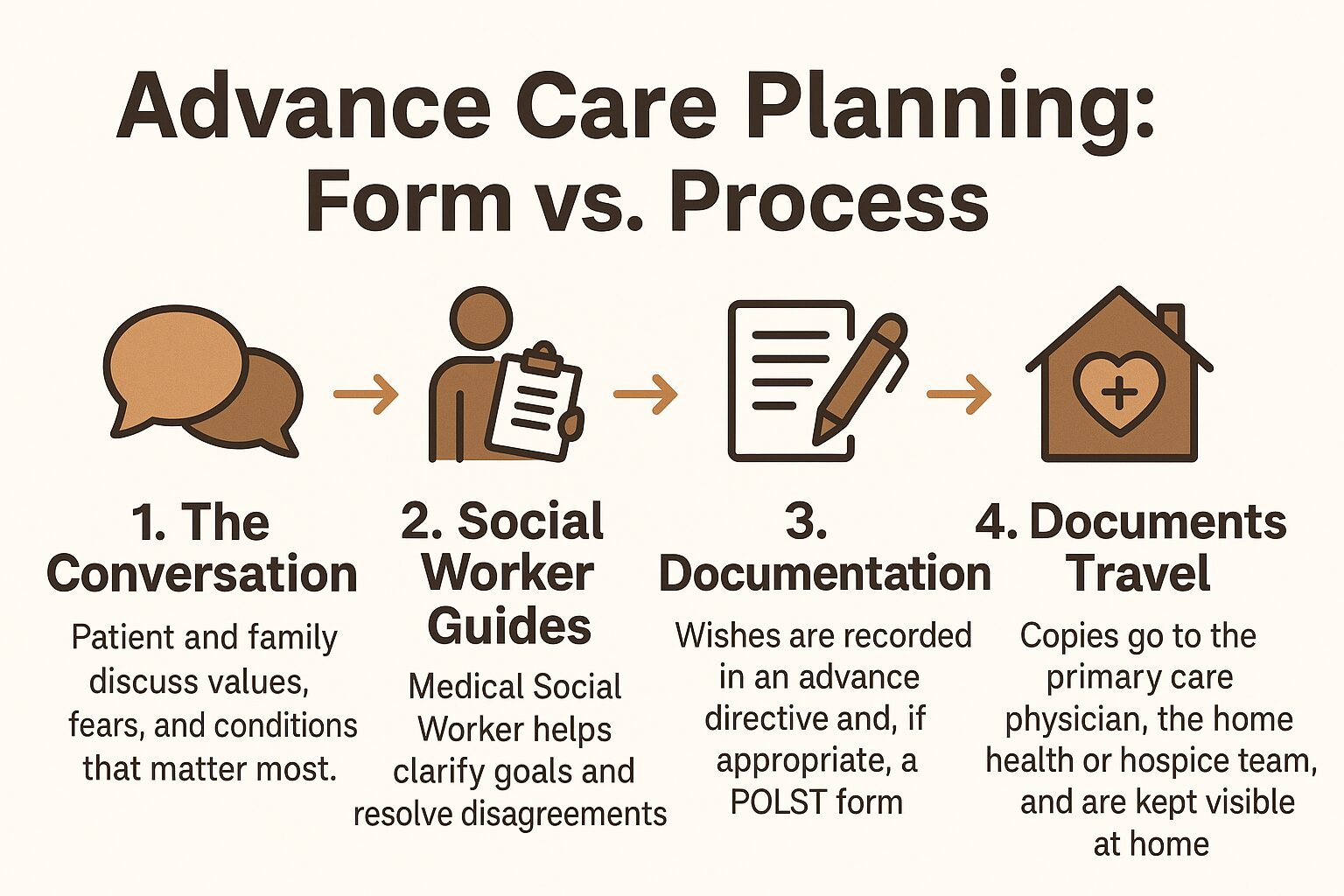
The obvious participants are the patient and the people they designate as decision-makers. But one role that often gets overlooked is the Medical Social Worker on a home health or palliative care team. Medical Social Workers are trained specifically to help patients and families do three things that are genuinely difficult:
- Articulate what matters most in plain language, even when the feelings are complicated
- Work through disagreements between family members who see things differently
- Translate those conversations into documentation that travels with the patient through every care setting
For patients already receiving home health care in Salinas, King City, Pacific Grove, or Hollister, this kind of conversation does not require a separate appointment or a formal meeting. A Medical Social Worker visiting a patient at home can open and guide these discussions in a living room, with the people who know the patient’s history. That context changes the conversation considerably compared to a clipboard in a doctor’s office.
The care team involved in these conversations typically includes Registered Nurses, Nurse Practitioners, Medical Social Workers, and depending on the patient’s situation, Chaplains and other clinicians who know the patient’s full picture. Advance care planning is not a one-time event. It is a conversation that may happen more than once as a person’s health changes, and having a consistent care team at home means someone is always there to revisit it.
Advance Care Planning: The Process at a Glance
This overview shows the difference between signing a directive and completing the full planning process, including who is involved and what each step produces.
Where the Documents Need to Go After You Sign Them
This is the practical piece that a reader of VNA’s earlier advance directives article specifically raised, and it deserves a direct answer.
An advance directive or POLST form (Physician Orders for Life-Sustaining Treatment) is only useful if the right people can find the most current version at the right moment. In Monterey County, POLST forms carry specific medical orders and are designed to travel with a patient between care settings, including Salinas Valley Health, Community Hospital of the Monterey Peninsula, and home. But that only works if the form exists, is current, and is accessible.
Here is where copies should go:
- Primary care physician, the form should be in the patient’s medical record
- Specialists, if the patient sees any regularly
- Home health or hospice team, clinicians visiting at home need to know what the patient’s documented wishes are
- A visible location at home, the refrigerator door is standard guidance for a reason: first responders in Monterey County are trained to look there
One detail families often miss: if an advance directive is updated, the old version should be destroyed or clearly marked as superseded. A care team acting on an outdated document is not acting on the patient’s actual wishes.
The California Attorney General’s office provides standardized advance directive forms that meet state legal requirements, which is a useful starting point for families who want to make sure the paperwork is valid before the conversations begin.
For families sorting out what all of this means alongside a home health transition, what families often miss when planning a hospital discharge to home covers related ground that is worth reading together with this.
Advance Directive vs. POLST: What Each One Does
These two documents serve different purposes and are not interchangeable. Understanding which one applies in a given situation helps families make sure the right document is in the right hands.
| Document | What It Does | Who Acts on It |
|---|---|---|
| Advance Directive | Records a patient’s general values and wishes about future medical care, including who makes decisions | Physicians, hospitals, and care facilities when the patient cannot speak for themselves |
| POLST Form | Carries specific, immediately actionable medical orders (e.g., DNR, hospitalization preferences) | First responders, emergency staff, home health and hospice clinicians in any care setting |
| Healthcare Power of Attorney | Legally designates a specific person to make medical decisions on the patient’s behalf | Any medical provider when the patient lacks decision-making capacity |
When Palliative Care and Home Health Teams Are Already Involved
Families sometimes assume advance care planning requires scheduling a special meeting or hiring an attorney. For patients already receiving home-based care, that assumption is worth setting aside.
Registered Nurses, Nurse Practitioners, and Medical Social Workers who visit patients at home in Monterey County, Salinas, King City, and Hollister regularly engage in these conversations as part of ongoing care. A nurse assessing a patient’s pain management may naturally open the question of what the patient’s goals for treatment are. A Medical Social Worker helping a family coordinate care may be the first person to ask who the patient wants making decisions if they cannot.
These are not bureaucratic checkboxes. They are conversations that happen because the care team has built enough of a relationship with the patient to have them. That relationship is part of what makes home-based care different from a clinic visit. For families thinking about what that kind of support looks like in practice, what a skilled nurse actually does on a home visit gives a realistic picture.
If a family member is dealing with a serious or progressive illness and has not yet had any of these conversations, how do you know when it is time to consider hospice care is another place to start, particularly if the question of comfort-focused care is beginning to feel more pressing.
Frequently Asked Questions About Advance Care Planning
Does my loved one need an attorney to complete an advance directive in California?
No. California law allows advance directives to be signed without an attorney as long as the document is witnessed by two people who are not the patient’s healthcare providers or heirs. Some families do choose to have a document notarized for extra certainty, but it is not required. The California Attorney General’s office provides a free standardized form.
What if family members disagree about what the patient would want?
This is one of the most common and most painful situations families face. A Medical Social Worker on a home health or palliative care team is specifically trained to help families work through these disagreements, not by deciding for them, but by helping everyone articulate what they understand and what they fear. Getting those conversations on the table before a crisis is far less painful than having them in a hospital hallway.
How is a POLST different from a Do Not Resuscitate (DNR) order?
A DNR is one specific order within a POLST, which covers a broader set of decisions including hospitalization preferences, artificial nutrition, and other interventions. A POLST form is a physician-signed medical order that travels with the patient and can be acted on immediately by first responders. A DNR alone may not address what happens in other situations where intervention is possible but not desired.
Can an advance directive be changed after it is signed?
Yes, and it should be updated whenever a patient’s health situation, values, or wishes change significantly. The most important step after updating is making sure old versions are replaced in every location where the document was previously distributed, including the patient’s physician, any specialist offices, and the home health or hospice team.
At what age or health stage should someone start advance care planning?
There is no minimum age or health condition that makes it appropriate. Most planning guides recommend starting these conversations well before any diagnosis, while the person has full capacity to articulate what matters to them. For people already managing a serious or chronic illness, the conversation becomes more urgent, but it is rarely too late to have it meaningfully.
Ready to Start This Conversation With Someone Who Knows Your Family’s Situation?
For patients already receiving home health or palliative care in Monterey County, these conversations do not have to happen in a waiting room or a formal meeting. Central Coast VNA & Hospice has been supporting families across the Central Coast since 1951, and the nurses, Medical Social Workers, and other clinicians on its home-based teams are available to help patients and families think through what advance care planning actually looks like for their situation. You can reach VNA at 831-372-6668 or visit ccvna.com to connect with a care coordinator.