
Direct Answer: Comfort care focuses on managing pain and symptoms at any stage of illness. Hospice is a specific program for patients with a life expectancy of six months or less. The two overlap but are not the same thing.
If you’ve heard a doctor use the phrase comfort care and walked away unsure what it actually meant, you’re not alone. Families across Monterey County hear this term during hospitalizations, in physician offices, and from discharge planners, and almost no one uses it the same way. Some clinicians mean palliative support alongside active treatment. Others use it to signal a shift toward end-of-life focus. A few use it interchangeably with hospice. The term itself is genuinely inconsistent across hospitals, insurers, and physicians, and the confusion that follows is completely understandable.
What matters is that the phrase almost always carries more weight than people realize in the moment. When a doctor brings up comfort care, it usually means something specific is being proposed, and the family deserves to know exactly what that is. This article breaks down what comfort care actually means in a clinical context, how it differs from hospice, and what questions will help any family in Monterey, Salinas, or the surrounding Central Coast communities understand what’s being offered before they agree to anything.
What ‘Comfort Care’ Actually Means When a Doctor Says It
In most clinical settings, when a physician or hospital team uses the phrase comfort care, they are signaling a shift in treatment goals, from curing or controlling a disease to managing how a patient feels day to day. That means focusing on pain, breathlessness, anxiety, nausea, and other symptoms that reduce quality of life.
But here is what many families miss: that shift in goals does not automatically mean treatment is ending. Comfort-focused care can run alongside active medical treatment. A patient receiving chemotherapy, for example, can also receive symptom management support for the side effects of that treatment. These are not mutually exclusive approaches.
When you hear a physician propose comfort care, the most important thing you can do is ask a few direct questions:
- Is this being offered alongside my loved one’s current treatment, or instead of it?
- What specific symptoms are you hoping to address?
- Does this change any of the medications or therapies already in place?
- Are you recommending a referral to a palliative care team or to hospice?
Those four questions will tell you almost everything you need to know about what is actually being proposed. Families who understand this early tend to accept appropriate support sooner, and that timing genuinely affects how much relief their loved one receives.
For a broader look at what comfort-focused care looks like in practice, What “Comfort-Focused Care” Really Means, and When to Ask About It is worth reading before or after any conversation with a physician.

Hospice Is a Specific Program, Not Just a Philosophy
Hospice is not a vague idea or a general approach to care. It is a structured, medically defined program with specific eligibility requirements, a dedicated team, and its own coverage under Medicare and Medi-Cal.
To qualify for hospice, a physician must certify that a patient’s life-limiting illness may result in death within six months if the illness follows its expected course. That is the threshold. It does not mean a patient will die in six months, some patients on hospice live longer and are discharged. But that medical determination is required before the program can begin.
Once enrolled, hospice brings an interdisciplinary team into the home that most families did not know existed. That team typically includes:
- Registered Nurses who assess symptoms, manage medications, and are available around the clock
- Hospice Aides who help with personal care and daily routines
- Medical Social Workers who address practical needs, family stress, and care coordination
- Chaplains who offer spiritual support to patients and families of any faith background or none
- Bereavement Specialists who continue supporting the family after the patient passes
- Volunteers who provide companionship and give family members a break
Medicare covers hospice as a distinct benefit, including medications related to the terminal diagnosis, equipment like a hospital bed or wheelchair, and all of the team visits described above. Medi-Cal and Veterans benefits also cover hospice, though the specifics vary. If you want to understand how that eligibility question actually works in practice, The Hospice Eligibility Question Most Families Are Afraid to Ask addresses it directly.
Comfort care, by contrast, has no formal eligibility threshold. A patient at any stage of illness can receive comfort-focused symptom support. That is one of the most important distinctions families need to hear: you do not have to qualify for hospice to get meaningful relief.
Comfort Care vs. Hospice: A Side-by-Side Look
These are the practical differences families most often need to understand when weighing their options.
| Feature | Comfort Care (General) | Hospice Program |
|---|---|---|
| Eligibility requirement | None, available at any illness stage | Physician certifies 6-month prognosis |
| Can continue curative treatment? | Yes | Generally no, goals shift to comfort only |
| Medicare/Medi-Cal benefit | Covered based on diagnosis and how services are ordered | Distinct Medicare Hospice Benefit with defined coverage |
| Team involved | Varies, may include nurses, therapists, social workers | Full interdisciplinary team: nurses, aides, social workers, chaplains, volunteers, bereavement specialists |
| Where care is provided | Home, clinic, or hospital setting | Primarily in the home or a homelike setting |
| Duration | As long as clinically appropriate | Recertified in 90-day periods; no set end date |
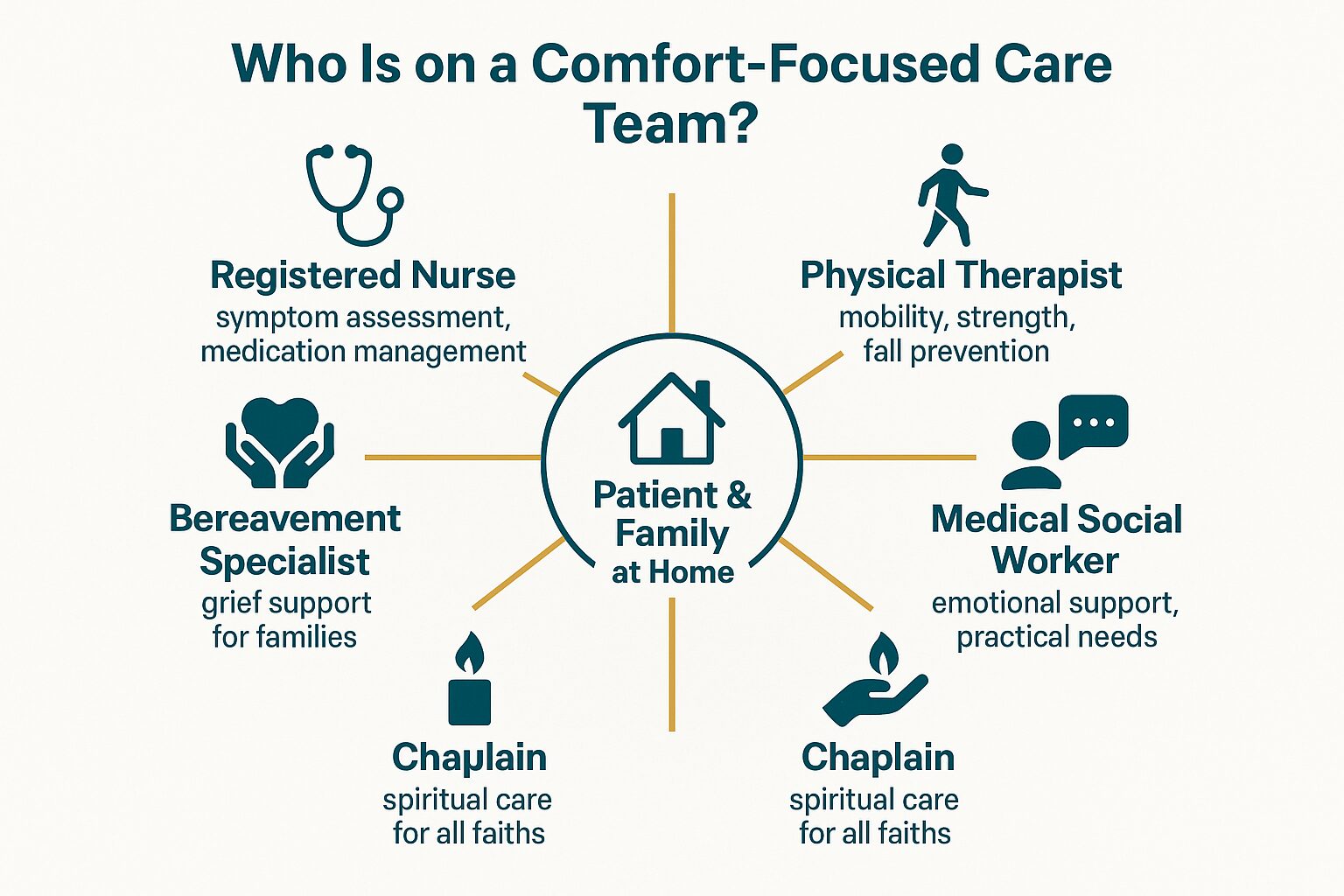
The Team Behind Comfort-Focused Care
Most families are surprised by how many clinicians can be involved before a hospice decision is ever made. This shows who is typically part of a comfort-focused care team.
Why Families Hear ‘Comfort Care’ and Think It Means Giving Up
This is one of the most consistent patterns in conversations with families navigating a serious illness. Someone hears a physician recommend comfort care during a hospitalization and interprets it as the medical team stepping back, as giving up on their loved one.
That interpretation is understandable. And it is also often wrong.
Focusing on comfort does not require stopping other care. In many cases, physicians recommend a palliative layer of support specifically because a patient is in active treatment and the treatment itself is causing significant suffering. Adding symptom management in that context is not a retreat. It is an expansion of care.
The phrase that tends to create the most confusion is when comfort care is offered as a goal-of-care conversation, a discussion about what matters most to the patient as a person, not just as a medical case. Those conversations can feel heavy, and physicians do not always frame them in a way that feels reassuring. But families who engage with those conversations openly tend to find that their loved one’s wishes become clearer, and that the care that follows is more aligned with those wishes.
If your family is in the middle of that conversation right now, How Families Describe the Moment They Chose Hospice offers real perspective from people who have been through it, and may help the decision feel less isolating.
For families in Salinas, King City, Hollister, or the Monterey Peninsula who are trying to figure out what comes next after a hospitalization, What Families Often Miss When Planning a Hospital Discharge to Home is also worth a read before discharge day arrives.
How Coverage Works, and Why It Should Not Stop You from Asking
One question that comes up constantly, from families in Pacific Grove to patients in King City, is whether Medicare or Medi-Cal will pay for comfort-focused care. The short answer is: it depends on how the services are ordered and what the underlying diagnosis is.
Medicare’s Hospice Benefit is one of the most clearly defined coverages in all of Medicare. Once a patient is enrolled in a certified hospice program, Medicare covers the team visits, medications related to the terminal diagnosis, and equipment delivered to the home, with little to no cost to the patient.
Palliative and comfort-focused care outside of hospice is covered differently. Skilled nursing visits, physical therapy, and other home health services are generally covered under Medicare Part A or Part B when a physician orders them and the patient meets homebound criteria. The Medicare website has a useful breakdown of what home health services Medicare covers and the conditions that apply.
The most practical step any family can take is to ask two questions of their physician and their care team:
- How will these services be billed, and under what part of my coverage?
- Is there anything I need to do to make sure the referral is in place before care begins?
Coverage should never be the reason a family waits to ask for help. If there is uncertainty, a care coordinator can help clarify what applies to a specific situation before anything is scheduled. For more on how Medicare coverage intersects with palliative care specifically, What Medicare Covering Palliative Care Could Mean for Your Family explains the landscape in plain language.
Frequently Asked Questions About Comfort Care and Hospice
Can my loved one receive comfort care and still try to get better?
Yes. Comfort care and curative treatment can run at the same time. Focusing on symptoms like pain or breathlessness does not require stopping chemotherapy, dialysis, or other active treatment. The two goals can coexist, and in many cases, managing symptoms actually helps a patient tolerate treatment better.
How is hospice different from just having a nurse come to the house?
Home nursing visits and hospice are very different programs. A skilled nursing visit through home health focuses on a specific clinical task, wound care, medication management, post-surgical recovery. Hospice brings a full team into the home on an ongoing basis: Registered Nurses, Hospice Aides, Medical Social Workers, Chaplains, and Volunteers, all coordinated around one goal, which is quality of life for the patient and support for the family. It is a much broader program than a single nursing visit.
Does choosing hospice mean we’re giving up?
Most families who have been through it say the opposite. Hospice shifts the focus from fighting the illness to focusing on the person, their comfort, their dignity, and their wishes. Families often describe feeling that hospice gave their loved one more presence, more peace, and more control over their final months than continued aggressive treatment would have. That is not giving up. It is a different kind of commitment.
What if my parent isn’t ready for hospice but is still struggling with symptoms?
This is exactly the situation where palliative and comfort-focused care is most valuable. There is no eligibility threshold for comfort-focused symptom support. A patient does not have to be near the end of life to benefit from a Medical Social Worker helping with stress, or a Registered Nurse managing pain more effectively. If your loved one is suffering and you are not sure whether hospice is the right step, asking about palliative care first is a completely reasonable path.
Does a physician referral have to come first?
For most home health and hospice services, yes, a physician order is required to get started. Many families don’t realize this until they call, which can create frustrating delays. If you know care is coming, the fastest thing you can do is contact the physician’s office and ask them to send a referral directly to the home health or hospice agency. A care coordinator can walk you through that process and often help facilitate the paperwork.
What happens to the family after a hospice patient passes away?
Hospice care does not end at the moment of death. Bereavement support, including grief counseling and ongoing check-ins from Bereavement Specialists, continues for the family after their loved one passes. This is a covered part of the Medicare Hospice Benefit and can make a meaningful difference for spouses, adult children, and others navigating loss.
Still Trying to Sort Out What Your Family Actually Needs?
Families across Monterey County, from Pacific Grove to Salinas to Hollister, are often working through these questions in real time, after a hospitalization, during a health decline, or in the middle of a conversation with a physician that left more questions than answers. Central Coast VNA & Hospice has been helping families in this region find clarity since 1951, and a care coordinator is available to talk through what options may apply to your specific situation. You can reach the team at 831-372-6668 or visit ccvna.com to learn more.