
Direct Answer: A Registered Nurse can visit your parent’s home, review every medication, check for interactions, and set up a safe daily schedule, and Medicare often covers this when a physician orders it.
A Monterey County family reached out in early 2026 with a situation that many families here are quietly living through. Their 83-year-old mother, a cancer survivor, and their 86-year-old father, recently diagnosed with dementia, were living independently, but managing more than five medications between them had become more than Mom could handle alone. The question they asked was simple: can a Registered Nurse come to the house and help sort this out?
The answer is yes. But most families don’t know that until they’re already in crisis.
This article explains what medication management at home actually looks like, why it matters more when dementia is part of the picture, and how skilled nursing visits work, including what Medicare covers and how to get one started in Monterey County.
What Polypharmacy Means and Why It Raises the Stakes
Polypharmacy is the term clinicians use when a patient takes five or more medications regularly at the same time. It’s common in older adults managing multiple chronic conditions, heart disease, diabetes, cancer recovery, and now, increasingly, dementia, and the risks grow with every added prescription.
The National Institute on Aging notes that drug interactions and dosing errors are among the most preventable causes of hospitalization in older adults. When you add dementia to the picture, those risks compound.
A parent with dementia may:
- Take a dose twice because they don’t remember the first one
- Skip doses entirely without realizing it
- Be unable to describe side effects they’re experiencing
- Struggle to manage a pill organizer independently, even a simple one
For an adult child managing this from across the Monterey Peninsula, or from Salinas, or King City, the coordination challenge is real. You can’t be there for every dose. And the stakes of a mistake are high.
What a Skilled Nursing Medication Visit at Home Actually Looks Like
This is not a wellness check or a friendly drop-in. A skilled nursing medication management visit is licensed clinical work, performed by a Registered Nurse in the patient’s home.
Here’s what happens during that visit:
- The RN collects and reviews every medication the patient is taking, prescriptions, over-the-counter drugs, and supplements
- Each drug is checked for correct dose and timing against the physician’s orders
- The nurse screens for drug interactions that may not have been flagged when prescriptions came from different specialists
- If adjustments are needed, the RN coordinates directly with the prescribing physician
- The patient and family receive clear education on what each medication does and what warning signs to watch for
- A daily schedule is established that works for the household, not just for a chart
For a family where one parent has dementia and the other is managing recovery from cancer treatment, this kind of structured visit changes the daily reality. It moves the household from guesswork to a clear, clinically reviewed plan.
You can read more about what a nurse actually does on one of these visits in this overview of what a skilled nurse actually does on a home visit.
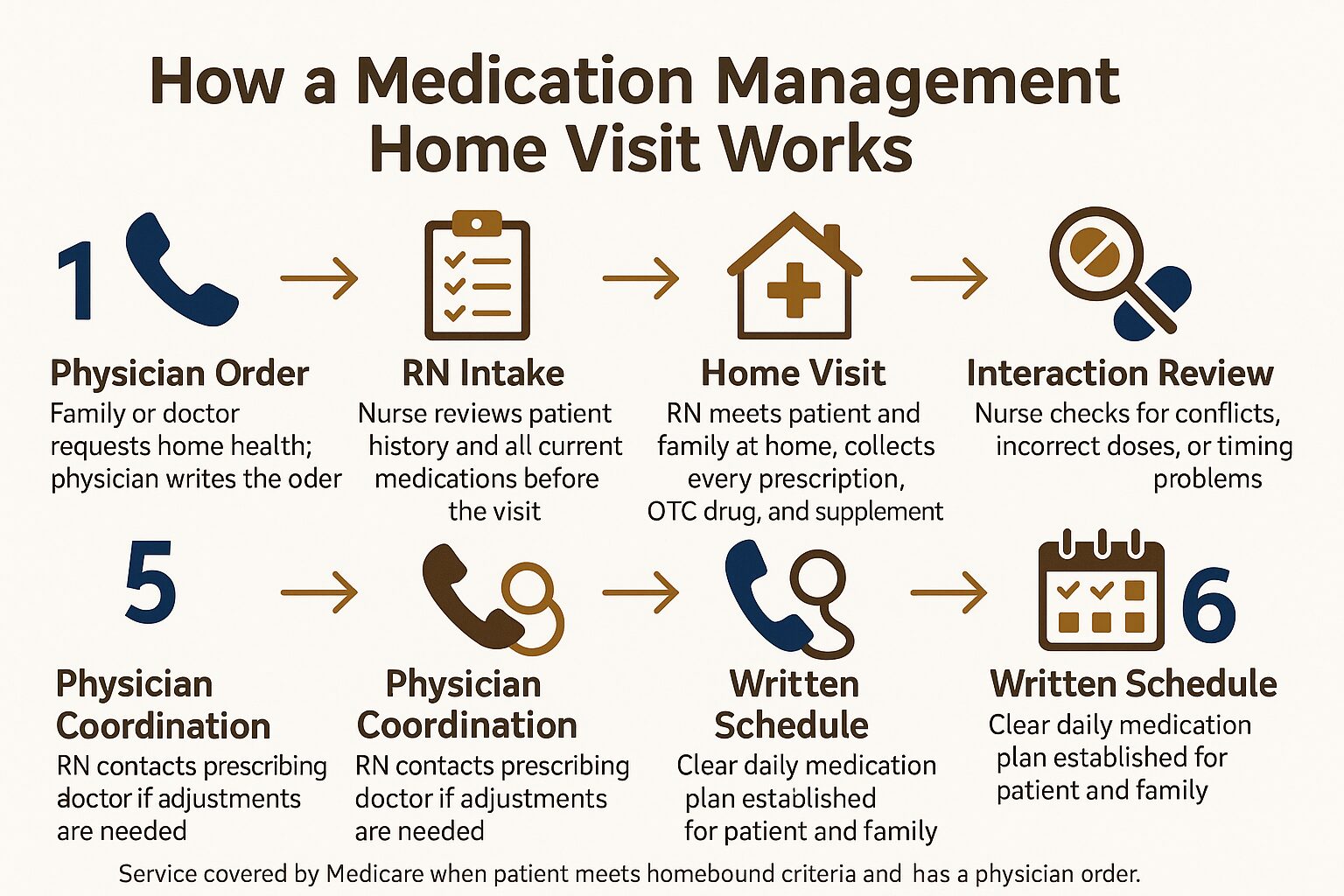
How a Medication Management Home Visit Works
This step-by-step breakdown shows what happens from the first phone call to an established medication plan in the home.
Does Medicare Cover This, and How Do You Get It Started?
Medicare Part A and Part B both cover skilled nursing home visits when the patient meets homebound criteria and has a physician order for the service. Homebound does not mean bedridden, it means that leaving home requires a considerable effort due to illness, injury, or cognitive decline.
For a parent with dementia and multiple complex medications, that threshold is often met. The conversation starts with the patient’s physician.
Many families are surprised to learn that a physician referral is required before a skilled nurse can come to the house. It’s not a barrier, it’s how the clinical and insurance systems connect. If you’re not sure how that process works, this explanation of why a physician referral is required for home health walks through it clearly.
VNA accepts Medicare, Medi-Cal, and Veterans benefits for qualifying home health services. For families navigating both parents’ needs simultaneously, knowing that coverage exists for this kind of skilled visit is often the piece of information that changes everything.
Skilled Nursing at Home vs. Managing Medications Without Help
This comparison shows what changes when a Registered Nurse steps in to manage a complex medication situation at home.
| Area of Risk | Without Skilled Nursing Support | With RN Medication Management |
|---|---|---|
| Drug interactions | Unknown unless a pharmacist flags it at pickup | Clinically screened during the visit; physician contacted if needed |
| Missed or doubled doses | Common, especially with dementia; often undetected | Daily schedule established and reviewed; family educated on monitoring |
| Side effect recognition | Patient may not self-report; family may not know warning signs | RN educates family on what to watch for and when to call the doctor |
| Coordination between specialists | Falls to the family to relay information between offices | RN communicates directly with prescribing physicians on the patient’s behalf |
| Medicare coverage | Not applicable | Covered when patient meets homebound criteria and has a physician order |
The Emotional Weight Nobody Talks About
Managing two aging parents with serious health histories, one with dementia, one recovering from cancer, is not a logistical problem. It’s an emotional one that happens to have logistical symptoms.
Families in this situation often describe the same feelings: they’re afraid of making a mistake, they don’t know where to start, and they feel like they’re doing it alone. Those feelings are completely understandable. The medication situation is genuinely complex. It’s not something a pill organizer and a spreadsheet can solve when cognitive decline is in the picture.
Calling a nurse to the home is not an admission of failure. It’s the right tool for a genuinely difficult clinical situation. The skilled nursing care at home article addresses a lot of the assumptions families carry into this, including the worry that asking for help means giving something up.
For families managing a parent with dementia specifically, it can also help to understand the full picture of what support looks like as the disease progresses. The article on hospice criteria for dementia addresses questions families often don’t feel ready to ask out loud, but frequently need answered.
Why Local, Nonprofit Care Makes a Difference Here
In 2025, VNA’s nurses and clinicians made more than 73,000 home visits across Monterey County, serving over 3,800 patients across the full spectrum of care. Medication management is one of the core services that Registered Nurses and Licensed Vocational Nurses deliver on those visits every week, in Salinas, in Pacific Grove, in King City, and throughout the Salinas Valley.
For a family trying to coordinate care for two aging parents from across town, that local presence matters. A nonprofit with 75 years of community history in Monterey County knows the area’s physicians, the local hospital discharge teams, and the real geography of getting to a patient’s home.
That’s a meaningfully different experience from navigating a large regional agency that doesn’t know the Central Coast. And for families wondering how to keep a parent at home safely as their needs grow, understanding how long aging in place can realistically work is a worthwhile starting point.
Frequently Asked Questions About Medication Management at Home
Can a nurse really come to my parent’s house just to review medications?
Yes. A Registered Nurse can come to the home specifically to review all medications, check for interactions, confirm correct dosing, and set up a daily schedule. This is a skilled nursing service covered by Medicare when the patient meets homebound criteria and has a physician order. It is not a general wellness visit, it is clinical work.
My father has dementia. Does that change what kind of help is available?
It changes how care is delivered, not whether it’s available. For a patient with dementia, the RN will work closely with family members to establish a system that accounts for the patient’s cognitive limitations. The nurse also educates the family on warning signs, because the patient may not reliably report how they’re feeling. The physician is kept in the loop throughout.
We have two parents with different health histories. Can a nurse help with both?
Home health services are ordered per patient, so each parent would have their own plan and physician order. But a skilled nursing team can coordinate visits and care planning for both. That’s a conversation worth having with a care coordinator when you first reach out.
Does Medicare cover medication management visits at home?
Medicare Part A and Part B both cover skilled nursing home visits when the patient is homebound and has a physician order. Homebound doesn’t mean bedridden, it means leaving home takes considerable effort. Many patients with dementia or serious chronic illness qualify. Medi-Cal and Veterans benefits may also apply depending on the patient’s coverage.
How do I get this started for my parent in Monterey County?
The first step is a physician order. Talk to your parent’s primary care physician and ask for a home health referral specifically for skilled nursing and medication management. If you’re not sure how to have that conversation, a VNA care coordinator can walk you through the process. You can reach the care team at 831-372-6668 or visit ccvna.com.
Ready to Get a Clearer Picture of Your Parent’s Medication Situation?
If you’re managing a parent’s medications in Monterey County and things have gotten too complex to handle alone, Central Coast VNA & Hospice has care coordinators who can help you figure out the right next step. You can reach the team at 831-372-6668 or visit ccvna.com to learn more about home health services and what Medicare covers.