
When dealing with the pain of loss, finding the right words can feel impossible. The silence left by a loved one can be overwhelming. Writing letters of grief can be a powerful way to heal.
Putting feelings on paper helps make sense of sorrow. It creates a private space to speak to the person you've lost or document memories. This process helps you reflect and honor a relationship that still matters.
This article shares examples of grief letters for different needs. We will look at the tone, structure, and goal of each one. This will help you write your own meaningful message.
1. C.S. Lewis's Letters to Malcolm: Chiefly on Prayer – Grief Letters
Some of the most powerful letters of grief were never meant to be public. C.S. Lewis wrote to his friend Malcolm after his wife, Joy Davidman, died. These letters show a raw and honest look at loss.

This collection shows that grief writing can be messy. It can be a questioning process shared with a trusted friend. Lewis was not afraid to ask hard questions about his faith and loss.
Strategic Analysis & Breakdown
- Tone: The tone is personal, honest, and thoughtful. Lewis is not just sad; he is trying to understand his sadness.
- Structure: The letters are like a conversation. This format allows for exploring complex feelings without pressure.
- Audience: The first audience was one trusted friend. This allowed for total honesty, which makes the letters so powerful.
Actionable Takeaways for Your Own Letters
If this approach feels right for you, here are some tips:
- Find a trusted friend: Share your raw thoughts with someone who will not judge you. This person should be a safe space for your questions or anger.
- Think through your feelings: Use writing to explore big questions. It is okay to analyze your feelings as you navigate grief.
- Don't hide your doubt: Healing involves facing difficult emotions, like doubt or frustration. Your letters can be a place to voice these thoughts safely.
2. Lincoln's Bixby Letter – Condolence to Bereaved Mother
Sometimes, letters of grief are written for a whole country. Abraham Lincoln's 1864 letter to Mrs. Lydia Bixby is a great example. She was a mother thought to have lost five sons in the Civil War.
The letter shows how to offer comfort with dignity. It acknowledges a terrible sacrifice while reminding the family of the honor in their loved one's service. This is a powerful approach for official letters.
Strategic Analysis & Breakdown
- Tone: The tone is formal, serious, and caring. It carries official weight while showing real compassion.
- Structure: The letter is short and to the point. It acknowledges the loss, offers comfort, and ends by honoring the sacrifice.
- Audience: The letter was for a grieving mother, but it also spoke to a nation at war. It validated personal loss on a public level.
Actionable Takeaways for Your Own Letters
To write a letter with dignified comfort, follow these tips:
- Acknowledge the sacrifice: Directly and respectfully state the size of the loss. Do not downplay the pain.
- Connect loss to a larger meaning: If it fits, frame the loss in a context of shared values, like service or community. This can offer a sense of purpose. Organizations like Central Coast VNA & Hospice offer hospice and bereavement support services to help families find meaning.
- Use respectful language: Choose words carefully to show honor. Formal language can create a sense of deep respect.
3. Rilke's Letters on Loss and Solitude
The poet Rainer Maria Rilke saw grief as a deep part of life. His letters to grieving friends treat loss as something that helps us grow. These letters of grief are less about quick comfort and more about making sorrow a part of you.

For Rilke, grief was something that needed time to develop within us. His writings encourage a quiet, patient relationship with sorrow. He often used powerful images, connecting loss to creativity and nature.
Strategic Analysis & Breakdown
- Tone: The tone is deep, patient, and poetic. Rilke’s letters offer a gentle path through pain, framing it as necessary for growth.
- Structure: His letters are thoughtful and use imagery. They are like meditations that guide the reader to a new view of their loss.
- Audience: The audience was usually a friend or mentee dealing with loss. This allowed Rilke to offer personal, thoughtful guidance.
Actionable Takeaways for Your Own Letters
If you like this thoughtful approach, here are some tips:
- Use images: Instead of saying "it will get better," use pictures. For example, describe grief as a cold winter that will turn to spring.
- Frame grief as part of life: Acknowledge that sorrow is a hard but normal part of being human. Writing about grief as a season or journey can help.
- Connect loss to deeper meaning: Your letters of grief can be a place to explore how loss changes your view on life and love. This moves the focus from pain to growth. Finding community is also helpful; learn about bereavement and grief support groups on ccvna.com.
4. Queen Victoria's Letters After Prince Albert's Death
For some, grief is a long and public journey. Queen Victoria’s letters after her husband, Prince Albert, died in 1861 are a powerful example. Her letters show a deep mourning period that lasted for decades.
These letters of grief were sent to family, friends, and officials. They offer a look into her struggle with overwhelming loss. This collection shows grief is a marathon, not a sprint.
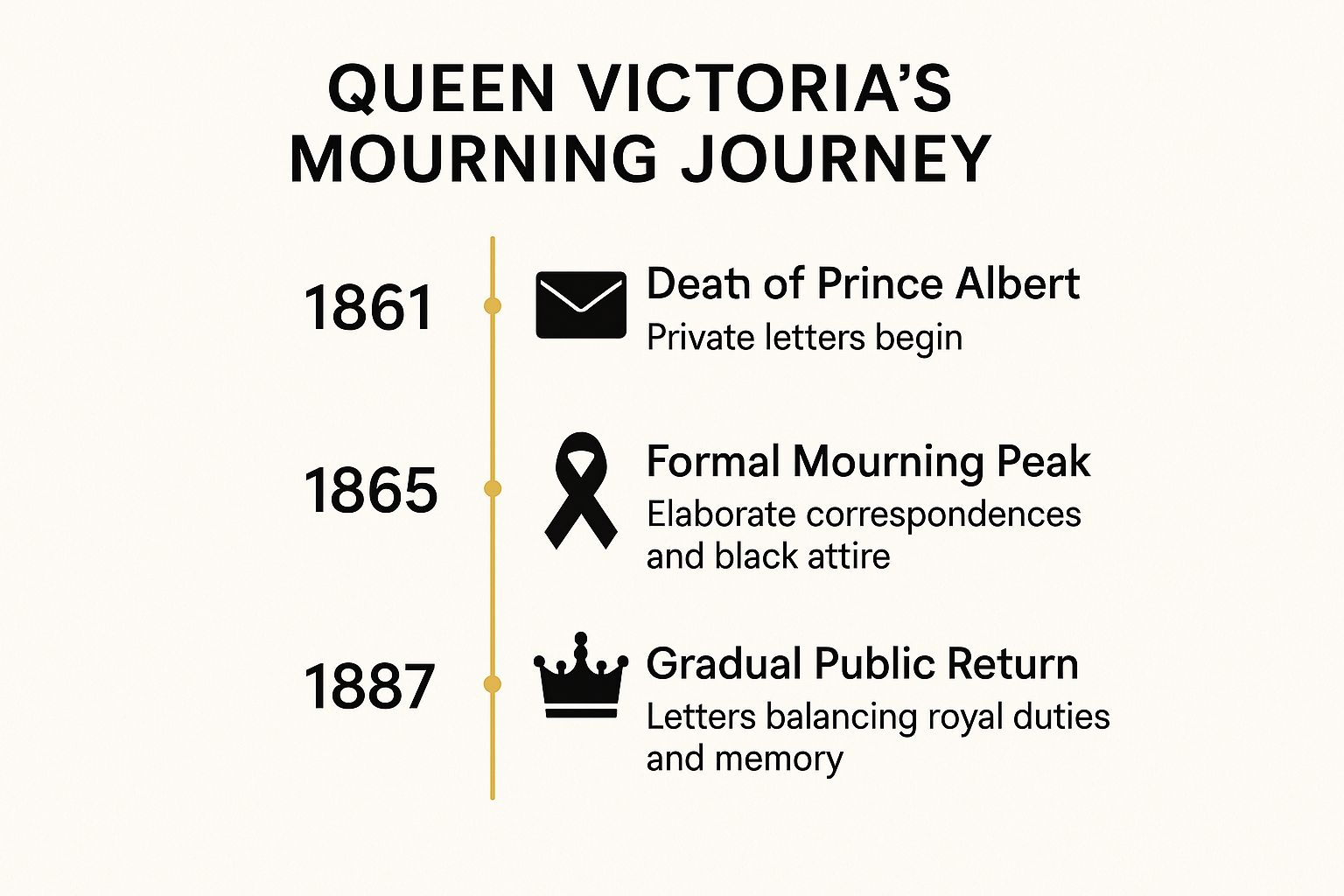
The infographic shows how her letter writing changed over many years. It moved from intense private sadness to a mix of personal memory and public duty.
Strategic Analysis & Breakdown
- Tone: The tone is one of deep, lasting sorrow, but also duty. Victoria’s letters are formal yet filled with personal pain.
- Structure: Her letters varied. Some were intimate notes to family, while others were official papers where grief was a reason for her actions.
- Audience: The audience was broad, from her daughter to government ministers. She had to adapt her expression of grief for each person.
Actionable Takeaways for Your Own Letters
If you are grieving while managing big responsibilities, consider Victoria’s approach:
- Integrate, don't hide: Allow your grief to be part of your life. Acknowledge your loss in your communications when it feels right.
- Maintain a connection: Use your writing to talk to or about your loved one. Sharing memories helps maintain a comforting connection.
- Allow a long timeline: Victoria’s long mourning reminds us there is no "right" amount of time to grieve. Let your letters of grief reflect your own journey.
5. Joan Didion's Email Grief Communications
In our digital age, letters of grief have changed. Joan Didion used email to communicate with friends and family during a time of great tragedy. She managed her husband's death and her daughter's critical illness through digital messages.
These emails show how modern communication helps us connect during loss. Her messages were a lifeline, allowing her to share updates and receive support. It shows that grief writing can be urgent and practical.
Strategic Analysis & Breakdown
- Tone: The tone is often direct and factual. Didion's emails focused on clarity over fancy words, showing the crisis she was in.
- Structure: The messages were short and functional, often updates to a group. This highlights a key purpose of modern letters of grief: managing information.
- Audience: The audience was a close network of friends and family. An email list allowed her to reach everyone at once, saving emotional energy.
Actionable Takeaways for Your Own Letters
If you are navigating grief today, consider these strategies:
- Create a communication hub: Use an email list or private group chat to share updates. This saves you from repeating painful news.
- Focus on function: During a crisis, don't worry about perfect writing. Short, direct messages are fine and often better.
- Save important messages: The digital record of support can be a comfort to look back on. Helping others through such times can be a powerful experience; you can learn more about volunteering for hospice to support families in Monterey and Santa Cruz Counties.
6. Military KIA Notification and Response Letters
The exchange of letters of grief in the military is a structured but personal process. When a service member is killed in action (KIA), a formal notice is given. This is often followed by condolence letters from commanders and fellow soldiers.
These letters have great emotional weight. They connect the family's private sorrow with the military unit's shared grief. They honor the soldier's service and sacrifice.
Strategic Analysis & Breakdown
- Tone: The tone is a mix of formal respect and deep personal sadness. Official letters follow rules, while personal replies can be very emotional.
- Structure: The process is structured. It starts with official notice, then condolence letters, and often a response from the family.
- Audience: The audience includes the grieving family, commanding officers, and fellow service members.
Actionable Takeaways for Your Own Letters
If you are navigating a loss in the military community, these ideas can help:
- Balance formality and emotion: It is fine to use formal language. But don't let rules stop you from sharing your true feelings.
- Ask for memories: When writing to your loved one’s unit, ask them to share stories. This can provide a fuller picture of their life.
- Connect with support systems: Writing these letters is very hard. Military grief counselors and support groups for families can help. Preparing for end-of-life decisions is also a critical part of this process; Learn more about advance care planning on ccvna.com.
7. Parent-to-Child Explanation Letters About Death
Some of the most important letters of grief are written from a parent to a child. These letters explain the death of a family member or pet in a simple, honest way. They can be a gentle start to a hard conversation and become a treasured memory.
These letters focus on clarity and emotional safety. For instance, explaining a grandparent's death needs simple words a child can understand without being scared. The goal is to provide a foundation for understanding.
Strategic Analysis & Breakdown
- Tone: The tone must be gentle, reassuring, and direct. It balances honesty about death with a message of love and safety for the child.
- Structure: The letter is usually short with simple sentences. It often states a fact, shares a happy memory, expresses feelings, and ends with reassurance.
- Audience: The audience is a child. The words and ideas must be right for their age.
Actionable Takeaways for Your Own Letters
If you need to write this difficult letter, these tips can help:
- Use simple, clear language: Avoid confusing phrases like "passed away." Instead, use clear terms like, "Grandma's body stopped working, and she died."
- Reassure and validate: Tell the child they are loved and safe. Acknowledge that it's okay to feel sad, angry, or confused.
- Create an opening for talk: End the letter by inviting questions. Let the child know you are there to talk when they are ready. A grief book specifically designed to help children tackle difficult emotions can also help. For more support, families can find information on grief counseling for families.
Comparison of 7 Grief Letter Examples
| Example | Implementation Complexity 🔄 | Resource Requirements ⚡ | Expected Outcomes ⭐ | Ideal Use Cases 💡 | Key Advantages 📊 |
|---|---|---|---|---|---|
| C.S. Lewis's Letters to Malcolm | Moderate – thoughtful, intellectual | Low – personal writing | Deep theological insight on grief | Intellectual/spiritual grief exploration | Honest, comforting, integrates faith & doubt |
| Lincoln's Bixby Letter | Low – formal, concise, scripted | Low – brief official correspondence | Empathy and national solidarity | Official condolence, leadership communication | Balances formality with genuine emotion |
| Rilke's Letters on Loss and Solitude | Moderate – poetic, abstract | Low – personal, artistic writing | Emotional depth, artistic transformation | Artistic and philosophical processing of grief | Elevates grief to meaningful human experience |
| Queen Victoria's Letters After Albert's Death | High – extensive, long-term | Moderate – ongoing written records | Public and private mourning balance | Historical mourning, sustained grief expression | Shows grief as ongoing process, combines duty |
| Joan Didion's Email Grief Communications | Low to Moderate – digital, immediate | Moderate – requires tech access | Fast, widespread emotional support | Crisis communication, digital grief processing | Immediate support, community building |
| Military KIA Notification and Response Letters | High – formal protocols, sensitive | Moderate – official coordination | Structured grieving, honor and support | Military loss notification and family communication | Structured support, honors sacrifice |
| Parent-to-Child Explanation Letters | Moderate – age-appropriate, careful | Low to Moderate – thoughtful crafting | Child-friendly understanding of death | Explaining death to children | Provides comfort, educational, reusable |
Your Story, Your Words: Compassionate Support on the Central Coast
Written words can be very powerful in times of grief. From a president’s formal letter to a mother’s private thoughts, there is no single right way to express sorrow. These examples of grief letters all create a space for honest emotion and connection.
Key Takeaways from Historic and Modern Grief Letters
The main lesson from these examples is authenticity. Whether you write to a friend or for yourself, your true feelings are what matter most. The structure can be simple or deep, but the words should come from a place of genuine care.
Another key lesson is the power of shared experience. Lincoln’s letter acknowledged a shared sacrifice. Writing or receiving a letter reminds us that we are not alone in our grief.
Putting Pen to Paper: Your Next Steps
These examples are practical guides to help you find your voice when words are hard to find.
Here are some steps you can take:
- Start small: A simple, heartfelt note can mean the world to someone who is grieving.
- Share a memory: Sharing a happy memory of the person who has passed helps keep their spirit alive.
- Write for yourself: Writing a letter to the person you lost can be a healing way to process your own grief.
Writing letters of grief is about empathy and courage. It is a skill that helps you offer support and understand your own feelings. If you want to share your story more widely, you might find inspiration in these ideas for a memoir.
Navigating grief is a deeply personal journey, and no one should have to walk it alone. Central Coast VNA & Hospice has provided compassionate care for over 74 years. We are a local, nonprofit organization serving Monterey County, San Benito County, Santa Cruz County, and South Santa Clara County.
Our mission-driven team offers expert emotional, spiritual, and medical support for patients and their families. This support is part of our Continuum of Care, from home health and palliative care to hospice. If you or a loved one needs support, contact us to learn more about our services.
Frequently Asked Questions (FAQs)
1. Why is writing a letter of grief helpful?
Writing a letter of grief helps organize your thoughts and feelings. It provides a private outlet to express love, sorrow, or unspoken words. This process can be a very healing part of the grieving journey.
2. What should I include in a grief letter to a friend?
A good grief letter to a friend should be simple and sincere. Acknowledge their loss, share a fond memory of the person who died, and offer specific support, like bringing over a meal or helping with errands. Avoid clichés and focus on genuine compassion.
3. How can I write about my own grief if I can't find the words?
Start by writing just one sentence about how you feel right now. You don't need to write a perfect letter. You can also try writing a letter directly to the person you lost, sharing memories or feelings you never got to express.
4. What kind of support does Central Coast VNA & Hospice offer for grief?
As a nonprofit serving the Central Coast for over 74 years, we offer comprehensive bereavement services. Our support includes counseling with professional staff like Chaplains, support groups, and resources for families in Monterey, San Benito, and Santa Cruz Counties. These services are designed to help families navigate loss with compassionate care.
5. How do I explain death to a child in a letter?
Use simple, direct language that is appropriate for the child's age. Avoid confusing phrases. Reassure the child that they are loved and safe, and let them know it is okay to feel sad. End the letter by inviting them to ask questions.