
Direct Answer: Ask for the provider’s current CDPH license, CMS Star rating, and exact service area before enrollment. In 2026, California’s hospice industry has real compliance problems, verification is not optional.
When a loved one’s health is declining, most families in Monterey County focus on finding someone who can help quickly. What they rarely think to ask is whether the hospice they are considering is legally operating at all.
That is not an abstract concern in California right now. The California Department of Public Health has revoked the licenses of more than 280 hospice providers in the past two years, with roughly 300 more currently under evaluation. Many of those cases involved billing fraud, failure to deliver required services, or inadequate staffing. Families who enrolled without checking their provider’s credentials had no idea anything was wrong until care fell apart.
This article focuses on three things that actually matter when evaluating a hospice: how to verify that a provider is licensed and compliant under California’s new 2026 regulations, what questions to ask about geographic coverage so you are not left without care at the worst moment, and what real families consistently describe as the signs of a trustworthy team.
California’s Hospice Licensing Landscape Changed in June 2026
For decades, hospice oversight in California was thin. The California Hospice Licensure Act of 1990 set a framework, but enforcement was inconsistent and the regulatory gap allowed poorly run agencies to operate with little accountability.
That changed on June 22, 2026, when California enacted its first updated, comprehensive hospice licensing framework through emergency CDPH regulations. The new rules introduced specific requirements that families can now ask about directly:
- Nurse-to-patient ratios, providers must meet defined staffing levels, not just claim adequate coverage
- Management qualifications, agency leadership must meet documented experience requirements
- Unannounced inspections, CDPH can now conduct surprise reviews, not just scheduled ones
- Individualized care planning, each patient must have a documented, specific care plan, not a generic template
The practical meaning for families is that the bar for what a licensed, compliant hospice must provide is now higher and more specific than it has ever been. You can and should ask any prospective provider directly: Are you currently licensed by CDPH, and are you in full compliance with the June 2026 emergency regulations?
A trustworthy provider will answer that question directly. One that hedges or changes the subject is worth a second look.
For broader context on how CMS oversees hospice quality and what transparency tools are being developed, the CMS Hospice Center is worth bookmarking. CMS is actively developing a public scoring tool to flag providers with concerning utilization patterns, and new telehealth restrictions now apply to any hospice operating under enhanced oversight.

The Geographic Question Families Forget to Ask
Monterey County is large. Salinas, King City, Hollister, and Pacific Grove are all in the service area of some providers but not others. And there is a real source of confusion specific to this region: Central Coast VNA & Hospice, based in Monterey, is sometimes mistaken for other organizations with similar names serving areas like Santa Cruz.
Callers to VNA’s intake line regularly ask whether the organization serves their specific neighborhood. Some have already started the enrollment conversation before discovering the provider they called does not actually cover their address. That kind of mix-up, when it happens during a health crisis, can leave a family without care at exactly the wrong moment.
Before a loved one is admitted to any hospice program, ask these questions and get specific answers:
- Does this agency serve [your exact city or zip code]? Not the county in general, your neighborhood.
- Do you have nurses and other clinicians already working in this area, or would my loved one require a long travel window for every visit?
- If I am in Hollister or King City, does your coverage there match what you offer in Monterey?
- Are you the same organization as [any similar-sounding agency], or are you independent?
If a provider cannot answer those questions cleanly and specifically, that is information worth having before you sign anything.
If you are unsure whether hospice is even the right fit right now, this overview of how families describe the moment they chose hospice may help you think through where your family actually stands.
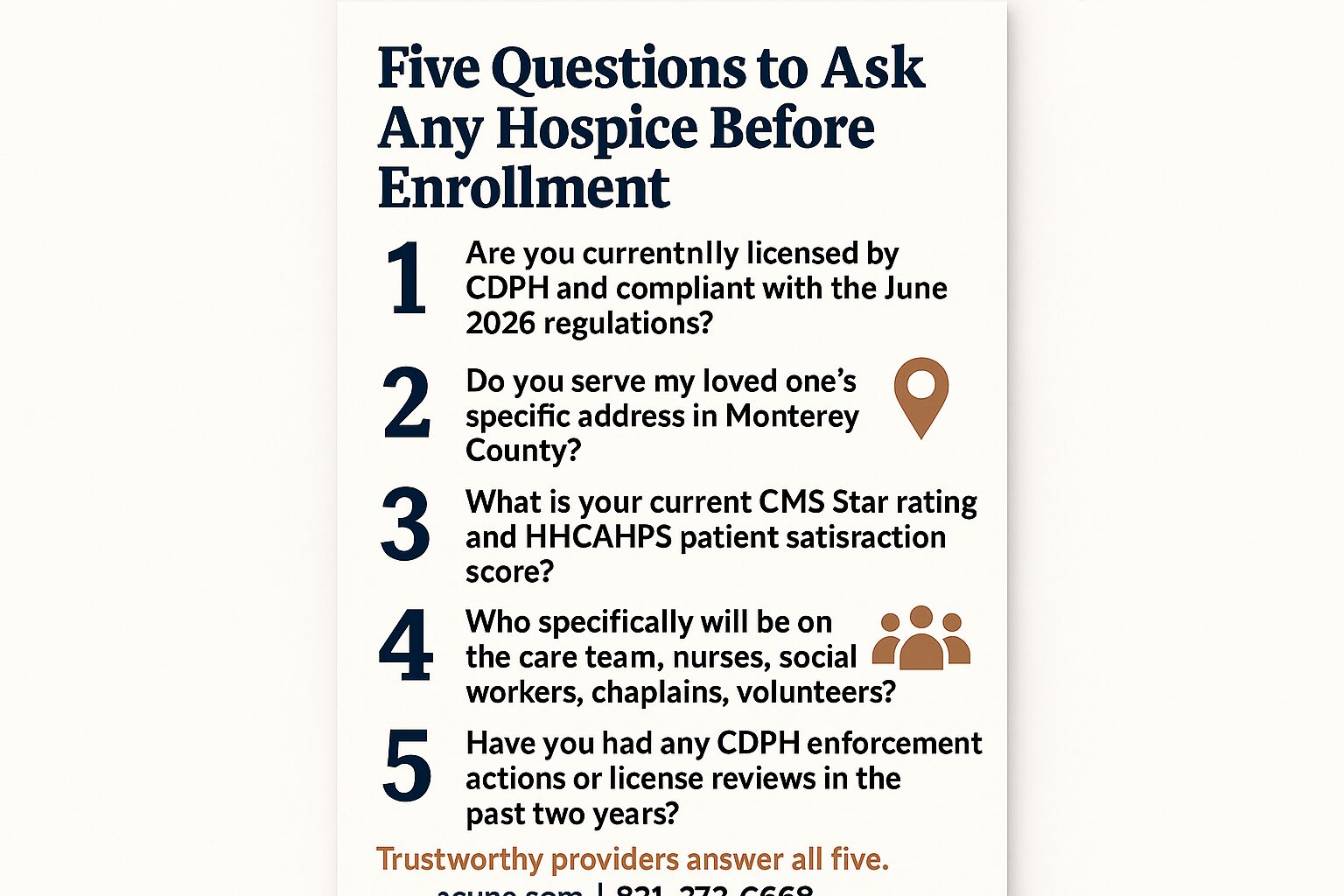
Five Questions to Ask Any Hospice Provider Before Enrollment
These five questions give families a practical checklist for evaluating a hospice before agreeing to any admission.
How to Read the Public Record on Any Hospice
Most families do not realize there is a public paper trail on every Medicare-certified hospice in the country. You do not have to take a provider’s word for how well they operate.
Here is what you can ask about or look up directly:
- CMS Star ratings, the Centers for Medicare and Medicaid Services publishes ratings on Medicare.gov for hospice providers. Ask any provider you are considering for their current Star rating.
- HHCAHPS patient satisfaction scores, these are standardized surveys completed by families after a hospice stay. A provider’s score reflects how real patients and families rated their communication, responsiveness, and emotional support.
- CDPH survey history, you can ask a hospice directly whether they have had any unannounced inspections, deficiency citations, or enforcement actions in the past two years. Under the new June 2026 regulations, that history is more relevant than ever.
- License verification, CDPH maintains a database of licensed hospice agencies. A quick check can confirm whether the agency you are speaking with is currently in good standing.
CMS is also developing a public icon system for its Medicare.gov comparison tool that will flag hospices that have not submitted required quality data. Until that feature is live, ask providers directly for their submission history.
A nonprofit organization with 75 years of continuous service in a community, a public track record, and a verified license is a materially different thing from a recently licensed agency with no local history and no public data trail. That difference is worth understanding before you commit to a provider.
For more background on what the hospice benefit actually covers and when it applies, this explanation of hospice eligibility questions families are afraid to ask is a useful starting point.
What Trustworthy Hospice Providers Can Show You
A compliant, accountable hospice should be able to answer or provide documentation for each of the items below. This is not an exhaustive legal checklist, but a practical starting point for families evaluating a provider.
| What to Ask For | What It Tells You | Red Flag If… |
|---|---|---|
| Current CDPH license number | The agency is legally authorized to operate in California | They cannot provide a number or deflect the question |
| CMS Star rating on Medicare.gov | How their quality compares to other hospices nationally | They have no published rating or refuse to share it |
| HHCAHPS patient satisfaction score | How families rate their communication and responsiveness | Scores are unavailable or the provider is unaware of the metric |
| Recent CDPH survey/inspection history | Whether they have had deficiencies or enforcement actions | They have had actions in the past 24 months they cannot explain |
| Specific coverage confirmation for your address | That they actually serve your loved one’s neighborhood | They confirm ‘Monterey County’ without specifying your area |
| Named care team roles | That a full team, including chaplains and social workers, is in place | They describe a team vaguely or cannot name specific roles |
What Real Families Say Makes a Hospice Team Worth Trusting
Marketing materials from hospice agencies tend to emphasize the same things: experience, compassion, and 24/7 availability. Those claims are worth little without a way to evaluate them.
What real families consistently describe as meaningful is different from what brochures emphasize. One reviewer described a team that explained what was happening and why, translated the parts that did not make sense, and made the path forward feel possible. Another noted staff who seem to truly care about helping others, not just showing up to complete tasks.
The pattern across real feedback is consistent. Families remember:
- Whether nurses showed up consistently and communicated proactively, not just when called
- Whether the Medical Social Worker actually helped navigate decisions rather than just handing over a pamphlet
- Whether Chaplains and Volunteers were present and genuine, not perfunctory
- Whether the team spoke clearly about what was happening medically, without hiding behind clinical language
Scheduling inconsistency is also a real concern families raise. When visits happen at unpredictable times, or when patients do not know who is coming or when, the anxiety that creates is significant. A reliable hospice team should be able to tell you, before enrollment, how visit windows are communicated and what happens when a scheduled clinician cannot make a visit.
If you are still working through whether your loved one’s situation calls for hospice or something earlier, this piece on comfort-focused care and when to ask about it may help clarify the options. And for families earlier in the process, understanding what palliative care actually means is often the right first conversation to have.
Frequently Asked Questions About Choosing a Hospice Provider in California
How do I verify that a hospice is currently licensed in California?
You can ask the provider directly for their CDPH license number and then verify it through the California Department of Public Health’s licensing database. Under the new June 2026 regulations, licensed hospices must meet specific staffing, planning, and inspection requirements. If a provider cannot give you a license number or hesitates to confirm their compliance status, that is worth taking seriously.
What is a CMS Star rating and where do I find it?
The Centers for Medicare and Medicaid Services assigns Star ratings to hospice providers based on quality measures and patient satisfaction surveys. You can look up ratings at Medicare.gov. You can also ask any provider you are considering to tell you their current rating directly. A provider that does not know their rating or cannot share their HHCAHPS patient satisfaction scores is missing a basic level of transparency.
Does Medicare cover hospice at home?
Yes. Medicare Part A covers hospice services for patients who meet eligibility requirements, which generally means a physician has certified a prognosis of six months or less if the illness follows its expected course. Medi-Cal and Veterans benefits also cover hospice in most cases. There is typically no out-of-pocket cost for covered hospice services under Medicare. For more detail on what the eligibility question actually involves, this article on hospice eligibility walks through it plainly.
What should I do if I’m not sure whether a hospice covers my area in Monterey County?
Ask directly and ask specifically. Give the provider your city, zip code, or neighborhood and ask whether they have clinicians currently serving that area. There is real confusion in this region between organizations with similar names, and assuming coverage by county rather than confirming by location has left some families without care. If you are in Salinas, Hollister, King City, or a smaller community in the area, get a specific yes before moving forward.
Is a nonprofit hospice meaningfully different from a for-profit one?
The organizational structure does matter in practice. A nonprofit hospice reinvests any surplus back into services and community programs rather than returning it to shareholders. That does not automatically make every nonprofit better than every for-profit, but it does mean the incentive structure is different. When combined with a long track record, public accountability, and a verifiable history in the community, nonprofit status is one reasonable factor to weigh.
Can I switch hospice providers if I am unhappy with the care being given?
Yes. Under Medicare, patients have the right to change hospice providers. You can discharge from one hospice and re-enroll with another. The process involves paperwork and a transition period, so it is not seamless, but it is possible. If care is falling short of what was promised or what the new CDPH regulations require, you do not have to stay. Document your concerns and speak with a Medical Social Worker or patient advocate if you need help navigating the transition.
Questions About Hospice Care in Monterey County?
Central Coast VNA & Hospice has been serving families across Monterey County, San Benito County, and surrounding communities since 1951. If you want to talk through what questions to ask, confirm whether your loved one’s address falls within the service area, or simply understand what the process looks like, a care coordinator is available to help without pressure. You can reach the team at 831-372-6668 or visit ccvna.com to learn more.