
Direct Answer: Most home health patients see a nurse one to three times a week. The exact number comes from the physician’s plan of care and shifts as the patient improves or declines.
Your mother came home from the hospital on Tuesday. Someone said a nurse would start visits this week. It is now Thursday morning, you took the day off work, and nobody has called.
That question, when is someone coming and can I get a time, is one of the most common reasons families call after care has already started. In one recent month, roughly 6 percent of calls to a Monterey County home health office came from people who were already patients and simply wanted a confirmed window. One caller put it plainly: she is already a patient, I just need to know when someone is coming.
This is an anxiety problem as much as a scheduling problem. Below is how visit frequency actually gets decided, why exact appointment times are rare in home care, and the specific things you can ask for to make the week feel predictable again.
How Often Does a Home Health Nurse Visit? The Doctor Decides, Not the Agency
Most families assume the agency picks the schedule. It does not. The physician’s plan of care spells out how many visits per week and for how long, and the agency works inside those orders.
Orders are written in plain clinical shorthand. A typical one might read as two nursing visits per week for three weeks, plus physical therapy twice a week, with a Medical Social Worker visit as needed.
Home health also runs in 60-day certification periods. Near the end of each period, the clinical team reviews progress with the physician, and care is renewed only if a skilled need still exists.
That is why the number changes over time:
- Visits often taper as a wound closes, strength returns, or medications stabilize
- A decline, a fall, or a new hospital stay can trigger more frequent visits
- Therapy may continue after nursing ends, or the reverse
- Discharge from service happens when goals are met, not on a fixed date
Medicare covers home health on a part-time or intermittent basis. According to Medicare’s home health coverage rules, that generally means fewer than eight hours a day and no more than 28 hours a week combined, with more frequent care possible for short stretches when the provider determines it is needed.
If the referral itself is still in motion, it helps to understand why a physician order comes first.

Why You Get a Window Instead of a 10 a.m. Appointment
Nobody explains this part to families, and it causes more frustration than almost anything else in home care.
A visiting clinician does not work a clinic schedule. They work a daily route. One patient found short of breath, one urgent call to a physician, one wound that turns out to be worse than expected, and every visit behind that one shifts.
Geography on the Central Coast makes the math harder. A single route can run from the Monterey Peninsula down Highway 68 to Salinas, another 60 miles south on 101 to King City, or east over to Hollister in San Benito County.
Then add the local variables that every driver here knows:
- Summer fog slowing traffic on 68 and along the coast in the morning
- Harvest truck traffic through the Salinas Valley from midsummer into fall
- Peninsula tourist season and event weekends clogging Munras and Del Monte
- Rural addresses in south county where a gate or a long driveway adds ten minutes
This is why most agencies work in arrival windows with a call ahead rather than hard appointment times. Knowing that on day one prevents a family from sitting at the window feeling forgotten.
What Visit Frequency Tends to Look Like
Every plan of care is different and only the physician can set yours. These examples show how orders are commonly structured and what moves the numbers.
| Situation | How orders are often written | What can change it |
|---|---|---|
| First weeks home after surgery | Nursing a few times a week, therapy added after evaluation | Pain control, wound status, fall risk |
| Active wound care | Nursing visits that taper as the wound closes | Signs of infection can push visits back up |
| Stable chronic condition | Fewer nursing visits focused on teaching and monitoring | A hospitalization resets the whole plan |
| Therapy-driven recovery | Physical or occupational therapy on a set weekly count for a set number of weeks | Progress toward mobility and safety goals |
| Hospice at home | A visit pattern built around symptoms and family need | Symptom changes, especially in the final weeks |
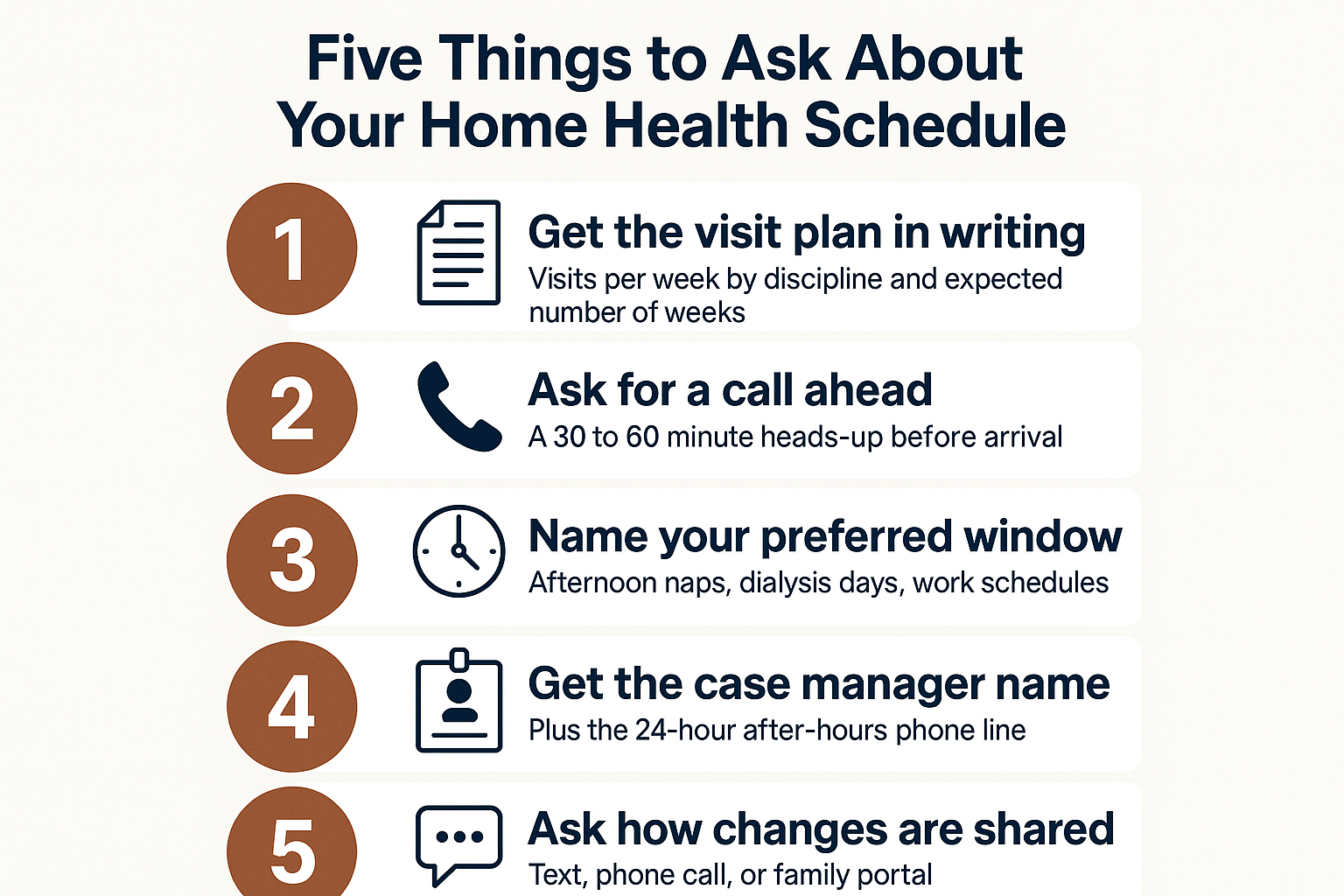
Five Things to Ask in the First Week
These five questions, asked early, remove most of the uncertainty families feel about scheduling.
Ask for These Specific Things, Not Just Reassurance
Asking someone to “keep me posted” rarely works. Asking for named, concrete items usually does.
At the start of care, request the visit plan in writing: visits per week by discipline, and the expected number of weeks. Then ask for a call ahead of 30 to 60 minutes so you are not holding an entire day open.
Name your constraints out loud. If your father naps from 1 to 3, or has dialysis every Tuesday and Thursday, say so at the first visit so the scheduler can build around it.
Two more items belong in your phone before the first week ends:
- The case manager’s name and direct line, since that person owns the schedule
- The after-hours number, which should be answered around the clock
Then ask one question that solves most of the rest: how are schedule changes communicated? Text, phone call, or a family portal. That single answer tells you where to look when a visit moves.
If you are still in the early stretch, the first 72 hours after a hospital stay set the tone for everything that follows.
When the Schedule Feels Chaotic, Say Something Early
Some families describe visits arriving unannounced, or so many different faces that nobody seems to know the patient. That is worth raising, and raising quickly.
There is a right way to do it. Bring the concern to the clinical manager or case manager, not to the clinician standing in your living room, who does not control routing.
Three specific requests tend to help:
- Ask for continuity with the same Registered Nurse or Physical Therapist where staffing allows
- Ask for the schedule to be confirmed the day before
- Ask that any unplanned change come with a phone call, not silence
Continuity matters clinically, not just emotionally. A nurse who saw your mother last week notices the swelling in her ankles that a first-time visitor would not.
In hospice, this weighs even more. An unpredictable week costs a family time it cannot get back, which is part of why understanding whether home health or hospice fits right now is worth sorting out early.
What Continuity Actually Looks Like From the Living Room
Scale is what makes a predictable schedule possible in a region this spread out. In 2025, Central Coast VNA & Hospice made more than 73,000 visits across Monterey County for over 3,800 patients, coordinated across nurses, therapists, social workers, chaplains, volunteers, and other clinicians, and holds a 4-Star Home Health rating from CMS Care Compare.
But families do not experience numbers. They experience the same person walking through the door.
One local family described it this way in a public review: “Then another nurse (Mary) came every week for a month, checked her vital signs and made suggestions that helped alleviate any discomfort that Mom had.” That same review went on to describe a Physical Therapist who came weekly for six weeks and built an exercise plan the family kept using.
Weekly. Same name. That is what continuity feels like from a living room in Pacific Grove or Prunedale, and it is a fair thing to ask for. It also helps to know what a skilled nurse actually does during a home visit, so you can tell whether a 40-minute visit was thorough or rushed.
Frequently Asked Questions About Home Health Visit Schedules
Can I get an exact appointment time for home health visits?
Usually no, and that is standard across home care rather than a sign of disorganization. Clinicians travel a daily route, so most agencies offer an arrival window plus a call ahead of 30 to 60 minutes. You can and should ask for a preferred window if your parent naps, has dialysis, or you are coordinating time off work.
How many hours a day will a nurse be at the house?
Home health visits are typically 30 to 60 minutes, not shifts. Medicare covers care on a part-time or intermittent basis, generally fewer than eight hours a day and no more than 28 hours a week combined. Families who need someone present all day are usually looking at private-duty help alongside skilled home health, which is a different service.
Why did the number of visits go down after a few weeks?
That is often a good sign. As a wound closes, balance improves, or medications stabilize, the physician adjusts the plan of care and frequency tapers toward discharge. If the reduction does not match what you are seeing at home, tell the case manager, because the plan can be revisited with the physician.
What do I do if nobody showed up and nobody called?
Call the case manager directly rather than the general line, and ask for the visit to be rescheduled with a confirmed window. Also ask, in that same call, how future changes will be communicated to you, by text or phone. That one question tends to stop the pattern from repeating.
Is the hospice visit schedule different from home health?
Yes. Hospice visits are built around symptoms and family need rather than a rehab timeline, and they change as a patient’s condition changes. Support also includes an around-the-clock phone line, plus Hospice Aides, Chaplains, Medical Social Workers, and Volunteers on top of nursing visits.
Still Have Questions About How Visits Get Scheduled?
Schedules feel less unnerving once you know who sets them and what you are allowed to ask for. Families across Monterey County, from the Peninsula to Salinas to King City, work through these same questions every week. If you would like to talk it through with a care coordinator, Central Coast VNA & Hospice can be reached at 831-372-6668 or at ccvna.com.