
When a loved one is facing a serious illness, you will hear two terms: palliative care and hospice care. They may sound similar, but they are very different. Understanding the difference is a key step for your family.
Here is the simplest way to think about it. Palliative care helps with comfort and symptom relief at any stage of a serious illness. This happens even while someone is getting treatment to cure their illness.
Hospice care is a special type of palliative care for the end of life. It is usually for someone with a life expectancy of six months or less who is no longer seeking a cure.
Understanding the Two Paths of Comfort Care
For families in Monterey County, San Benito County, Santa Cruz County, and South Santa Clara County, getting these terms right is important. It helps you make confident healthcare choices. Both paths improve quality of life, but they start at different times.

Confusing the two can cause stress. It might also prevent your loved one from getting the right support at the right time.
Palliative care is a layer of support that can start on the day of diagnosis. It works with a patient’s doctors to manage pain, side effects, and stress. Hospice is a focused type of care for when goals change from curing an illness to maximizing comfort.
At Central Coast VNA & Hospice, we have served our community for over 74 years. Our nonprofit mission is to guide families with clear, compassionate information.
Palliative Care vs. Hospice Care at a Glance
This simple table helps show the main differences. It breaks down the purpose of each service.
| Care Aspect | Palliative Care | Hospice Care |
|---|---|---|
| Timing of Care | Can begin at diagnosis, at any stage of illness. | Begins when a cure is no longer the goal, typically with a prognosis of six months or less. |
| Treatment Goals | To relieve symptoms and stress from a serious illness while you continue active treatment. | To provide comfort, dignity, and quality of life when the illness is no longer curable. |
| Curative Treatment | Provided alongside curative treatments (e.g., chemotherapy, dialysis). | Patients are no longer seeking curative treatments for their terminal illness. |
| Who Provides Care | A specialized team that works with your other doctors. | An interdisciplinary team including a Registered Nurse, Hospice Aide, Social Worker, and Chaplain. |
This comparison is often a helpful first step. For more details, our guide on "What is palliative care?" is a great resource. Central Coast VNA & Hospice is here to guide you, no matter where you are on your journey.
Comparing the Goals of Palliative and Hospice Care
Definitions are a good start. But understanding the heart behind each type of care is what really helps families. Knowing the main purpose helps you see which path fits your loved one’s wishes.
The biggest difference is not just about timing. It is about the entire philosophy of care.
Palliative Care Aims for Comfort During Treatment
Palliative care is all about improving quality of life. Its goal is to add an extra layer of support that works alongside curative treatments. The team focuses on managing difficult symptoms so patients feel stronger.
Imagine a patient in Monterey County getting chemotherapy. The treatment is needed, but it causes nausea and fatigue. This is a perfect time for palliative care at home.
A palliative care team would work with the oncologist to:
- Manage tough side effects of treatment.
- Provide emotional support to cope with stress.
- Coordinate care between all the different doctors.
In this case, the goal is not to replace treatment. It is to make treatment more tolerable. The patient keeps fighting their illness with a dedicated team focused on their comfort.
Hospice Care Aims for Peace at the End of Life
Hospice care shifts its focus to providing peace, comfort, and dignity. This happens when a cure is no longer the goal. This is not about giving up; it’s about choosing to prioritize the quality of time that is left.
For a patient in Hollister with end-stage heart failure, hospice is a great option. The Central Coast VNA & Hospice team, which includes a Registered Nurse and Hospice Aide, focuses entirely on comfort at home.
The goals of care would be:
- Expert Pain and Symptom Control: Making sure the patient is free from pain or other distressing symptoms.
- Emotional and Spiritual Support: A Social Worker and Chaplain help the patient and family find peace.
- Practical Assistance: Offering help with personal care and giving guidance to family.
The hospice mission is to ensure a person's final months are spent with dignity. The focus moves from adding more days to life to adding more life to the days that are left. Understanding these goals helps families make decisions. Contact Central Coast VNA & Hospice to learn how we align care with your goals.
Who Qualifies for Palliative and Hospice Services
Knowing who is eligible for each type of care is very important. Palliative care and hospice have different qualifications. This helps families find the right support at the right time.
Palliative care has broad eligibility. It is available to any patient at any age and at any stage of a serious illness. This could be cancer, heart failure, COPD, or dementia.
A person can start palliative care when they are diagnosed. They can get it alongside treatments like chemotherapy. The main qualifier is having a serious illness that causes symptoms and stress.
Hospice Care Has More Specific Requirements
Hospice care has more defined rules. It is for people who are nearing the final phase of their illness.
To qualify for hospice, a doctor must certify two things:
- The patient has a terminal illness. This means the condition is not curable.
- The patient likely has a prognosis of six months or less to live if the illness runs its natural course.
The six-month timeframe is a guideline, not a strict limit. Patients can be on hospice longer and be recertified if they still meet the criteria. The main decision is shifting the focus from cure to comfort. You can learn more in our guide on hospice eligibility requirements.
This chart helps show the main question that guides the choice.
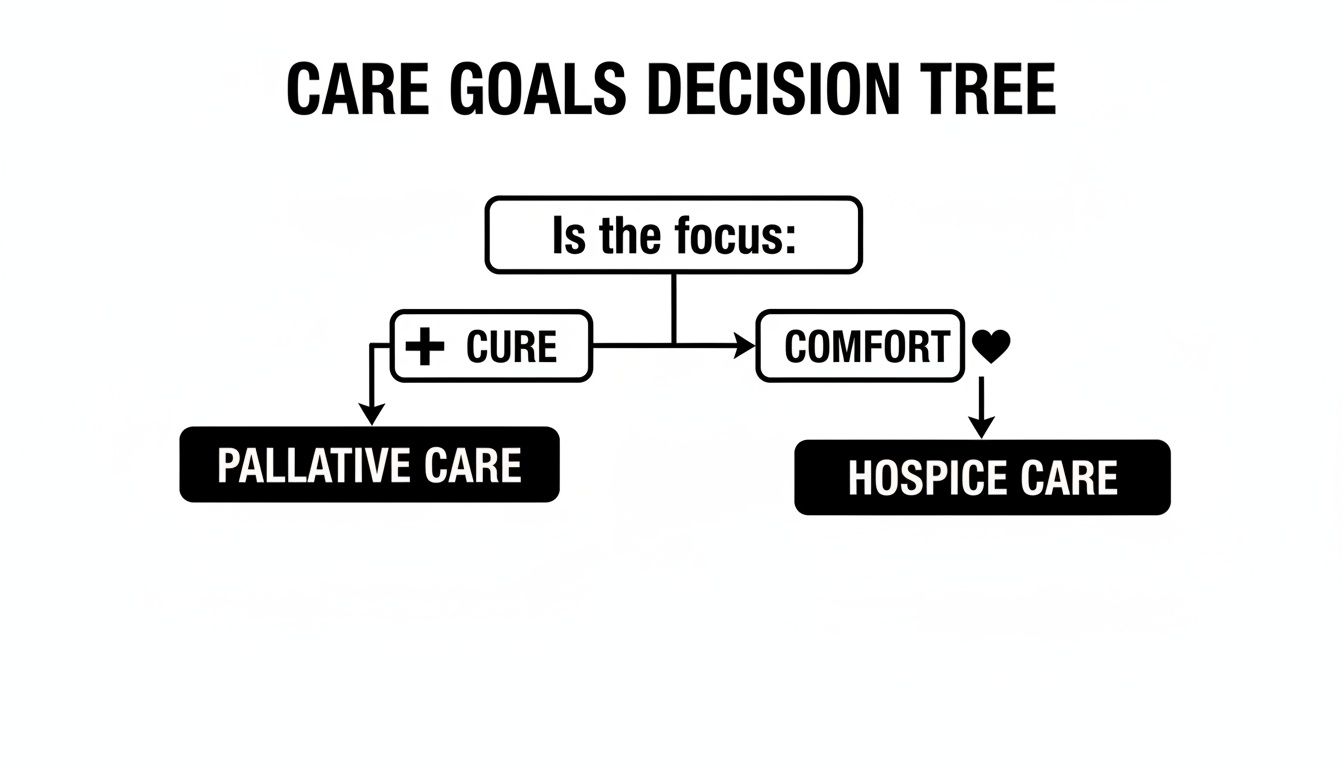
If someone is still seeking a cure, palliative care can help. If the focus is on comfort, hospice is the right path.
Choosing Quality of Life Is Not Giving Up
Many families feel the word "hospice" means giving up. We see it differently. Choosing hospice is a powerful decision to prioritize quality of life, dignity, and peace.
It’s about managing pain and having meaningful moments with loved ones at home. This choice empowers patients to live their final months on their own terms. Hope for a cure may change to hope for a peaceful day or living without pain.
Navigating these choices can feel hard, but you are not alone. Our team at Central Coast VNA & Hospice serves families across Monterey, San Benito, Santa Cruz, and South Santa Clara counties. We can walk you through the options in a compassionate, no-obligation conversation.
Comparing Services Offered By Each Care Team
When choosing between palliative care and hospice, look at the services each team provides. Both focus on comfort, but the teams are structured differently. This helps families understand which is the right fit.
Think of palliative care as an extra layer of support. The team works with your regular doctors to help manage a serious illness while you continue treatment.

Hospice care, on the other hand, provides a complete team for the patient and family. When comfort becomes the main focus, the hospice team manages everything related to the terminal illness.
The Palliative Care Team And Its Services
The palliative care team is designed to add to your medical care, not replace it. The team has special expertise in symptom control and emotional support.
Here’s what to expect from a palliative care team at home:
- Expert Symptom Management: The team is skilled at treating tough symptoms like pain, nausea, and anxiety.
- Support for Medical Decisions: Palliative care specialists help you understand treatment options and talk about your goals.
- Care Coordination: The team connects you, your family, and all your doctors to reduce stress and confusion.
With this support, patients often feel stronger and more in control. This can make it easier to continue curative treatments.
The Hospice Care Team And Its Services
When the focus shifts from cure to comfort, the hospice team offers a more complete approach. For over 74 years, Central Coast VNA & Hospice has provided this nonprofit, mission-driven care.
Our hospice team is a group of professionals who provide physical, emotional, and spiritual support. Hospice is a philosophy of care that honors the whole person. It also provides a strong support system for the family.
Services Offered by Palliative and Hospice Teams
This table compares the support you can expect from our palliative and hospice care programs.
| Service Provided | Palliative Care | Hospice Care |
|---|---|---|
| Symptom & Pain Management | Yes, core service to improve comfort during curative treatment. | Yes, primary focus of all care provided by the team. |
| Medical Decision Support | Yes, helps patients and families align treatment with personal goals. | Yes, guides conversations around end-of-life preferences and comfort. |
| Emotional & Social Support | Provided by palliative specialists and social workers as needed. | Yes, a core component delivered by a dedicated Medical Social Worker. |
| Spiritual Care | Can be arranged upon request. | Yes, a dedicated Chaplain provides non-denominational support. |
| Personal Care (Bathing) | Not typically included; focuses on medical and emotional support. | Yes, a Hospice Aide provides hands-on assistance with daily activities. |
| 24/7 On-Call Nurse | Varies; often coordinated through the primary physician's office. | Yes, a Registered Nurse is always available for urgent needs. |
| Medical Equipment & Meds | Not covered; paid through regular insurance. | Yes, all medications, supplies, and equipment related to the terminal illness are covered by the hospice benefit. |
| Bereavement Support | Not included; focuses on the patient's current care journey. | Yes, grief support is provided to the family for up to 13 months. |
As you can see, the hospice team is designed to meet the complex needs at the end of life. To learn more, read our guide on what to expect from hospice care.
How Insurance and Medicare Cover Care Costs
Money worries should not get in the way of compassionate care. For families on the Central Coast, from Salinas to Santa Cruz, understanding insurance coverage brings peace of mind. The payment for these two types of care is quite different.
Most families are relieved to find that palliative care is covered like other medical services.
How Palliative Care Is Paid For
Palliative care is usually covered by Medicare Part B, Medicaid, and most private insurance plans. It’s treated as a specialist visit, so your plan's deductibles and co-pays will likely apply.
Our team at Central Coast VNA & Hospice can help you understand your coverage. We work with your insurance provider to make sure you get this support without financial stress.
The Comprehensive Medicare Hospice Benefit
Hospice care is covered differently—and often, more completely. The Medicare Hospice Benefit is a plan that covers almost all costs related to the terminal illness. This is an important point for families.
The Medicare Hospice Benefit was designed to remove the financial burden from families at the end of life. It allows everyone to focus on comfort and quality time together.
This all-inclusive benefit covers:
- The full services of the hospice team, including the Registered Nurse, Hospice Aide, Social Worker, and Chaplain.
- All medications needed for pain and symptom management.
- Medical supplies and equipment, such as a hospital bed or oxygen.
- 24/7 on-call support for urgent needs.
For most families, this means no out-of-pocket costs for hospice care. Statistics show that in 2022, only 49.1% of Medicare decedents accessed hospice care, highlighting a need for greater awareness.
For a detailed look at this benefit, you can review our guide on how to pay for hospice care. Our team is always here to help you navigate your coverage.
Navigating Your Journey on the Continuum of Care
A serious illness is a journey with changing needs. A care plan must be flexible enough to change with the person. This is why the continuum of care is so important for families on the Central Coast.

Many families find they start at one point and move to another level of support. That process should feel smooth and reassuring.
From Home Health to Hospice with One Trusted Team
Central Coast VNA & Hospice is the only nonprofit provider in our region offering the full range of home-based care. Our unique model means your family can be supported by one familiar team through every stage. This continuity is a source of great comfort.
Here is a common journey:
-
Starting with Home Health: A person in Santa Cruz County is discharged from the hospital. Our home health team, including a skilled Registered Nurse, helps them recover safely at home.
-
Transitioning to Palliative Care: Over time, their chronic condition gets worse. They can then transition to our palliative care program for expert symptom control and support.
-
Moving to Hospice Care: Eventually, the illness reaches an advanced stage. They can then move smoothly into our hospice program with the same organization they trust.
The greatest benefit of a continuum of care is stability. Instead of searching for new providers, families have a consistent, compassionate partner who knows their story.
Seamless Support for Families in Monterey and San Benito Counties
This seamless approach prevents the stress of starting over with new healthcare teams. For families from Monterey to Hollister, this means one phone number and one trusted resource.
Whether your loved one needs recovery support or end-of-life care, our continuum ensures they get the right care at the right time. By providing home health and hospice care under one roof, we build lasting relationships based on trust.
Frequently Asked Questions About Palliative and Hospice Care
Navigating a serious illness brings many questions. You deserve clear, honest answers. We have gathered some of the most common questions to give you the clarity you need.
1. What is the main difference between palliative care and hospice?
Palliative care can be provided at any stage of a serious illness, alongside curative treatments, to manage symptoms. Hospice care is for patients with a life expectancy of six months or less who are no longer seeking a cure and want to focus on comfort.
2. Can we still see our own doctors?
Yes. With palliative care, our team works with your regular doctors. With hospice care, our hospice physician manages the terminal illness, but you can always stay in touch with your longtime doctor for support.
3. Does choosing hospice mean giving up hope?
Not at all. It means redefining hope. Hope shifts from a cure to goals like living without pain, having meaningful conversations, and enjoying quality time with family.
4. Can a patient stop hospice care?
Yes. A patient can leave hospice care at any time if their condition improves or they decide to seek curative treatment again. They can return to hospice later if they still meet the eligibility criteria.
5. Where is care provided?
Both palliative and hospice care are most often provided wherever the patient calls home. This can be a private home, assisted living facility, or nursing home. Our teams at Central Coast VNA & Hospice serve Monterey County, San Benito County, Santa Cruz County, and South Santa Clara County.
The journey of a serious illness is challenging, but you don't have to navigate it alone. With over 74 years of nonprofit service to the Central Coast, Central Coast VNA & Hospice provides a complete continuum of care—from home health to palliative to hospice—all with one compassionate, trusted team. If you are not sure what care is needed, our team will help guide you.
Contact us today to start a no-obligation conversation about what matters most to your family. Learn more about our mission and services at https://ccvna.com.