
End-of-life care planning is the process of deciding what kind of healthcare you would want if you were facing a serious illness or couldn't speak for yourself. Taking this step ahead of time makes sure your values are honored, giving both you and your loved ones peace of mind. It's a combination of personal reflection, legal documents, and honest conversations.
Why Starting the Conversation Matters

Talking about end-of-life wishes can feel difficult. However, it is a profound act of love that empowers you to guide your own medical journey. This ensures your voice is heard even when you can no longer express your wishes.
This foresight saves your family from the pressure of making urgent, difficult decisions during a crisis. Instead of guessing what you might have wanted, they can move forward with confidence, knowing they are honoring your preferences. A key reason to start this conversation is to avoid the mistake of failing to address your healthcare in your estate plan.
The Gift of Clarity and Control
Initiating these discussions gives you control over your future. It is your chance to define "quality of life," specify preferences for medical treatments, and choose a trusted person to speak for you. This clarity is a genuine gift to everyone involved.
For families in Monterey County, San Benito County, Santa Cruz County, and South Santa Clara County, this planning provides a clear path forward. It reduces the potential for family conflict and allows loved ones to focus on providing comfort and support.
By planning ahead, you transform uncertainty into a thoughtful, deliberate process. It's an opportunity to align your medical care with your personal values, ensuring your final chapter is written on your own terms.
Despite its importance, advance care planning is often overlooked. According to the National Hospice and Palliative Care Organization (NHPCO), while 90% of people say that talking with their loved ones about end-of-life care is important, only 27% have actually done so (NHPCO, 2018).
A Compassionate Partner for Your Journey
You do not have to navigate these conversations alone. For over 74 years, Central Coast VNA & Hospice has been a trusted, nonprofit partner for families on the Central Coast of California. Our mission is to provide compassionate guidance and expert care that respects each person we serve.
Our experienced team, including Social Workers and Chaplains, can help facilitate these important discussions. We support families in understanding their options, from palliative care to hospice, ensuring a smooth continuum of care. A key part of this process is understanding when to call hospice to bring in professional support at the right time.
Understanding Your Advance Directives
Advance directives are your voice when it comes to future medical decisions. These documents are a personal instruction manual for your healthcare. They ensure you remain in control, even if you cannot speak for yourself.
These documents lift the heavy burden of guessing from your family and medical team. By putting your wishes in writing, you create a roadmap that ensures your personal values guide every decision.
The Power of a Living Will
A Living Will is a written statement that details what medical treatments you would or would not want to keep you alive. It also lets you express preferences on pain management or organ donation. This document only applies if you are terminally ill or permanently unconscious.
For example, a person in Monterey County might specify in their Living Will that they do not want mechanical ventilation if they are in a permanent vegetative state. This instruction clarifies their wishes and prevents confusion among family members.
Appointing Your Healthcare Advocate
A Durable Power of Attorney for Health Care is where you name a person to be your healthcare agent (or proxy). This person is legally empowered to make medical decisions for you if you become unable to communicate. It is vital to choose someone who understands your values and can advocate for you.
Imagine a resident of Santa Cruz County has a sudden stroke and cannot speak. Her designated healthcare agent—her son—can immediately step in. He can confidently inform the medical team that his mother would want comfort-focused care, just as they had discussed.
This appointed advocate becomes your voice, ensuring the care you receive aligns with your preferences. It transforms a crisis into a moment of clarity, guided by your expressed wishes.
Creating these documents is an empowering process that starts with reflection. It involves thinking about what you want and choosing the right person to speak for you.
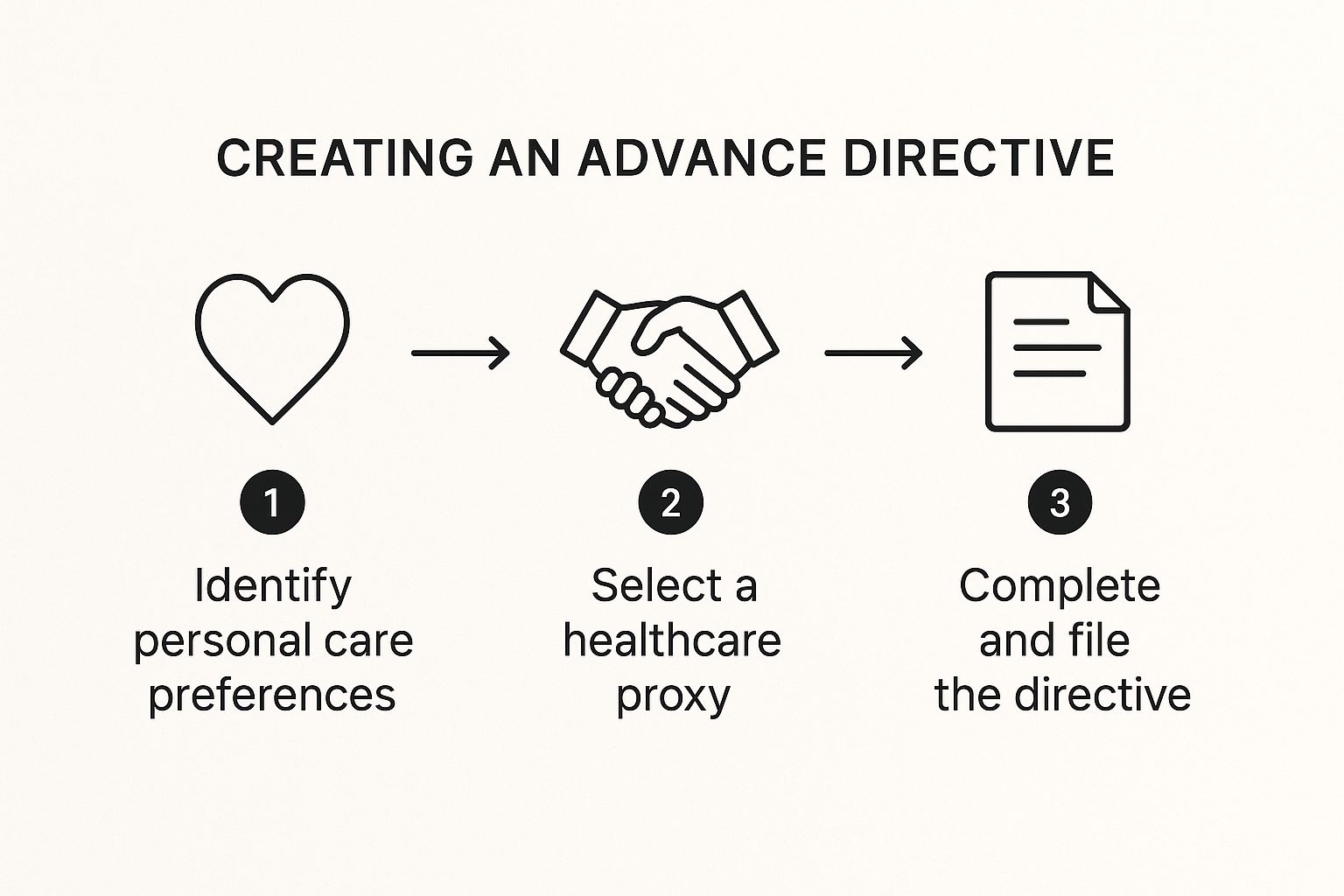
Key Advance Directive Documents Explained
To make things clearer, let's break down the most common documents. Each has a distinct role in protecting your healthcare wishes.
| Document Type | Primary Purpose | Key Decision Area |
|---|---|---|
| Living Will | To state your wishes for end-of-life medical treatment. | Use or withholding of life-sustaining procedures (e.g., ventilators, feeding tubes). |
| Durable Power of Attorney for Health Care | To appoint a person (agent/proxy) to make medical decisions for you. | All healthcare decisions, if you're unable to make them yourself. |
| Do Not Resuscitate (DNR) Order | To instruct medical professionals not to perform CPR if your heart or breathing stops. | Cardiopulmonary Resuscitation (CPR) in an emergency medical situation. |
These documents work together to create a comprehensive plan. They ensure your voice is heard, from broad decisions to specific medical orders.
Clarifying Life-Sustaining Treatment with a DNR
A Do Not Resuscitate (DNR) order is a specific medical order written by a doctor. It instructs healthcare providers not to perform cardiopulmonary resuscitation (CPR) if breathing or heartbeat stops. It is different from a Living Will because it is a direct medical order for a specific emergency.
A DNR is often chosen by individuals with a terminal illness who feel CPR does not align with their quality-of-life goals. A patient receiving hospice care at home in San Benito County might have a DNR in place. This ensures their wishes are respected. You can learn more in our three common advance directives guide.
Completing these documents brings incredible peace of mind. Here are a few tips:
- Use State-Specific Forms: California has an official Advance Health Care Directive form that is legally recognized.
- Share Copies Widely: Give copies to your healthcare agent, your doctor, and your local hospital.
- Review and Update: Look over your directives every few years or after a major event like a new diagnosis or marriage.
Taking these steps puts your healthcare future firmly in your hands. At Central Coast VNA & Hospice, our team has helped guide families through these decisions for over 74 years, reinforcing our nonprofit mission.
Choosing Your Healthcare Agent Wisely

Choosing a healthcare agent is one of the most critical steps in end-of-life planning. This person becomes your voice if you cannot speak for yourself. They are your advocate and decision-maker.
This role demands a deep understanding of your values and the strength to stand up for them. The real question is whether this person can champion your wishes during an emotional, high-stakes situation.
Qualities of an Effective Healthcare Agent
The ideal person for this role is someone who is able to handle the responsibility. You are choosing the most capable advocate for your care.
Think about who in your life fits these qualities:
- Assertiveness: Can they speak confidently to doctors and family, even if others disagree?
- Emotional Strength: Can they stay level-headed and focused during a crisis?
- Respect for Your Wishes: Will they honor your choices, even if they don't personally agree with them?
- Geographic Proximity: Having an agent who lives nearby in areas like Monterey County or Santa Cruz County can make a real difference.
Choosing a healthcare agent is an act of profound trust. You are entrusting them with your autonomy and dignity.
Once you have someone in mind, it is time to have a conversation. This is not a responsibility you can assign without their full consent.
Initiating the Conversation with Your Potential Agent
Asking someone to be your healthcare agent deserves a real conversation. Find a quiet, comfortable time where you will not be interrupted.
You can start by saying, "I'm working on my advance care planning, and it's really important to me that my wishes are respected. I was hoping you would consider being the person who speaks for me if I can't." This conversation is your chance to share what matters to you.
Here are a few things you should cover:
- Your Values: Talk about what gives your life meaning, such as independence or being with family.
- Specific Scenarios: Discuss your feelings on life-sustaining treatments like ventilators or feeding tubes.
- Care Philosophy: Share your thoughts on comfort-focused care. Learning what hospice care is together can be a great way to align.
Finally, always name an alternate agent in your advance directive. As a nonprofit serving the Central Coast for over 74 years, Central Coast VNA & Hospice emphasizes these careful steps.
Defining Your Personal Care Preferences
Your advance directives are the legal bedrock of your end-of-life planning. However, the best plans go beyond medical treatments to define what a good day looks like for you. This is where you can spell out the personal details that make life feel worthwhile.
This reflection ensures your quality of life is honored in every way possible. It transforms a clinical document into a deeply personal guide for everyone involved in your care.
Looking Beyond Medical Decisions
While legal paperwork outlines treatments, your personal preferences add humanity to the plan. These details guide your family and care team in creating an environment that feels comforting and uniquely yours. A personal letter or "values statement" attached to your directives can be a powerful tool for your healthcare agent.
"What matters most to you is the heart of your care plan. It’s about ensuring that your final chapter is filled with dignity, respect, and the personal touches that bring you joy and peace."
Creating a Comfort-Focused Environment
Think about the setting where you would feel most at ease. Many people prefer to be at home, and Central Coast VNA & Hospice can provide expert medical care right in your home. Our services are available across Monterey, San Benito, Santa Cruz, and South Santa Clara counties.
To start defining your ideal environment, consider these elements:
- Your Surroundings: Do you find peace in a quiet room, or do you prefer the gentle background noise of family life?
- Atmosphere and Sensory Details: Think about what soothes you, such as specific music or the feel of a particular blanket.
- Social Connections: Specify who you would like to visit and how often to conserve your energy.
It is also worth exploring comfort-focused therapies. For many, something like an Oncology Massage can be a vital part of their well-being.
Incorporating Spiritual and Emotional Needs
Your spiritual and emotional well-being are just as important as your physical comfort. A comprehensive plan should make space for your beliefs and practices. A CCVNA Chaplain can provide invaluable, non-denominational support to you and your family.
What brings you emotional and spiritual peace? It might include:
- Visits from a spiritual leader or a CCVNA Chaplain.
- Quiet time for prayer or meditation.
- Reading specific texts or listening to spiritual music.
- Having meaningful final conversations with loved ones.
As awareness grows, so does the demand for specialized support. The global palliative care market is projected to reach $265 billion by 2031, reflecting a deeper understanding of patient needs (iHealthcareAnalyst, 2023). You can learn more about these trends in palliative care. By capturing these preferences, you ensure your care team supports your whole self.
Navigating Your Care on the Central Coast

An end-of-life care plan connects you to the right care at the right time. For families in Monterey County, San Benito County, Santa Cruz County, and South Santa Clara County, this plan is a roadmap. It is a guide our teams at Central Coast VNA & Hospice can follow.
A well-defined plan is the bridge between your wishes and the practical support you receive. It empowers you to move through different stages of care at home. This is the continuum of care, and it is the heart of our nonprofit mission.
The Continuum of Care Explained
Your healthcare needs can change over time. Our services are designed to meet you where you are, providing a trusted presence from a single, local organization. As your community partner with over 74 years of service, CCVNA is the only provider on the Central Coast offering this complete spectrum of in-home care.
- Home Health Care: After a hospital stay, your plan might call for skilled nursing and therapy at home. Our Registered Nurses and therapists help you recover and regain strength.
- Palliative Care: While living with a serious illness, you may need to manage symptoms and improve quality of life. Palliative care can be provided alongside curative treatments.
- Hospice Care: When comfort becomes the primary goal, your plan guides the transition to hospice. Our team provides expert pain management and emotional support to ensure your final months are lived with dignity.
Your Dedicated Care Team
Putting your plan into action requires a team of dedicated professionals. At CCVNA, our mission-driven experts work together to honor your choices.
A thoughtful plan does more than state your wishes; it activates a team of compassionate experts who are committed to delivering the exact care you envisioned, right where you want to be—at home.
Our interdisciplinary team includes a range of specialists:
- Registered Nurses manage medical care and symptoms.
- Hospice Aides assist with personal care to maintain comfort and dignity.
- Social Workers provide emotional support and connect you to community resources.
- Chaplains offer non-denominational spiritual guidance.
This team-based approach ensures every aspect of your well-being is supported. You can learn more about how our home health care services can support you.
Integrating these services remains a global challenge. A 2017 assessment revealed that only about 8.5% of countries had fully integrated palliative care services (The Actuary, 2017). You can explore more about this global perspective on end-of-life care. By planning ahead, you ensure access to the compassionate care you deserve.
Frequently Asked Questions (FAQs)
1. When is the right time to start end-of-life care planning?
The best time to start is now, while you are healthy and can think clearly. Planning is not just for those with a serious diagnosis. Having your wishes documented relieves loved ones from making tough decisions during a crisis.
2. What is the difference between palliative care and hospice care?
Palliative care can begin at any stage of a serious illness and be received alongside curative treatments to improve quality of life. Hospice care is a specific type of palliative care for people with a life expectancy of six months or less, when comfort is the primary goal.
3. Do I need a lawyer to complete my advance directives?
In California, you typically do not need a lawyer for standard forms like the Advance Health Care Directive, as long as they are properly signed and witnessed. However, if your situation is complex, consulting an attorney can provide extra security.
4. Can I change my mind after I complete my plan?
Yes. Your plan is a living document that you can change or revoke at any time, as long as you are of sound mind. It is a good idea to review your documents after any major life event, such as a new diagnosis or marriage.
5. How can Central Coast VNA & Hospice help with planning?
As a nonprofit with over 74 years of local service, our expert teams can guide these sensitive conversations. Our Social Workers and Chaplains can help you understand care options, discuss your goals, and connect you with resources to complete your advance directives.
6. Who should have copies of my advance directives?
You should provide copies to your designated healthcare agent, your alternate agent, your primary care physician, and any other specialists you see regularly. It is also wise to give a copy to your local hospital to keep on file.
7. What if my family disagrees with my choices?
A legally completed advance directive is a clear statement of your wishes that should be honored. Choosing a strong healthcare agent who is willing to advocate for your decisions is the best way to ensure your plan is followed, even if others disagree.
At Central Coast VNA & Hospice, our mission is to provide compassionate, expert care that honors your wishes every step of the way. If you have more questions or are ready to begin your planning journey, we are here to help. Contact us today to learn more about our services at https://ccvna.com.