
Yes, you can. It is not only possible to get skilled nursing care without moving your parent into a facility—it is often the best choice for their health and happiness.
This means licensed medical professionals can provide vital services like wound care, medication management, and physical therapy. They deliver this care right in the comfort and safety of your parent's home.
Understanding At-Home Skilled Nursing Options
The conversation about moving a loved one into a nursing home is one of the toughest a family can face. It is filled with worries about their independence, comfort, and quality of care. Families often ask about alternatives when they feel a loved one isn't getting enough attention in a facility or want to avoid placement altogether.
But here is the good news: that move is often not necessary. The belief that "skilled care" can only happen in a facility is a common misstep. In reality, services from licensed professionals can be provided at home.
Skilled Nursing at Home vs. a Nursing Facility
To help you see the differences more clearly, let's break down what each option looks like.
| Feature | Skilled Care at Home | Nursing Home Facility |
|---|---|---|
| Environment | The patient's own comfortable and familiar home. | A clinical, institutional setting with multiple residents. |
| Care Team | A dedicated team of visiting Registered Nurses and therapists. | Rotating shifts of staff members serving many residents. |
| Independence | Promotes maximum independence and personal routine. | Structured schedules for meals, activities, and care. |
| Family Involvement | Family can be present and actively involved in daily care. | Restricted visiting hours and less direct involvement. |
| Cost | Often more cost-effective; may be covered by Medicare. | Can be very expensive, often requiring private pay. |
| Infection Risk | Lower risk of exposure to infections. | Higher risk of exposure due to a communal environment. |
As you can see, the benefits of staying home go far beyond comfort. They often lead to better health outcomes and greater peace of mind for everyone.
Rethinking Where Skilled Medical Care Happens
For many families, hearing that a parent needs advanced medical support brings an immediate, stressful thought: a nursing home. It can feel like an impossible choice between their safety and their desire to stay home.
But the reality is more flexible and hopeful than most people realize. The majority of seniors are aging at home. In fact, only 1% of seniors aged 65-74 and just 8% of those 85 and older live in nursing homes.
The term "skilled care" refers to medical services that must be performed by a licensed health professional, like a Registered Nurse or therapist. It's about who performs the care, not where it happens. Services like wound care, medication management, and rehab therapies can all be done at home.
What Skilled Nursing at Home Really Looks Like
When a doctor orders skilled nursing care at home, it involves specific, complex medical tasks. These can only be handled by a Registered Nurse (RN) or Licensed Vocational Nurse (LVN).
These trained professionals bring their clinical expertise directly to your parent. They are a part of Central Coast VNA & Hospice, a nonprofit, mission-driven provider serving the Central Coast for over 74 years.
For families here in Monterey and Hollister, this means a licensed nurse from Central Coast VNA & Hospice visits to:
- Manage IV Therapy: Administering intravenous medications or fluids is a delicate task that requires precise medical knowledge.
- Provide Complex Wound Care: Changing dressings on surgical wounds or treating pressure sores is crucial for preventing infection.
- Administer Injections: Giving necessary shots for conditions like diabetes or for pain management requires correct dosage and technique.
- Monitor Vital Signs: After a hospitalization, a Registered Nurse checks blood pressure and oxygen levels to track stability and catch issues early.
These duties are just a small sample of the professional support that defines skilled home health.
Patient and Family Education: A Core Part of the Service
Beyond hands-on medical tasks, a huge part of in-home skilled nursing is education. A visiting Registered Nurse from Central Coast VNA & Hospice does more than just treat a condition. They empower your parent and your family to manage it with confidence.
This educational role is vital for long-term health and independence. Think about real-world situations like:
- Teaching a patient how to check their blood sugar and safely administer their own insulin.
- Showing the family how to operate new medical equipment, like an oxygen concentrator.
- Explaining medication schedules, potential side effects, and why each prescription is important.
- Providing practical guidance on diet and exercise to help manage chronic conditions.
This level of professional support builds competence and reduces the anxiety that comes with managing a health condition. The goal is to create a support system that enables your parent to thrive at home.
How to Arrange Skilled Nursing Care at Home
Figuring out how to arrange skilled nursing care at home can feel like a maze, but it usually starts with a single step. The journey often begins with a conversation with a doctor.
The most important piece of the puzzle is a physician's order. Your parent's doctor must certify that the care is medically necessary.
Starting the Conversation with a Doctor
You do not have to wait for a hospital discharge planner to bring up home health care. Being proactive is one of the best things you can do.
Ask for a home health evaluation. If your loved one is homebound and recovering from surgery or managing a chronic illness, in-home skilled nursing may be covered by Medicare or health insurance. You don’t need to wait for a hospital to refer you.
A home health evaluation is a detailed assessment by a qualified clinician. A Registered Nurse will typically:
- Review Medical History: They’ll look at diagnoses, recent hospital stays, and all current medications.
- Assess Physical and Functional Needs: This involves checking mobility, strength, and ability to perform daily tasks.
- Evaluate the Home Environment: The Registered Nurse checks for safety risks and suggests helpful modifications.
- Discuss Goals: They'll talk with you and your parent about what everyone hopes to achieve with in-home care.
Gathering the Necessary Documents
To make everything go smoothly, it helps to have key information ready. When you work with an agency like Central Coast VNA & Hospice, these details speed up the intake process.
This infographic shows some of the core medical tasks that our skilled nursing staff can perform in your parent's home.
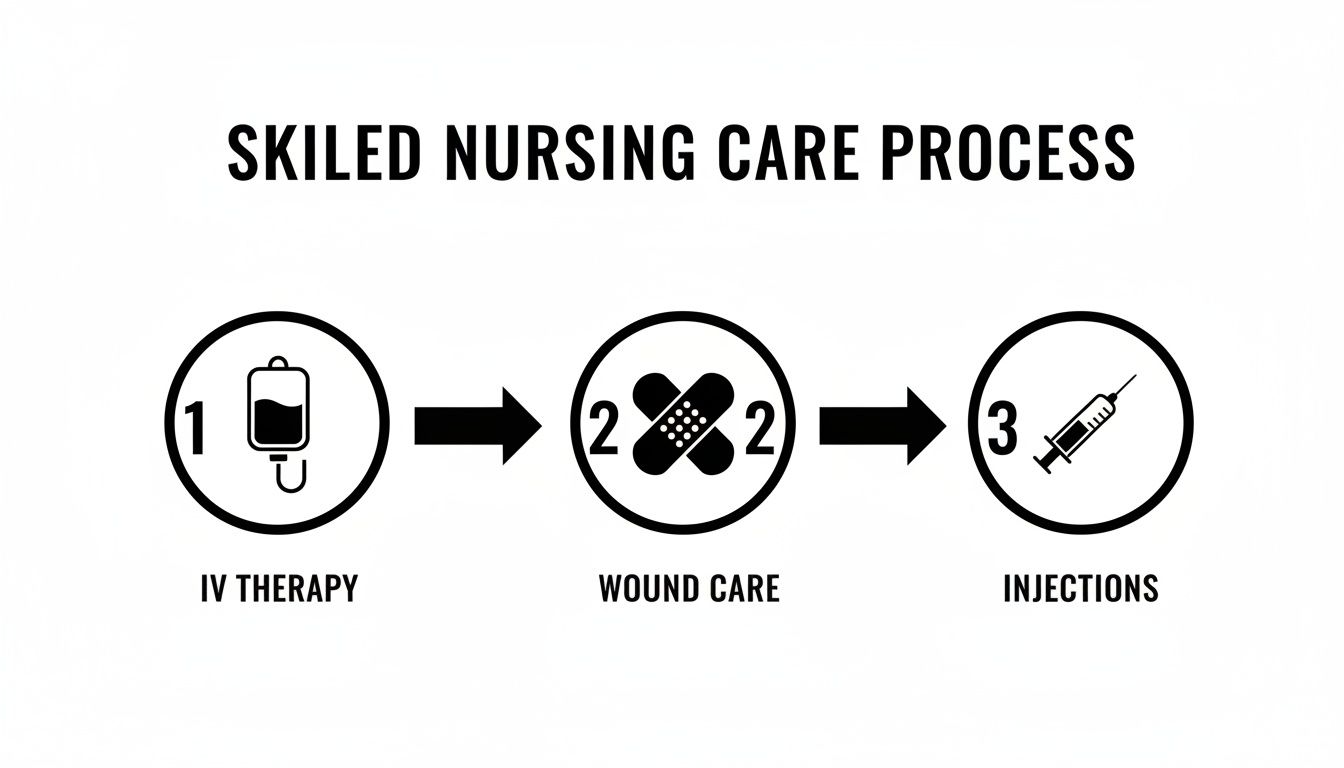
As you can see, services like IV therapy and wound care are managed safely at home by licensed professionals.
Try to have the following ready to go:
- Insurance Information: This includes Medicare, Medi-Cal, or private insurance cards.
- Physician’s Contact Information: The name and phone number of the doctor who ordered the care.
- List of Medications: A complete list of all prescriptions, over-the-counter drugs, and supplements.
- Medical History Summary: Key dates for surgeries or major health events are very useful.
Having this paperwork organized makes the first consultation more efficient. It allows the home health agency to verify benefits and start coordinating a plan of care. For more information, see our guide on qualifying for home health care in our guide.
Why Staying Home Is Often the Healthier Choice
The decision about skilled medical support goes beyond clinical care—it is about a parent's whole well-being. Many families find that bringing skilled nursing care into the home leads to better health outcomes. Data supports this, showing advantages when a loved one can recover in a familiar environment.
The comfort of being at home cannot be overstated. Surrounded by personal belongings and daily routines, a parent feels more secure and less anxious.
This sense of normalcy is a powerful part of healing. It reduces the stress that often comes with a stay in an unfamiliar facility. This familiar environment actively contributes to a more positive outlook, which can speed up recovery.
The Power of Consistent, Personal Care
This positive atmosphere translates into real clinical success. One study found home health care led to a 34% drop in hospital readmissions. This is a critical sign of effective, well-managed recovery.
One of the biggest wins for in-home skilled nursing is the consistency of the care team. Your parent can build a relationship with a dedicated group of professionals from a provider like Central Coast VNA & Hospice.
When a Registered Nurse from CCVNA visits, they know your parent’s history and what is "normal" for them. This continuity builds trust and ensures that subtle changes in health are caught right away. It's a level of personal attention that is tough to match in a facility.
Higher Satisfaction and Superior Outcomes
The numbers speak for themselves. Patients who receive skilled care at home often report higher satisfaction. They also tend to have better outcomes than those in institutional settings.
This is the model of care that Central Coast VNA & Hospice is built on. We have been serving California's Central Coast for over 74 years, delivering patient-centered care. For families in Monterey County, San Benito County, and Santa Cruz County, choosing skilled nursing at home means choosing excellent medical oversight and profound personal comfort.
You can read our detailed article about why it’s often safer to age at home instead of a nursing home.
How Central Coast VNA & Hospice Supports Your Family
Navigating the healthcare system for a parent is tough. But you do not have to go through it alone. For over 74 years, Central Coast VNA & Hospice has been a trusted, nonprofit partner for families on the Central Coast.
Our mission is to provide compassionate, top-tier medical care that honors your loved one’s wish to stay home. So when you ask, "Can I get skilled nursing care without moving my parent?" our answer is a confident yes. We are deeply rooted in the communities we serve, from Salinas to Santa Cruz.
A Collaborative Approach to In-Home Care
Effective in-home skilled nursing is a partnership. It is a collaboration between your family, your parent’s doctor, and our clinical team.
Central Coast VNA & Hospice provides skilled nursing care at home through licensed Registered Nurses (RNs), Licensed Vocational Nurses (LVNs), and therapists. Our team works with your physician to create a plan that meets medical needs while keeping your loved one comfortable and safe at home.
This teamwork is vital. It guarantees that every treatment is perfectly aligned with the doctor’s orders and your parent’s health goals.
Our Dedicated Team and Service Areas
This compassionate model is brought to life by our team of seasoned professionals. Every person on our team is committed to treating your loved one with dignity and respect.
We are proud to serve families across four counties. Our Continuum of Care progresses from home health to palliative and hospice care.
Our primary service areas include:
- Monterey County, including Salinas and the Monterey Peninsula.
- San Benito County, including Hollister.
- Santa Cruz County, including Santa Cruz and Watsonville.
- South Santa Clara County.
If your parent lives in one of these communities, our team is ready to help. Learn more about how CCVNA impacts lives across the Central Coast.
The decision to bring skilled care into the home is a powerful one. Our nonprofit mission is to make that choice a successful one for your family. Serving local families in Monterey, Hollister, Santa Cruz, and Salinas, CCVNA helps avoid facility placement when possible.
Is skilled nursing care at home the right fit for your situation? Call (831) 372-6668 to find out if it's the right fit for your situation. Contact us today to learn more about our services.
Frequently Asked Questions About In-Home Skilled Nursing Care
Here are answers to some of the most common questions we hear from families.
1. What is the difference between skilled nursing care and personal care?
Skilled nursing care is medical care that must be performed by a licensed nurse, such as a Registered Nurse (RN). It requires a doctor's order and includes services like IV therapy, injections, and complex wound care.
Personal care involves non-medical help with daily activities like bathing, dressing, and meal preparation. These tasks are typically handled by a home health aide.
2. How is in-home skilled nursing care paid for?
For patients who meet the requirements, Medicare Part A or Part B often covers 100% of the cost for intermittent skilled nursing at home. This includes visits from a Registered Nurse and physical or occupational therapy.
Other payment options include private health insurance, Medi-Cal, VA benefits, or private pay. Our team at Central Coast VNA & Hospice helps families in Monterey and Santa Cruz counties understand their coverage.
3. What does "homebound" mean for Medicare purposes?
"Homebound" is a Medicare term that causes confusion. It does not mean your parent is confined to their bed.
A person is considered homebound if leaving the house takes a considerable and taxing effort. They can still leave for medical appointments and short, infrequent non-medical trips. A doctor must certify that a patient is homebound for Medicare to cover home health services.
4. How often will a Registered Nurse visit my parent?
The frequency of visits is based on your parent’s medical needs, as outlined in the physician-ordered plan of care. A patient recovering from surgery might need daily visits at first. Someone with a chronic condition might only need a visit a few times a week.
The plan of care is flexible. Our clinical team communicates with the doctor to adjust the visit schedule as your parent's condition changes. Learn more in our guide on Medicare skilled nursing coverage.
5. Can we choose our own home health agency?
Yes, absolutely. Federal law guarantees you the right to choose which Medicare-certified agency provides your parent's care.
A hospital or doctor's office may provide a list, but the final decision is yours. Choosing an agency with deep local roots and a strong reputation, like Central Coast VNA & Hospice, helps ensure your parent receives the dedicated support they deserve.
At Central Coast VNA & Hospice, we have been the trusted choice for families on the Central Coast for over 74 years. If you believe your parent could benefit from skilled nursing care at home, contact us today to learn how we can support you. Visit us at https://ccvna.com to get started.