
Direct Answer: Not by itself. Hospice eligibility rests on a physician certifying an illness is likely to end life within about six months. Severe pain is still a good reason to call and ask.
The medication works for a few hours, then it stops working. By late evening your mother is crying, you are standing in the kitchen with the car keys in your hand, and you are wondering whether another trip to the emergency room is really the answer. Somewhere in that night, you type the question into your phone.
Families across Monterey County ask us a version of this all the time, usually in those exact words: can pain that cannot be brought under control make someone eligible for hospice? The honest answer is that pain level by itself is not the test. Hospice eligibility rests on a physician certifying that an illness, if it runs its normal course, is expected to end life within about six months.
But here is the part that matters more. Pain is a good reason to make the call even when it is not, on its own, a reason to qualify. Nobody gets turned away for asking at the wrong moment, and the conversation usually opens doors a family did not know were there.
Does Uncontrolled Pain Qualify for Hospice on Its Own?
No. Under Medicare, hospice coverage begins when a physician certifies a prognosis of roughly six months or less if the illness follows its expected path. That is the gate. Symptom severity is part of the clinical picture, but it is not the measure.
So why does the question come up so often? Because uncontrolled pain is usually the first thing a family actually notices. The decline that does make someone eligible is quieter and slower, and it often shows up alongside the pain rather than instead of it.
Medicare’s own guidance is more flexible than most families expect. The local coverage determination for hospice eligibility notes that a patient who does not neatly fit a published disease-specific guideline can still be covered when the clinical documentation supports the prognosis. In plain terms, there is room for judgment.
A few things that commonly sit alongside severe pain and do point toward eligibility:
- Repeat hospital stays or emergency visits over a short stretch of months
- Steady weight loss, or eating and drinking far less than before
- Less time out of bed, more time sleeping, less interest in things that used to matter
- A treating physician who has started using words like “we are running out of options”
If you are asking about a parent with memory loss, hospice criteria for dementia works a little differently and is worth reading on its own.

Two Questions Families Blur Together
Picture this at a kitchen table. There are really two separate questions sitting in front of you, and they get tangled together because both of them hurt.
The first question is how bad the symptoms are right now. The second is what the underlying illness is expected to do over the next several months. They are not the same, and one does not predict the other.
A person can live in severe pain for years with a condition that is not going to end their life. Spinal problems, neuropathy, advanced arthritis, old injuries. The suffering is real and it deserves attention, but the illness is not on a six-month path.
And the reverse happens just as often. Someone can be close to the end of life with very little pain at all, slipping away quietly while the family keeps waiting for a dramatic sign that never arrives.
When you call anybody about care, it helps to say both parts out loud: what today looks like, and what the doctor has said about where this is heading. Those two sentences will get you a far more useful answer than either one alone.
What the Situation at Home Actually Tells You
Here is how four common scenarios usually sort out. None of this replaces a physician’s judgment, but it helps you aim the conversation.
| What you are seeing at home | Does it answer the hospice question? | Usual next step |
|---|---|---|
| Severe pain from a long-term condition, otherwise stable | No. Pain is real but the prognosis is not the issue | Ask the treating physician about a revised pain plan or in-home symptom support |
| Severe pain plus weight loss and repeat hospital visits | Possibly. These often travel together | Ask the physician directly whether a hospice evaluation makes sense |
| Little pain, but steep decline in strength, eating, and alertness | Possibly, even without pain | Same conversation. Decline matters more than discomfort |
| Pain that spikes at night and forces ER trips | Not on its own, but it is a flag worth raising | Bring a written record to the next appointment |
What to Write Down Before You Call the Doctor
Underneath the eligibility question is a simpler worry: nobody is fixing the pain. That part you can start working on tonight, with a pen and a sheet of paper on the counter.
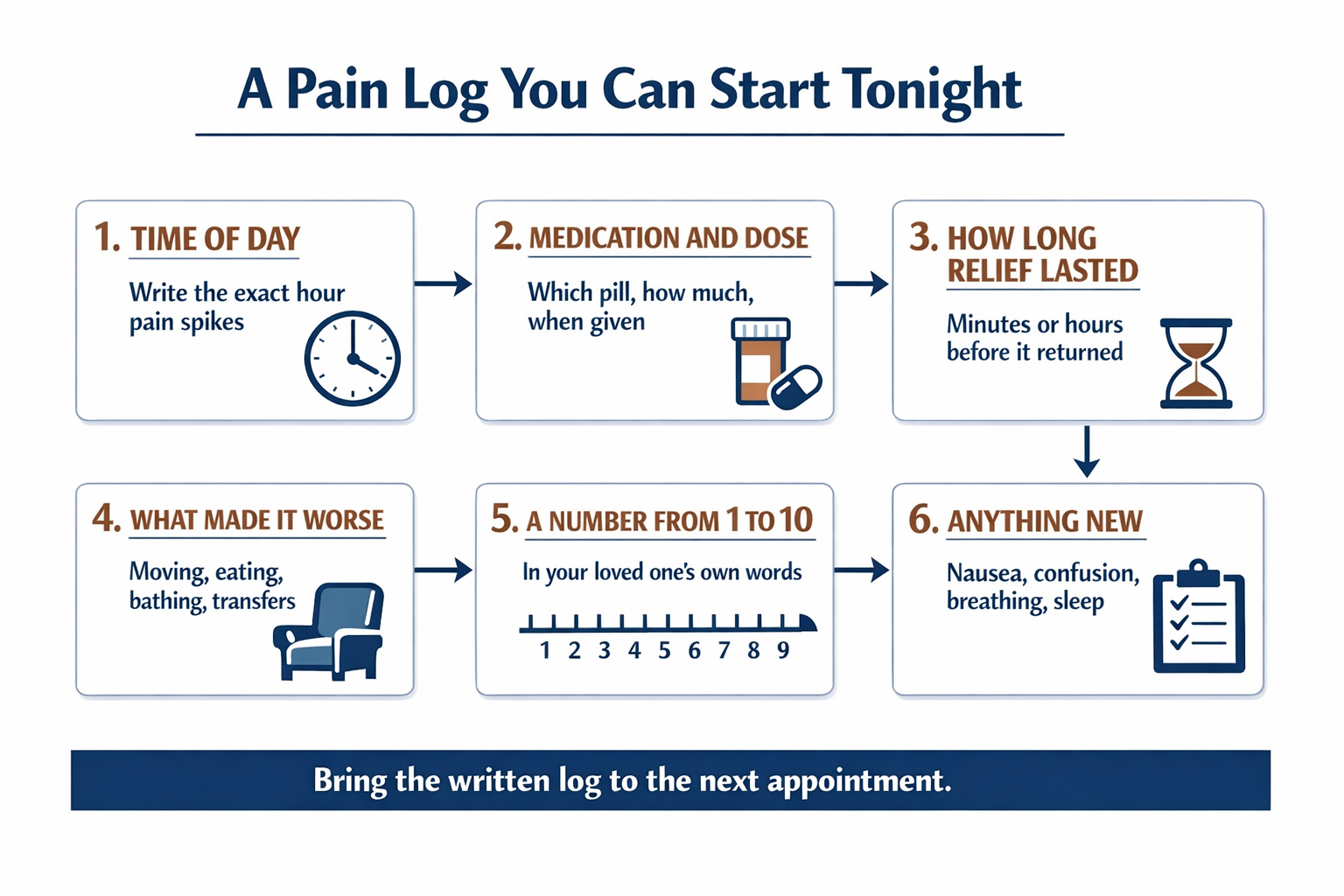
A physician cannot change a pain plan on the phrase “he is in a lot of pain.” What moves an appointment is a specific record. Write down, for three or four days:
- When the pain spikes, with the actual time of day or night
- Which medication, at which dose, and when it was given
- How long relief lasted before the pain came back
- What made it worse: moving, eating, bathing, being transferred to a chair
- A number from 1 to 10, in your loved one’s own words if they can give it
- Anything new: nausea, confusion, shortness of breath, not sleeping
Four days of handwriting will tell a doctor more than an hour of conversation. It shows patterns, and patterns are what prompt a change in dose, timing, or medication.
One family member who went through home health with her 91 year old mother in Monterey described a nurse who came weekly, checked vital signs, and “made suggestions that helped alleviate any discomfort that Mom had.” That kind of adjustment usually starts with somebody writing things down.
A Pain Log You Can Start Tonight
Six things to track in the days before the appointment. A short written record changes a doctor’s visit more than a description ever does.
When the Answer Is “Not Yet”
Hearing “not yet” from a hospice conversation does not mean hearing “nothing.” This is the part most families have no idea exists, and it is the reason the call is worth making even when you suspect it is early.
If the pain is severe but the illness is not at that stage, there are still home-based options:
- Skilled nursing visits for medication management, with a Registered Nurse or Licensed Vocational Nurse watching how a pain plan is actually working day to day
- Physician-directed symptom support at home, which focuses on quality of life while treatment continues
- Coordination back to the treating doctor, so changes get reported instead of waiting for the next appointment
- Physical and occupational therapy when pain is tied to movement, transfers, or weakness
All of that is delivered where the patient already is, which matters more than it sounds. Hospital-affiliated programs in this area often run symptom support through a clinic visit, or require that you already be their patient.
One thing worth knowing: skilled home health requires a physician referral, and it is intermittent clinical care, usually a visit of an hour or less once or twice a week. It is not someone staying in the house all day. Families looking for cooking, bathing, and companion help are looking at private non-medical home care, which is generally paid out of pocket and can run into the thousands per month depending on hours. Ask any agency for their current rates directly.
More families start support earlier than they expect. Our piece on when hospice starts earlier than most families expect covers that pattern in detail.
Why Distance Changes This Question in South County
A pain crisis at 11 p.m. in King City or Greenfield is not the same problem it is in Pacific Grove. It is a long drive up the valley to a hospital, and an emergency room visit that solves the night but not the week.
Families out toward Soledad, Gonzales, and Hollister feel that more sharply than families on the Peninsula. Managing pain at home is partly a clinical question and partly a distance question.
We hear from callers in outlying communities who hesitate before picking up the phone because they assume home-based care does not reach their address. It does. Home health, palliative support, and hospice all extend across Monterey County, including South County, as well as San Benito County and South Santa Clara County.
If the real fear is what happens at 2 a.m. when nobody is nearby, that is worth planning for ahead of time. Here is who to call after hours when something changes at home.
Frequently Asked Questions About Hospice Eligibility and Pain
Can severe pain alone make someone hospice eligible?
No. The test is a physician’s certification of a six-month prognosis if the illness runs its normal course. Severe pain often appears alongside that decline, which is why the two get confused, but pain by itself is not the qualifier.
Am I calling too early if I’m not sure my parent qualifies?
There is no wrong time to ask the question. A care coordinator can talk through what is happening at home and explain which kind of support fits, including options that are not hospice. Many families find out they qualified for something months before they called.
What does a doctor need from me before changing a pain plan?
Specifics. When the pain spikes, which medication at which dose, how long relief lasted, and what makes it worse. A few days of written notes gives a physician something to act on.
Does Medicare pay for hospice at home?
Yes, the Medicare hospice benefit covers hospice care for eligible patients, and Medi-Cal and Veterans benefits are also accepted by many providers here. Coverage questions are best confirmed during intake with your specific plan in hand.
What if we start hospice and the pain gets better?
Patients can leave hospice. If someone stabilizes or improves, or decides to return to curative treatment, they can be discharged and re-enroll later if things change. Choosing hospice is not a one-way door.
Not Sure Which Kind of Support Fits Yet?
Central Coast VNA & Hospice is a nonprofit founded in Monterey in 1951 and marking 75 years in 2026, with pain managed by a team rather than one visiting clinician: Registered Nurses, Licensed Vocational Nurses, therapists, Medical Social Workers, Chaplains, Volunteers, and other clinicians. Medicare, Medi-Cal, and Veterans benefits are accepted across Monterey County, San Benito County, and South Santa Clara County. If you are somewhere between “this is hard” and “I don’t know what to ask for,” a care coordinator can talk it through with you at 831-372-6668 or at ccvna.com.