
Direct Answer: Yes. A POLST signed before January 1, 2027 stays valid. SB 1088 renames the form, adds a date requirement, and widens who can sign, but it does not cancel existing orders.
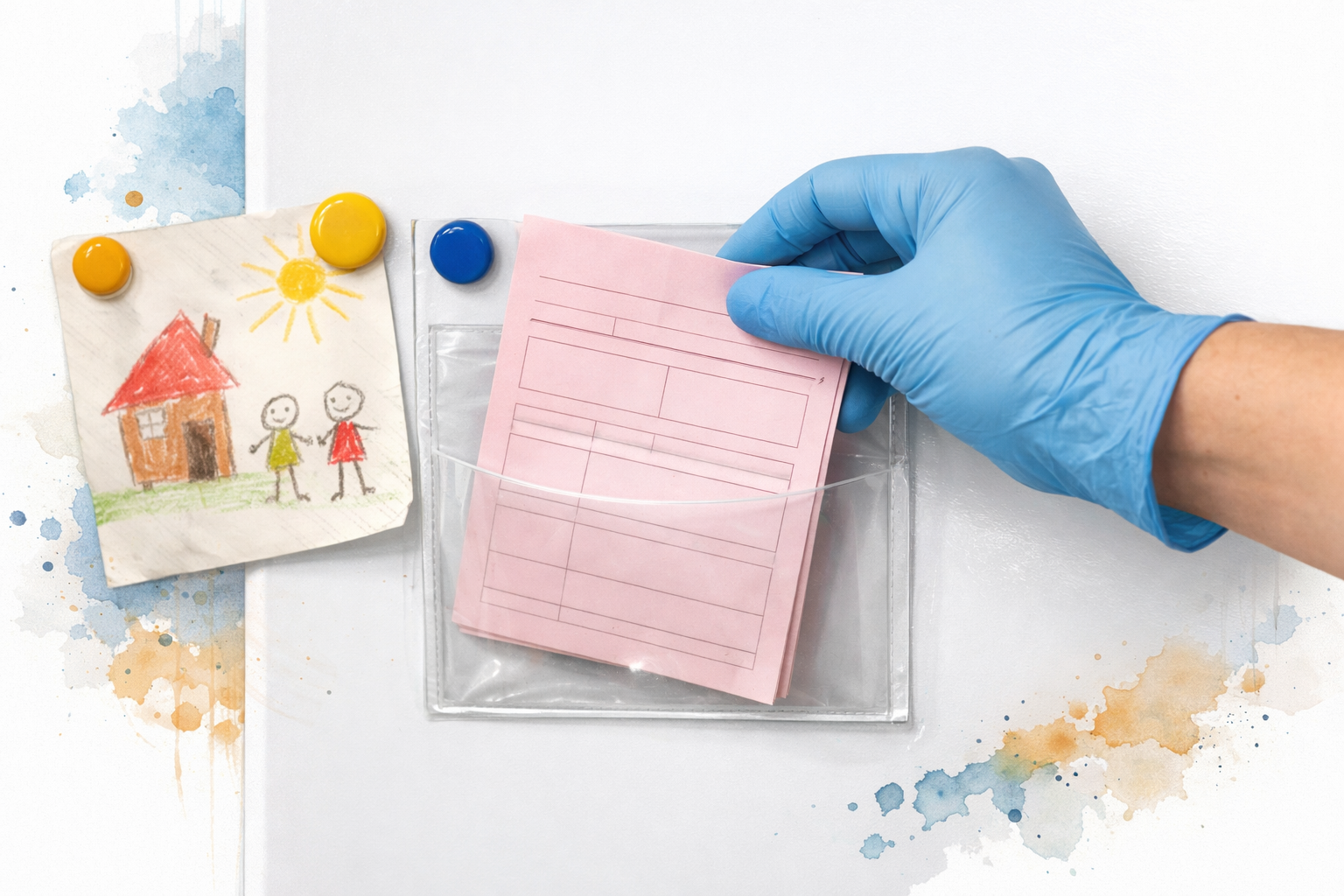
There is a pale pink sheet of paper taped to the side of your parent’s refrigerator. You may not remember exactly what it says, but you know paramedics look for it. Families who contact us often describe it the same way: the colored paper form the paramedics ask about.
Then you hear that California changed the rules on January 1, 2027, and the worry sets in. Is the form on the fridge now worthless? Does your mom have to go back to her doctor and sign a new one?
The short answer is no, and this article walks through why. We will cover what SB 1088 actually changed, who can sign the forms now, and the one new protection that matters most for families comparing care options across Monterey County.
The short answer: January 1 did not void the form on your parent’s fridge
SB 1088, authored by State Senator Catherine Blakespear, was approved by the Governor on September 27, 2026 and chaptered as Chapter 677, Statutes of 2026. It took effect January 1, 2027.
The law updates how these forms are named, signed, and dated going forward. It does not cancel orders that were already signed and in place.
So if your dad in Salinas completed a POLST with his cardiologist in 2023, that form still speaks for him. Emergency responders in Monterey County are still trained to look for it, and it still tells them whether he wants CPR, a breathing tube, or comfort-focused care at home.
What the law changes is the paperwork going forward. You can read the bill summary from the Office of California State Senator Catherine Blakespear, and CalMatters Digital Democracy tracked the bill through both chambers before it passed.
If your parent’s form is faded, torn, or you cannot find it at all, that is a reason to get a fresh one. A law change by itself is not.
What SB 1088 actually changed
The bill makes several practical updates. Here is the list, in plain terms:
- The name changed. POLST now stands for Portable Orders Listing Scope of Treatment instead of Physician Orders for Life Sustaining Treatment. The four letters stay the same.
- Electronic signatures are allowed on requests regarding resuscitative measures.
- Nurse Practitioners and Physician Assistants can sign the prehospital do-not-resuscitate form. Previously that signature came from a narrower group of providers.
- The forms must be dated. A missing date used to create real confusion in the field.
- Out-of-state POLST and DNR orders are recognized in California.
- Completing one is voluntary. It cannot be made a condition of care or of admission to a facility.
None of those changes reach backward. They shape the next form your parent signs, not the one already hanging in the kitchen.
If you want a side-by-side look at which documents are worth re-signing and which are fine as-is, we covered that separately in California POLST and DNR forms change January 1: what to re-sign.
Before and after January 1, 2027
A quick reference for the pieces families ask about most.
| Item | Before January 1, 2027 | On and after January 1, 2027 |
|---|---|---|
| Form name | Physician Orders for Life Sustaining Treatment | Portable Orders Listing Scope of Treatment |
| Existing signed forms | Valid | Still valid, no re-signing required |
| Who signs the prehospital DNR | Narrower set of providers | Also Nurse Practitioners and Physician Assistants |
| Signatures | Wet signature expected | Electronic signatures allowed on resuscitative measure requests |
| Date on the form | Not consistently required | Required |
| Out-of-state orders | Unclear standing in California | Recognized |
| Required for admission | Sometimes pressured | Voluntary, cannot be a condition of care or admission |
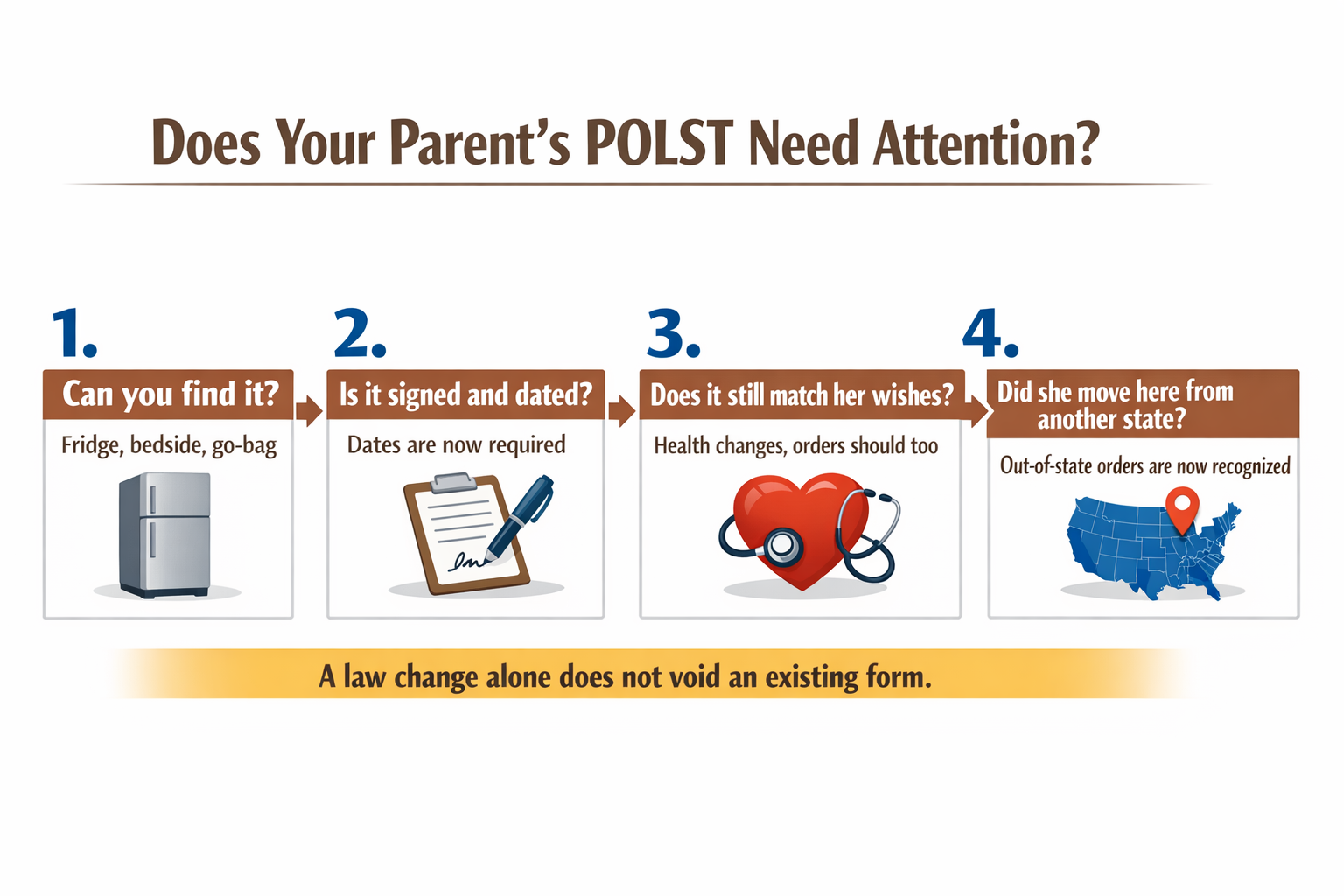
Does your parent’s form need attention?
Four quick checks that tell you whether to leave the form alone or ask the doctor for a new one.
Who can sign now, and why the date matters
The signature change sounds small. In South Monterey County it is not.
Families in King City, Greenfield, and the farther reaches of San Benito County often see a Nurse Practitioner or Physician Assistant as their regular provider. Waiting weeks for a physician appointment just to get a signature was a real barrier. Letting those clinicians sign the prehospital DNR closes that gap.
The dating requirement matters for a different reason. Paramedics arriving at 2 a.m. have seconds to decide whether a form is current and whether it belongs to the person in front of them.
An undated form invites hesitation. A dated one does not.
There is generally no charge for the form itself, though an office visit to discuss it may be billed like any other appointment. Coverage depends on the plan, so it is worth asking the provider’s front desk before you go. For a plain-language breakdown of how this form differs from a standard DNR, see what the colored paper form paramedics ask about really is.
No facility can require a POLST to admit your parent
This is the line in SB 1088 that families should remember. Completing a POLST is voluntary, and it cannot be made a condition of care or of admission to a facility.
If a skilled nursing facility or residential community tells your mother she has to sign one before she can move in, that is not how the law reads. She can say no, or say not yet, and still be admitted.
The out-of-state recognition piece pairs with this. About a quarter of the families who call us are coordinating from somewhere else, sometimes from another state, trying to get a parent settled on the Peninsula or in Salinas.
If your father completed a POLST in Oregon or Arizona and then moved in with you in Marina, California now recognizes that order. You should still review it with his new provider here, because his health may have changed since he signed it. But the document does not evaporate at the state line.
What to actually do in the next month
Four steps, and none of them require an attorney.
- Find the form. Fridge door, bedside drawer, hospital discharge folder. If it is not somewhere a stranger could spot it in thirty seconds, move it.
- Check for a signature and a date. If either is missing, ask the provider’s office for a fresh copy at the next visit.
- Read it out loud with your parent. Orders written during a 2022 hospital stay may not reflect what she wants today.
- Tell the people who need to know. Siblings, the primary care office, and anyone providing care in the home.
One more thing worth saying plainly. A POLST is not a hospice form, and signing one does not start hospice or end treatment. It is a medical order about what happens in an emergency.
Families weighing bigger decisions often find it helps to understand the sequence first. We walked through that timeline in the first 48 hours after a family calls about hospice.
Frequently Asked Questions About California POLST Changes in 2027
Does my mom have to re-sign her POLST because of SB 1088?
No. A POLST signed before January 1, 2027 remains valid. Re-sign it if her health or her wishes have changed, if the form is damaged, or if it is missing a signature or a date, not because of the law itself.
Is a POLST the same thing as a DNR?
They are related but not identical. A DNR addresses CPR specifically. A POLST covers a broader set of medical orders, including whether your parent wants a breathing tube, hospital transfer, or comfort-focused care at home. Many people in Monterey County have one, not both.
Can a nursing home refuse to admit my father if he will not sign one?
Under SB 1088, completing a POLST is voluntary and cannot be a condition of care or admission to a facility. If you are told otherwise, ask for it in writing and raise it with the facility administrator.
My parent signed a POLST in another state. Does it count here?
As of January 1, 2027, California recognizes out-of-state POLST and DNR orders. Still, review it with her new provider on the Central Coast so the orders match her current condition.
Who should actually have a copy?
Keep the original somewhere visible in the home, usually the refrigerator. Give copies to the primary care office, any specialist actively treating her, and the adult child most likely to be called first. If she travels between homes, send a copy with her.
Does signing a POLST mean we are giving up on treatment?
No. It records what she wants in an emergency, nothing more. People with POLST forms continue chemotherapy, surgery, dialysis, and rehab every day.
Still unsure what your parent’s paperwork means?
Sorting through advance directives, POLST forms, and care options is a lot to carry alone, especially when a parent’s health is shifting. Central Coast VNA & Hospice has supported families across Monterey County and the surrounding Central Coast since 1951, and a care coordinator can talk through where things stand without any pressure to start services. You can reach the team at 831-372-6668 or find more information at ccvna.com.