
Direct Answer: In California, the colored form paramedics ask for is the POLST, printed on bright pink paper. It is a signed medical order covering CPR and more. A DNR covers only CPR.
Somebody said your mom needs “the pink form.” Maybe paramedics asked about it during a 911 call in Salinas, or a discharge planner mentioned it on the way out the door, and nobody slowed down long enough to explain what it was.
In California, that bright pink paper is the POLST. It stands for Physician Orders for Life-Sustaining Treatment, and it is a medical order signed by a clinician, which is exactly why emergency crews look for it first.
It is not a DNR, though families use the two words as if they mean the same thing. Below is what the form actually covers, how it differs from a DNR, how a family here gets one, and why nothing on that pink page locks you in.
Why Paramedics Look for the Pink Paper First
When an ambulance crew walks into a house in Pacific Grove or Greenfield, they are working fast and they need orders, not wishes. A POLST gives them orders.
That is the whole reason the form exists on bright pink paper. It is meant to be spotted in seconds, from across a room, by someone who has never been in that house before.
The California POLST program describes the form as a set of medical orders completed with a provider, not a personal statement a family writes on its own. Because a clinician signs it, emergency responders in Monterey County are required to follow what it says.
A few things worth knowing up front:
- It is for people with serious illness or advanced frailty, not for every adult
- It travels with the patient between home, hospital, and skilled nursing
- It is one page, front and back
- A photocopy or scan is valid, so the original does not have to be the one in the room
Families often first hear about it during a hospital discharge at Salinas Valley Health or Community Hospital of the Monterey Peninsula. That is a stressful moment to absorb a new document, which is why so many people leave still unsure what it was.

POLST Form vs DNR in California: The Honest Difference
Picture a nurse sitting at a kitchen table in Salinas walking a family through this. She would probably put it in two sentences.
A DNR answers one question: if the heart stops and breathing stops, should anyone attempt to bring the person back? Yes or no. That is the entire scope of it.
A POLST answers that question and then keeps going. It also covers what should happen while the person still has a pulse and is still breathing.
That second part is where most of the real decisions live. A POLST asks about things like:
- Whether to send the person to the hospital at all, or treat symptoms where they are
- Whether to use a breathing tube and a ventilator, or use oxygen and medication for comfort
- Whether to attempt intensive care, limited treatment, or comfort-focused care only
- Whether the person wants feeding by artificial means, and for how long
So a person can absolutely want CPR attempted and still want to avoid a ventilator. Or want full treatment for an infection but no transfer out of the house for anything else. A DNR has no room for any of that. A POLST does.
This is also why “she has a DNR, so we’re covered” can leave a family unprepared. The DNR goes quiet the moment the answer is anything other than cardiac arrest.
POLST, DNR, and Advance Directive at a Glance
Three documents, three different jobs. Here is how they separate out in California.
| Document | What it actually decides | Who signs it |
|---|---|---|
| POLST (pink form) | CPR plus level of medical intervention, hospital transfer, breathing support, and artificial nutrition | The patient or their decision maker, plus a physician, nurse practitioner, or physician assistant |
| DNR | Only whether revival is attempted if the heart and breathing stop | The patient or decision maker and a physician |
| Advance directive | Who speaks for you later, and what you would generally want | The patient, usually with witnesses or a notary, no clinician required |
How a Family Here Actually Gets One
This is where people stall, and it is usually for the same reason. They go looking for a form to download, print, fill out, and file in a drawer. That is not how a POLST works.
The form is a conversation with the treating physician, and the signature is part of it. In California, a physician, a nurse practitioner, or a physician assistant can sign it.
The practical version looks like this:
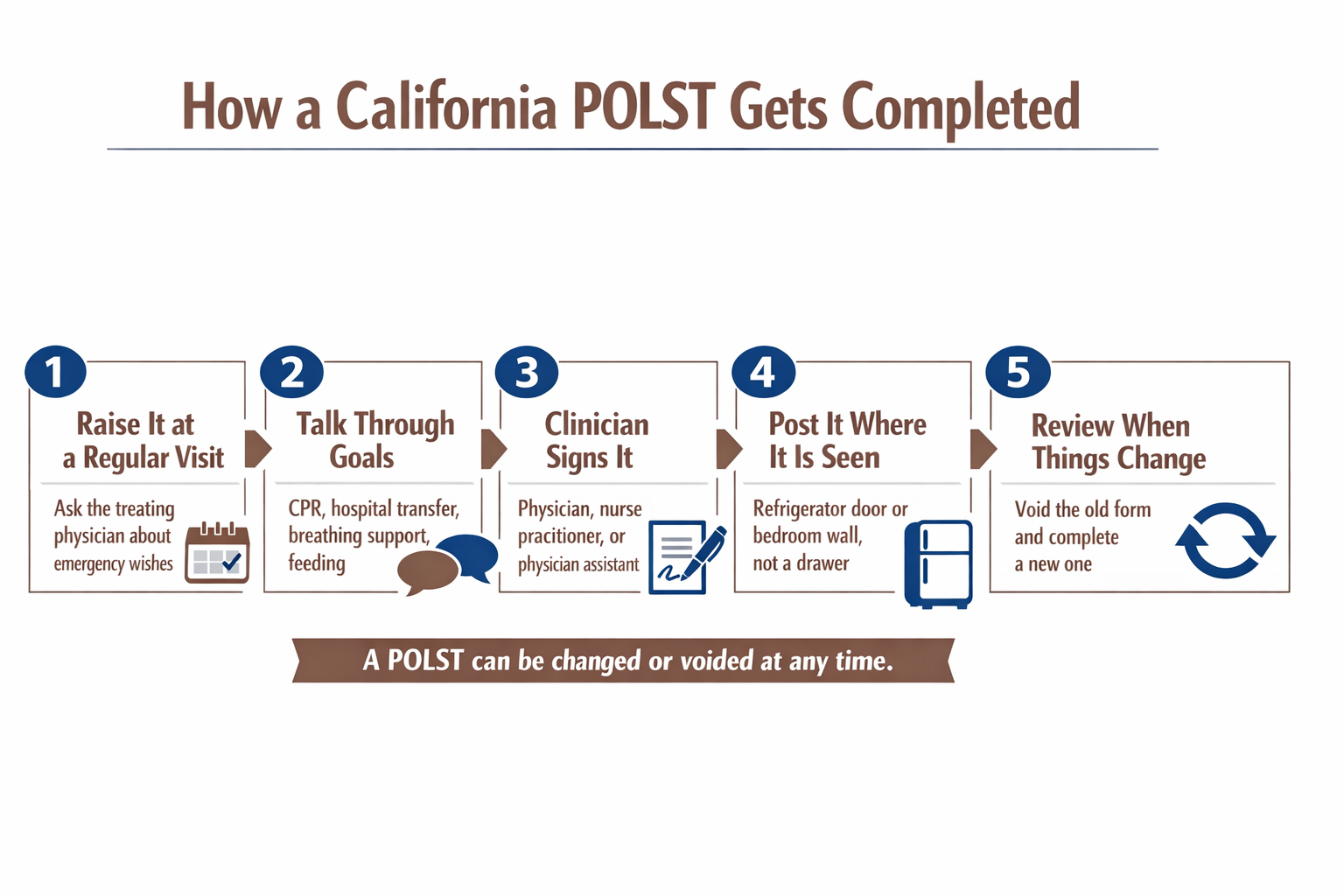
- Bring it up at a regular appointment, not a special one. A follow-up visit after a hospital stay is a natural moment.
- Say plainly that you want to talk about what happens in an emergency.
- Expect questions about goals, not just procedures. What matters most to the patient right now?
- Leave with the signed form in hand, and ask for a copy for the patient’s chart.
One more thing that matters in a county where a large share of families speak Spanish at home. The POLST has been translated into Spanish and many other languages, and asking for it in the language the patient actually reads is a normal request, not a favor. Signing a form you cannot read is not informed consent. Families working through this in two languages may also find the questions Spanish-speaking households ask first useful before the appointment.
And asking your doctor about the form does not start anything. It is a question, not a commitment.
The POLST in Five Steps
A quick look at how the pink form moves from a doctor’s office to the wall of a home.
A POLST Is Not an Advance Directive
The difference between these two comes down to time.
An advance directive speaks for a future you. It names who makes decisions if you cannot, and it describes the kind of care you would generally want. It is a letter to whoever is standing in the room later.
A POLST is for tonight. It turns those general wishes into orders that the crew in your hallway is required to follow right now.
Most people with serious illness end up with both. The advance directive names the decision maker, and the POLST tells responders what to do before anyone can reach that person by phone. If you have not started on the directive side yet, advance care planning is more than paperwork walks through what that conversation covers.
Where the Form Should Live, and Why It Is Not Permanent
A signed POLST in a filing cabinet in the garage is the same as no POLST at all. Responders will not find it.
Put it somewhere obvious:
- The refrigerator door, which is where most crews look first
- The bedroom wall near the bed, if that is where the patient spends the day
- A copy in the go-bag for any hospital or clinic trip
- A copy with the patient’s primary care office
Now the part that matters most to families who are afraid of deciding too soon. A POLST can be changed or voided at any time, verbally or in writing, by the patient or their decision maker.
California’s program guidance recommends reviewing it whenever the medical condition changes or the person’s goals shift. If the choices change, the cleaner path is to void the old form and complete a fresh one rather than crossing things out.
So after a hospital stay in Salinas, after a fall in King City, after a new diagnosis in Hollister, it is normal to pull the pink paper down and start over. Rules around these forms also get updated from time to time, and recent California changes to POLST and DNR forms are worth a look if yours has been on the fridge for a while.
Nothing on that page is a door that locks behind you.
Frequently Asked Questions About the POLST Form vs a DNR in California
Does the POLST have to be printed on pink paper to be valid?
No. A copy, a fax, or a photo of a completed POLST is valid in California. The pink stock exists so the form is easy to spot in an emergency, not because the color carries legal weight.
My dad already has a DNR. Does he still need a POLST?
It depends on what he wants. A DNR answers one question about CPR. If he has opinions about hospital transfers, breathing machines, or feeding tubes while he is still breathing, a DNR will not carry those instructions and a POLST will.
Can I fill out the POLST myself and have my mom sign it?
Not on its own. It is a medical order, so a physician, nurse practitioner, or physician assistant has to sign it before it means anything to a paramedic. The conversation and the signature happen together at a visit.
Does completing a POLST mean we are agreeing to hospice?
No. Plenty of people complete a POLST while still pursuing treatment, including people receiving home health or palliative care. The form records what should happen in an emergency, nothing more. If you are weighing options for a parent with dementia specifically, the hospice criteria families actually ask about covers a separate set of questions.
What if the person can no longer make decisions?
Their legally recognized decision maker can complete and sign the POLST on their behalf, based on what that person would have wanted. This is one reason having an advance directive in place early makes the later paperwork simpler.
Still Not Sure What You Are Looking At?
Registered Nurses, Medical Social Workers, Physical and Occupational Therapists, Chaplains, and Volunteers from Central Coast VNA & Hospice have been making home visits across Monterey County since 1951, and they see these pink forms on refrigerator doors every week. Medical Social Workers in particular are the ones families lean on when the paperwork stops making sense. If you have a question about the form, you can ask your own physician or speak with a care coordinator at 831-372-6668, and asking is not the same as starting services.