
Direct Answer: A home health referral is a document traveling from your doctor’s office to an agency intake desk. To check its status, call the ordering office first with the patient’s name, birth date, and order date.
Your dad came home from the hospital on Tuesday. Someone in a hallway said home health would be arranged and that you would hear from someone. It is now Thursday, the phone has not rung, and you are starting to wonder if anyone actually sent anything.
This is one of the most common calls home health agencies in Monterey County get, and families often call back two or three times because nothing has shown up in the system yet. The honest answer is usually boring and reassuring at the same time.
A referral sitting in limbo almost always means a document is waiting on a desk, not that anyone forgot your dad. Below is what a referral actually is, where in the chain to aim your next phone call, and what is worth doing with the next 48 hours.
What a Home Health Referral Actually Is
Most families picture a single button getting pressed. In reality, a referral is a physician’s order, a piece of paper or an electronic record, that has to move between three separate places.
That chain usually looks like this:
- The ordering physician’s office, where the order gets written and signed
- The hospital case manager or discharge planner, who may be the one actually sending it
- The agency intake desk, where it gets logged, read, and assigned
There is a possible pause at every handoff. A fax that landed in the wrong queue, an order written but not yet signed, a discharge planner handling eight other patients the same afternoon. None of those are emergencies, but none of them resolve themselves either.
So when you ask about your home health referral status, you are really asking one question: which of those three desks is it sitting on right now? That is answerable, usually in under a minute, by whoever picks up the phone. We are not going to re-litigate why a physician order is required in the first place here. The order exists. The question is where it went.

The Short List to Write Down Before You Dial
Insurance and referral questions are the single biggest thing that stalls these conversations. Callers often get three or four minutes in before realizing they do not have the one detail that would unlock the whole thing.
Write this on a sticky note before you call anyone:
- The patient’s full legal name and date of birth (legal name, not the one everybody uses)
- The name of the ordering physician, and the clinic or hospital they practice at
- The date the order was sent, as close as you can get it
- Whether it went by fax or through the hospital’s records system
- Which insurance plan is on file, including the Medicare Advantage plan name if there is one
The person who answers at an intake desk can usually find a referral in seconds if you can name the doctor and the date. Without those two things, they are searching a name against a system that may not have the record yet, which tells you nothing.
The insurance detail matters more than people expect. Some Medicare Advantage plans restrict which agencies you can use, and that gets verified early. If you are not sure what you have, this explains how plan rules can limit your choices.
Where a Referral Stalls and Who to Call
Aim your call at the right desk and you usually get an answer in one try instead of three. Here is who handles what.
| If the holdup is here | Call this person | Ask exactly this |
|---|---|---|
| The order was never written or signed | The ordering physician’s office, front desk or nurse line | Has the home health order been signed and sent, and on what date? |
| The order was written but not transmitted | The hospital case manager or discharge planner named in your folder | Which agency was it sent to, and by fax or electronic record? |
| The order was sent but not acknowledged | The agency’s intake or admissions line | Can you confirm you received an order for this patient on this date? |
| Insurance or address verification | The agency intake desk | Is anything outstanding on verification, and who is my point of contact? |
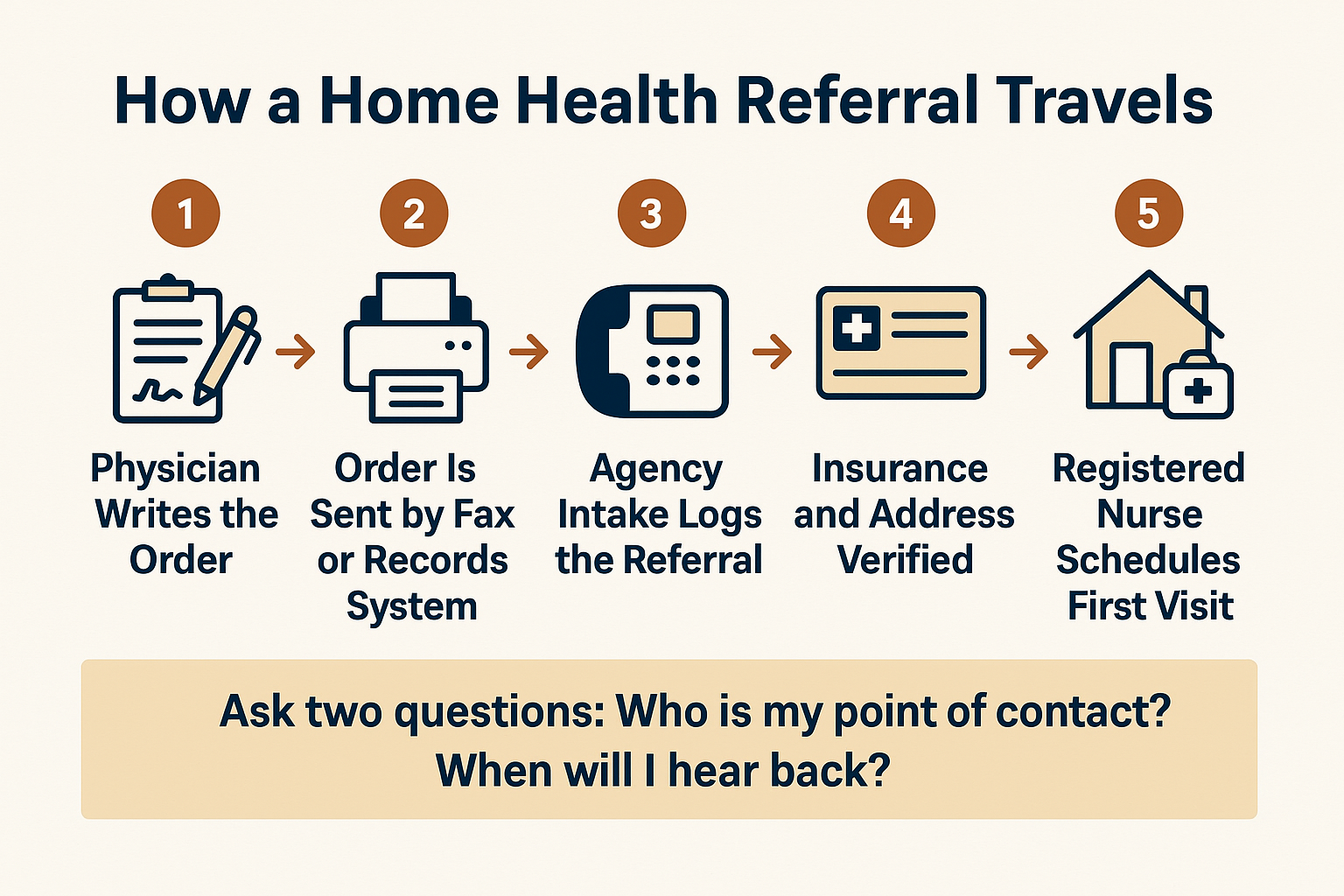
The Five Steps Between the Order and the First Visit
Nothing can be scheduled until each step clears. Knowing which one you are sitting in takes most of the mystery out of the wait.
What a Normal Timeline Looks Like, and What You Control
Here is the part nobody says out loud. A physician’s order has to exist before any agency can open a case. Insurance and geography get verified next. Only then does a Registered Nurse schedule the first visit.
You do not control the first step. You do control how clearly you ask about the rest.
A 24 to 48 hour window with a real callback is a reasonable thing to ask for by name. Once an order actually lands, things can move fast. Some programs, like orthopedic recovery care at Central Coast VNA & Hospice, aim to start within 24 hours of a patient getting home.
So ask two direct questions, and write the answers down:
- Who is my point of contact? Get a first name.
- When will I hear back? Get a window, not a “soon.”
Those two answers do more for the next 48 hours than anything else you can do. Vague promises are what keep families calling back three times. A named person and a real timeframe end that loop. For context on how visits get spaced once care does begin, this walks through how schedules actually get set.
How Referrals Travel on the Central Coast
Most home health orders around here start at a handful of places. Case managers and physician offices tied to Salinas Valley Health, Natividad, and Community Hospital of the Monterey Peninsula send a large share of them.
That matters for two reasons. First, the discharge folder you were handed is the start of a handoff, not the end of one. Second, a polite call to the doctor’s office the next business day is normal practice around here, not nagging.
Geography is its own common snag. Families in Salinas, Greenfield, Marina, Seaside, King City, and Hollister are often coordinating this while driving 40 minutes each way to check on a parent. Service area gets verified before anything is scheduled, and if an address falls outside coverage, here is what happens next.
If you want to confirm what Medicare covers while you wait, the federal Medicare home health benefit page lays out eligibility in plain terms.
What to Actually Do During the Wait
The honest answer to “what do I do right now” is short.
Keep one written log on one sheet of paper: who you spoke with, what they said, the date, and the callback number. Families who do this spend far less energy re-explaining the same situation to the fourth person who picks up.
If 48 hours pass with no contact, call back and ask for the referral to be re-sent. That is a routine request, and it is often all it takes.
Then use the quiet time to line up three things the first Registered Nurse visit will ask about:
- The current medication list, including anything started or stopped in the hospital
- The discharge paperwork, kept together in one folder
- A short note on what changed during the hospital stay, in your own words
One more thing worth knowing. Waiting on a referral is not the same as having no one to call in a crisis. If something changes at home overnight, this covers who to reach after hours.
Frequently Asked Questions About Home Health Referral Status
How long should I wait before calling to check on a referral?
One business day is fair. If the order was sent Monday afternoon, calling Tuesday morning is completely normal. Nobody at an intake desk thinks you are being pushy.
Can I call the agency directly, or do I have to go through the doctor?
You can call either one. Start with the agency if you know which one was named at discharge, since they can tell you in seconds whether an order arrived. If they have nothing on file, that is your answer, and the next call goes to the ordering physician’s office.
What if the hospital never told us which agency the referral went to?
That happens a lot. Call the hospital case manager or discharge planner listed in your folder and ask for the agency name and the date it was sent. Families also have the right to request a specific agency, so if you have one in mind, say so.
Does a referral expire if nobody acts on it?
Orders are tied to the patient’s clinical condition at the time they were written, so a stale order can require the physician to update it. If more than a week has gone by with no contact, ask the doctor’s office whether the order needs to be refreshed before it is re-sent.
Will Medicare cover the visits once the referral goes through?
For patients who meet eligibility rules, Medicare generally covers skilled home health visits with no copay for the services themselves. Costs vary with the plan and the situation, so confirm specifics with the agency and your plan rather than assuming.
Still Not Sure Where Your Referral Went?
Families across Monterey County deal with this gap every week, and asking a few plain questions usually closes it faster than waiting does. Central Coast VNA & Hospice has been part of this community since 1951, and a care coordinator can confirm whether an order has arrived or point you toward the right desk if it has not. You can reach the office at 831-372-6668 or find more information at ccvna.com.