
Direct Answer: A home health service area is a drive time and staffing boundary, not a marketing choice. Confirm your parent’s full street address with the agency, for the specific service needed, before discharge day.
You are standing in a hallway at a hospital in Salinas or Monterey. Discharge is set for tomorrow, the planner handed you an agency name, and you are on hold trying to get a nurse out to the house.
Then, three minutes into the call, you hear it. The address you are calling about sits outside that agency’s coverage area. Now you are starting over, with a clock running.
Roughly one in twelve calls that come into a home health office are some version of “do you serve my area?” Too many of those callers find out mid conversation that the answer is no. This article is about checking coverage before that moment instead of after it.
A Service Area Is a Drive Time Line, Not a Marketing Choice
It helps to know what you are actually running into. A home health or hospice service area is an operational boundary, built around how far a clinician can drive and still make the rest of the day’s visits.
Skilled home health is delivered by nurses and therapists who travel house to house. A single visit might take 45 minutes. Getting there and back can take twice that in this part of the state.
The boundary also has to hold up after hours. An agency will not promise coverage at an address it cannot reach with a nurse at 2 a.m. on a Sunday, because that promise would be hollow.
So when an intake coordinator says an address is out of area, it is rarely a brush off. It usually means:
- No clinician is currently staffed close enough to that address
- The drive would break the visit schedule for everyone else that day
- After hours response could not be guaranteed at that distance
- The specific therapy discipline you need is not staffed in that corridor
Understanding that changes how you ask. You are not negotiating. You are trying to find the agencies whose real footprint already includes your parent’s street.
How a Home Health Agency Service Area Gets Drawn in Monterey County
The geography here makes coverage messier than in most metro areas. Agencies commonly list whole counties on their websites. A county listing does not always mean every address inside that county.
Monterey County alone runs from Pacific Grove and Carmel down through Salinas, Soledad, Greenfield and King City. A nurse driving south from Monterey to a King City address can spend well over an hour each way, and that is before the return trip.
Then there are the wrinkles families run into constantly:
- Big Sur, where the drive down Highway 1 is long, slow, and occasionally closed
- Carmel Valley Road, where the last ten miles take as long as the first twenty
- The far end of San Benito County past Hollister, out toward the ranch roads
- South Santa Clara County around Gilroy and Morgan Hill, which some agencies serve and others do not
Partial county coverage is normal, not a red flag. An agency that lists Santa Cruz County may reach some communities and not others. The same is true inside Monterey County.
This is also why zip codes are a poor way to check. Boundaries can split a zip code down the middle, and the person answering the phone needs the street, not the city.

Medicare Gives You More Leverage Than Most Families Realize
Here is a piece most families never hear at the bedside. When a provider decides a patient needs home health care, Medicare’s home health coverage guidance says that provider should give the patient a list of agencies that serve the patient’s area.
That same guidance says the provider must tell you if their organization has a financial interest in any agency on the list.
So you can ask for two things, plainly and without apology:
- The list of home health agencies that serve your parent’s specific address, in writing
- Whether anyone on that list is there because of an ownership relationship
Most discharge planners will hand this over without blinking. It is a normal request. The written part matters because a name said out loud in a busy hallway gets lost by the time you are in the parking lot.
One name is not a list. If you were given a single agency and that agency turns out to be out of area, go back and ask for the rest. Plan network rules are a separate question, and worth reading up on if you are on an Advantage plan, but geography comes first.
Coverage Questions That Get Real Answers
Vague questions get vague answers. These are the ones worth reading off a piece of paper when you call.
| Ask this | Why it matters | What a clear answer sounds like |
|---|---|---|
| Read the full street address, not just the city | Boundaries can split a zip code or a road | Yes, that street is inside our footprint |
| Is that address covered for the specific service we need? | Home health and hospice footprints are not always identical | Home health yes, hospice we would need to check |
| Do after hours nurse visits reach that address? | Nights and weekends are when families panic | Yes, with a typical response window of X |
| Are Physical, Occupational and Speech Therapists staffed in that part of the county? | Therapy staffing is often thinner outside the Peninsula | PT and OT yes, speech therapy has a wait |
| If you cannot cover it, who can? | A good intake team should hand you names | Here are two agencies with phone numbers |
Check Coverage Before the Discharge, Not After
A short sequence families can run through while a hospital social worker is still available to help.
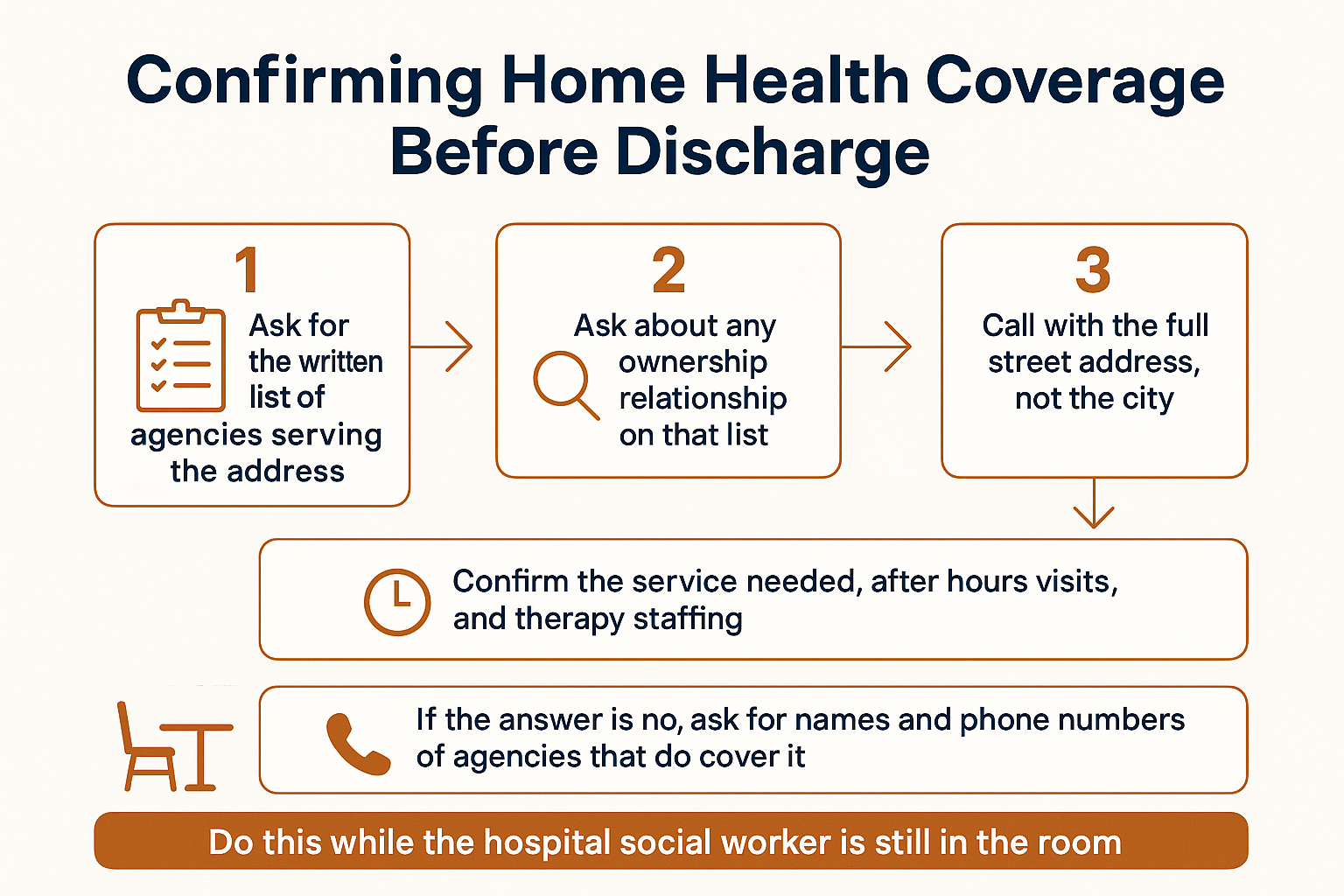
When the Answer Is No, Ask for Names Before You Hang Up
This is where families feel most stranded. The call ends, you have nothing new, and the discharge is still happening tomorrow.
A well run intake team should not simply decline. It should hand you names and phone numbers of providers who do cover that address. You are allowed to ask for exactly that, and most coordinators keep an informal list for this reason.
There is a second gap that comes up in almost every one of these conversations. Skilled home health visits are intermittent, meaning a few visits per week, not daily hands on help. A nurse might come twice a week and a Physical Therapist once or twice more.
For a parent in Greenfield or out past Hollister who needs help getting to the bathroom at 3 a.m., that clinical schedule alone will not carry the household. Families in outlying areas often combine a clinical team with separately hired private duty support or IHSS hours.
Private duty is paid differently, and the hours add up fast. One public review of a Monterey area experience described a family paying somewhere around $8,000 a month out of pocket for private aides, which gives a sense of scale, though rates vary widely by hours and agency.
Knowing that combination exists early spares families two weeks of confusion. It is worth reading how IHSS, home health and private duty each fit together before you start dividing up the week, and what visit schedules actually look like once care begins.
Do This While the Social Worker Is Still in the Room
One family described their situation in about as few words as it can be put. She was just discharged, and we need someone to come to the house.
That is the reality of these calls. They happen in the 24 to 72 hours after a discharge, not during calm planning at the kitchen table weeks ahead.
So the single most useful thing you can do is confirm coverage during the discharge planning meeting itself. The hospital social worker is in the room, has a phone, and can make calls on your behalf while everyone is together.
Ask them to verify the street address with the agency before the meeting breaks up. Ten minutes there saves a very bad afternoon later. If you want a sense of what else tends to get missed in that meeting, this walkthrough of what families overlook when planning a discharge to home covers the rest, and what the first 72 hours at home actually look like sets expectations for the days right after.
Why Some Organizations Reach Farther Than Others Here
Coverage on the Central Coast is often a matter of how long an organization has been operating outside the Monterey Peninsula.
Central Coast VNA & Hospice opened a Hollister office serving San Benito County in 1974. The Monterey Peninsula, Salinas Valley and San Benito visiting nurse organizations then merged into one nonprofit in 1984.
That history is why South County and San Benito coverage there is long established rather than newly added. Staffing in Salinas, King City and Hollister was built over decades, not stretched from the coast last year.
When care does reach the home, it is not one person. It is nurses, therapists, social workers, chaplains, volunteers and other clinicians working from the same plan. Families with a coverage question about a specific address can call 831-372-6668 or visit ccvna.com and ask before anything else gets decided.
Frequently Asked Questions About Home Health Coverage Areas
The discharge planner only gave me one agency name. Is that normal?
It is common, but you can ask for more. Medicare guidance says the provider ordering home health should give you a list of agencies serving the patient’s area, and must disclose any financial interest in those agencies. Ask for that list in writing.
The agency lists my whole county. Does that mean my parent’s house is covered?
Not always. Partial county coverage is common on the Central Coast, especially in Big Sur, upper Carmel Valley, and the far reaches of San Benito County. Read the full street address over the phone and get a yes or no on that specific address.
If they cover home health at our address, does that mean hospice too?
Not automatically. One organization’s home health footprint and its hospice footprint are not always identical, because the staffing and after hours requirements differ. Ask about the service you actually need by name.
We need someone there every day. Will home health cover that?
Skilled home health is intermittent, usually a few visits per week from nurses and therapists. Families who need daily hands on help typically pair that clinical team with separately arranged private duty aides or IHSS hours. Naming that combination early saves a lot of frustration.
What if we are out of area and nobody will take us?
Call back and ask directly for referral names and phone numbers. Intake teams in Monterey County generally know which agencies cover King City, Greenfield, Gonzales and the outlying roads, and a good one will not leave you with nothing.
Have a Specific Address You Need Checked?
Coverage questions are easier to answer with a street address in hand than with a city name. Families anywhere from Pacific Grove to King City, Hollister, or the Gilroy side of the county line are welcome to call 831-372-6668 or visit ccvna.com and simply ask whether a given address is served. A care coordinator can tell you yes or no, and point you elsewhere if the answer is no.