
Direct Answer: Medicare hospice respite covers a short inpatient stay, up to five days at a time, arranged by your hospice team. Respite you arrange yourself at home is paid through other programs.
You have not slept a full night in weeks. Someone mentions respite, and you nod like you know what that means, because at that point you will take anything.
But the word gets used for two completely different things. One is a short inpatient stay covered under the Medicare hospice benefit, set up by the hospice team. The other is a break a family arranges at home for themselves, whether or not their loved one is on hospice at all.
This piece stays on the mechanics: who arranges each one, how long it lasts, and who pays. That is usually the part nobody explains to families in Monterey, Salinas, or Hollister until they ask.
What Respite Care Medicare Covers Under the Hospice Benefit
The Medicare version is narrow and specific. It is a short stay in a Medicare-approved inpatient facility, and the hospice team arranges it.
Here is the structure:
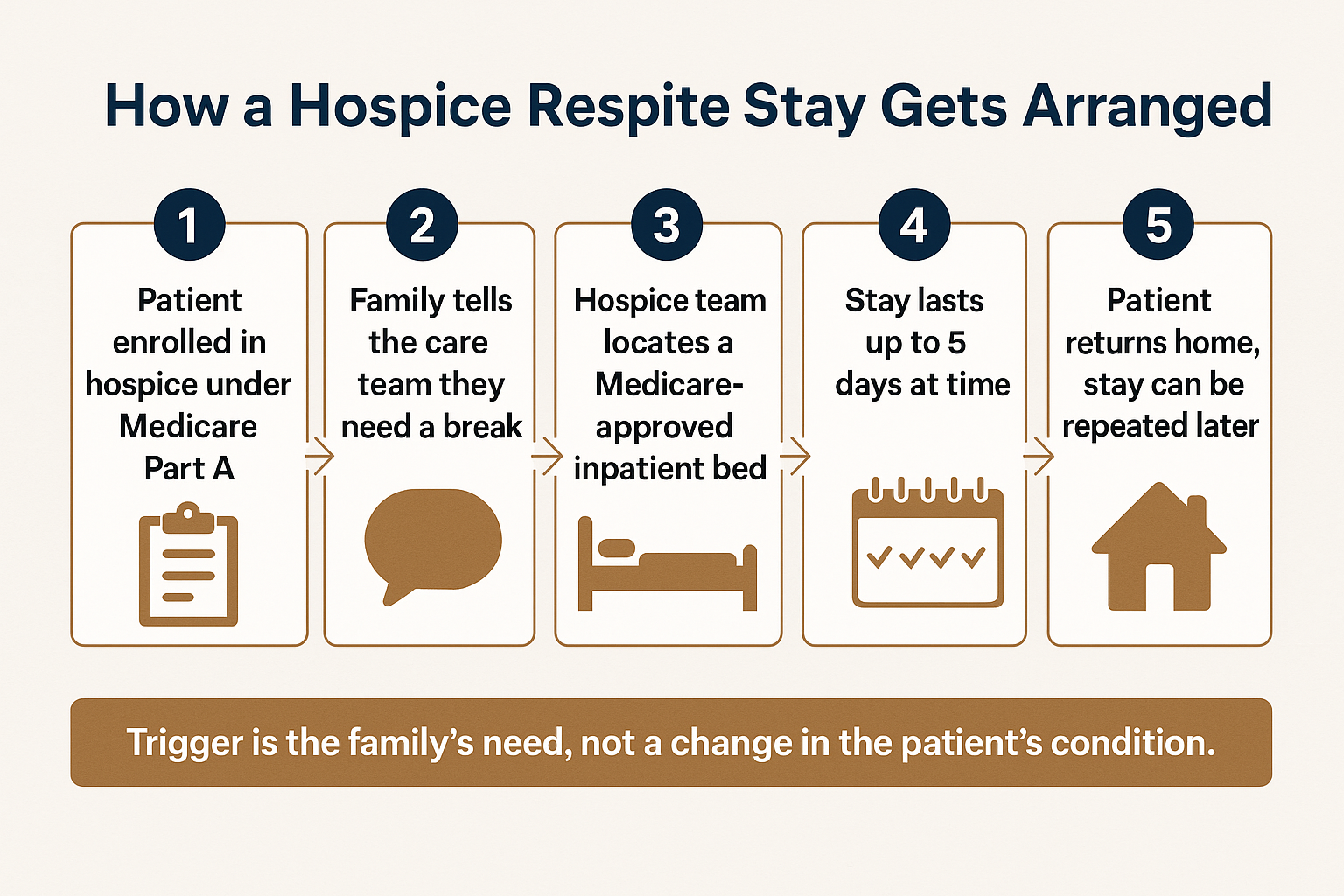
- The patient must already be enrolled in hospice under Medicare Part A
- The stay happens in a Medicare-approved inpatient setting, not at home
- It runs up to five days at a time
- It is meant to be used occasionally, not as ongoing care
- There is no set limit on how many separate respite stays a family can use over time
The part that surprises people most: the trigger is the family’s need for a break, not a change in the patient’s condition. Nobody has to be declining faster for this to be appropriate.
Medicare confirms that it covers short-term inpatient or respite care when the hospice team determines it is needed and arranges it. It also confirms that room and board is not covered when hospice care is happening at home, which is a separate question worth understanding on its own.
Many families in King City and Greenfield never ask about respite because nobody told them asking was allowed. It is allowed.
The Other Kind: A Break You Set Up Yourself
The second kind of respite has nothing to do with a hospice benefit period. It is a family hiring or arranging help so one person can stop doing everything for a few hours or a few days.
This version is flexible in ways the Medicare stay is not. It can happen at home, it can be a few hours on a Tuesday afternoon, and it does not require a hospice enrollment.
It also runs through different payment channels, each with its own eligibility rules:
- Private pay, billed hourly or daily by a private agency
- IHSS (In-Home Supportive Services), a county-administered Medi-Cal program
- Other Medi-Cal waiver and support programs
- VA caregiver support programs for eligible veterans and their families
- A regional Caregiver Resource Center, which serves this part of California
If you are trying to figure out whether you even need this yet, our piece on knowing when you need a break walks through the signs. This article is about the paperwork side of it.

Side by Side: Hospice Respite vs. Respite You Arrange
The two often get named the same thing in conversation. They work nothing alike.
| Medicare hospice respite | Respite you arrange yourself | |
|---|---|---|
| Where it happens | Medicare-approved inpatient facility | Usually at home |
| Who sets it up | The hospice team | The family, an agency, or a county program |
| How long | Up to five days at a time, occasional use | Hours or days, as arranged |
| Requires hospice enrollment | Yes, under Medicare Part A | No |
| Who pays | Medicare hospice benefit, with a small coinsurance | Private pay, IHSS, Medi-Cal, VA, or a Caregiver Resource Center |
| What triggers it | The family needs a break | The family needs a break |
What It Costs, and Why to Confirm the Number With Your Own Team
Under the Medicare hospice benefit, families are typically responsible for a 5 percent coinsurance on the Medicare-approved amount for inpatient respite. That copay is capped at the year’s Part A inpatient hospital deductible, so it cannot climb without limit.
What a five-day stay actually costs out of pocket depends on the facility’s rate, and published estimates vary widely. Treat any single dollar figure you find online, including in this article, as a rough signal rather than a quote.
The honest move is to ask the hospice team for the number that applies to your loved one, in writing if you can get it. They bill it, so they know it.
One other thing worth separating out: room and board at home is not part of the hospice benefit. If that distinction matters for your situation, who pays for room and board on hospice covers it in more detail.
For the do-it-yourself version, cost depends on the channel. Private agency hours on the Monterey Peninsula are billed hourly and add up quickly, while IHSS and Medi-Cal programs work off eligibility rather than a rate card. A Medical Social Worker is usually the person who can map which of those doors is actually open to you.
How a Medicare Hospice Respite Stay Gets Arranged
Five steps, in the order they usually happen.
Timing: Ask Two to Three Weeks Ahead, Not the Week Of
Respite beds get tight. General guidance in the field is to raise it with the care team two to three weeks ahead rather than a few days out.
The Central Coast has its own version of this pressure. There is no freeze season here and no storm-driven care crisis, so the crunch is social and calendar-driven:
- Thanksgiving, when whoever has been doing the caregiving is also hosting
- November and December, when adult children fly in from out of the area and see the situation up close for the first time
- January, when a family member who has not left the house in weeks finally says so out loud
If you already know December is going to break you, say something in November. A bed you asked about early and did not use costs you nothing. A bed you needed on December 22 and did not ask about is a different story.
What Respite Does Not Cover, and Where Families Get Redirected
Families almost never call and ask for respite by name. They call describing the load. One caller put it simply: “We just need someone to come to the house and help us figure out what to do next.”
The most common version of that ask is round-the-clock help at home, and this is the boundary worth knowing before you pick up the phone. Home health and hospice are not built to provide continuous shift care. Both are intermittent, meaning clinicians come, do the clinical work, teach the family, and leave.
When someone needs 24-hour presence, staff here regularly point them toward IHSS or a private caregiving agency, because that is the right tool for that job. That is not a brush-off. It is the difference between two kinds of service that sound identical over the phone. If you are still sorting out which lane you are in, home health vs. hospice lays out the split.
One family wrote in about a father coming home from rehab after a pacemaker, with moderate dementia, and said plainly that they did not yet know whether he needed 24-hour care. That uncertainty is the normal starting point, not a failure to prepare. The answer usually comes out of a clinical assessment in the home, not a decision you are supposed to make in advance.
One more practical filter: availability depends on the address. Roughly one in twenty callers finds out mid-conversation that a home falls outside a service area. Coverage here runs across Monterey County, including Salinas, Marina, Seaside, Greenfield and King City, plus San Benito County including Hollister, and South Santa Clara County. Confirm the address early so nobody spends a week on the wrong agency.
Why a Five-Day Break Is Maintenance, Not a Luxury
Monterey County has about 437,613 residents, and roughly 15 percent are 65 or older. That is around 65,000 older adults, and a large share of them are being looked after by one adult child or one spouse doing all of it.
That is the context where five days stops sounding indulgent and starts sounding like upkeep on the arrangement itself. If the one person holding it together goes down, the whole plan to keep someone at home goes with them.
Worth knowing: many hospice programs in the region offer respite only as a five-day inpatient stay tied to the hospice benefit period. Central Coast VNA & Hospice also offers respite for family caregivers as a standalone service, separate from hospice enrollment.
There is a volunteer side to this too. In 2025, Volunteers here contributed nearly 40,000 hours, more than 5 percent of all direct hospice care, including sitting vigil and giving a family member a few hours away from the house.
And when you hand off, you are handing off to a team: Registered Nurses, Physical, Occupational and Speech Therapists, Medical Social Workers, Chaplains, Volunteers, and other clinicians. If you want a sense of what that first contact looks like, the first 48 hours after a family calls about hospice walks through it.
Frequently Asked Questions About Respite Care and Medicare
Can I use Medicare respite more than once?
Yes. There is no set limit on how many separate respite stays a family can use, as long as the use stays occasional rather than continuous. Each stay runs up to five days.
Does my loved one have to get worse for respite to be approved?
No. The trigger is the family’s need for a break. The hospice team still has to determine the stay is appropriate and arrange the bed, but a decline in condition is not the requirement.
What will the five days actually cost us?
Under the Medicare hospice benefit, families are typically responsible for about 5 percent coinsurance on the Medicare-approved amount, and that amount is capped at the year’s Part A inpatient hospital deductible. Facility rates differ, so published out-of-pocket estimates range widely. Ask your own hospice team for the figure that applies to you.
We need someone here overnight, every night. Is that respite?
That is continuous personal care, and it is a different service from what hospice or home health provides. Families in that situation are usually pointed toward IHSS or a private caregiving agency, sometimes alongside hospice.
Can we get respite if my mother is not on hospice at all?
Possibly, through the standalone route rather than the Medicare hospice benefit. Payment would come through private pay, IHSS, a Medi-Cal program, VA caregiver support, or a regional Caregiver Resource Center, and each has its own eligibility rules.
How far ahead should I ask about a holiday respite stay?
Two to three weeks is the general guidance, and more is better around Thanksgiving and late December when beds across the region get tight.
Sorting Out Which Kind of Respite Fits Your Situation
If you are not sure whether you are looking at a Medicare hospice respite stay or a break you arrange at home, a care coordinator can walk through which one applies and what the payment path looks like. The line is 831-372-6668, and families across Monterey County, San Benito County, and South Santa Clara County are welcome to call with questions before anything is decided. VNA has been doing this work on the Central Coast for 75 years, and a conversation costs nothing.