
Direct Answer: Starting with hospice elections on or after October 1, 2026, every Medicare hospice must give families a written addendum listing the conditions, drugs, items, and services it will not cover.
Most families find out what hospice will not pay for the hard way. A bill shows up for a prescription, or a pharmacy says the claim was denied, and nobody can explain why. By then the decision is weeks old and the paperwork is buried in a folder somewhere.
That is changing. For hospice elections beginning on or after October 1, 2026, Medicare requires every hospice to hand the patient or their representative a written addendum listing what it has decided is not related to the terminal illness and therefore not covered.
For families in Salinas, Monterey, Marina, and King City who are often setting up hospice within days of a hospital discharge, this is a real shift. You get the list up front instead of after a denial. Here is what the form is, what to look for on it, and what to do if something on it looks wrong.
What the hospice election statement addendum required in 2026 actually is
The addendum is a written attachment to the Medicare hospice election statement. It lists and explains the conditions, items, services, or drugs the hospice has determined are unrelated to the patient’s terminal illness and related conditions, which means Medicare’s hospice benefit will not pay for them.
This document is not brand new. Medicare created it in the FY 2020 hospice rule, but back then a hospice only had to produce it if the patient or their representative asked for it. Most families never knew to ask.
In the FY 2027 Hospice Final Rule, the Centers for Medicare & Medicaid Services made it mandatory. Per the CMS fact sheet on the FY 2027 hospice rule, Medicare-certified hospices, and agencies seeking certification, must furnish the addendum upon a patient’s election of hospice care beginning on or after October 1, 2026. It has to be provided in writing within five days of the election effective date.
A few things worth being clear on:
- It applies to Medicare hospice elections, not home health and not palliative care
- It is triggered by the election itself, not by a request from the family
- It is a list of exclusions, not a bill and not a denial notice
- The hospice writes it, which means the hospice’s judgment about what is “unrelated” is what you are reading

Why this list is where surprise bills come from
Hospice covers care related to the terminal illness. Almost every patient has other conditions running alongside it, and those are the ones that create confusion.
Picture a parent on hospice for advanced heart failure who also takes medication for arthritis, glaucoma, and a thyroid condition. The hospice may decide some of those are unrelated. Those prescriptions then go back through regular Medicare Part D or private insurance, with normal copays.
The cost swing here is not trivial, though the real number depends entirely on the drug list, the plan, and the patient. What the addendum does is put that decision in front of you in writing, on day one, instead of leaving it for a pharmacy counter in Seaside to explain three weeks later.
It also helps separate two things families constantly mix up. Hospice pays for clinical care related to the terminal illness. It does not pay for round-the-clock personal help at home, and it does not pay for room and board in a facility. Those are different questions, and the addendum will not answer them.
One family who reviewed a Monterey Peninsula hospice publicly described paying roughly $8,000 a month out of pocket for private personal help alongside hospice care. That figure is one household’s experience, not a standard rate, but it reflects a gap families discover late. If room and board is part of your situation, who pays for hospice room and board is the better place to start.
What changed on October 1, 2026
The document itself is largely the same. Who receives it, and when, is what moved.
| Before Oct 1, 2026 | Elections on or after Oct 1, 2026 | |
|---|---|---|
| Who receives it | Only patients or representatives who specifically requested it | Every patient electing the Medicare hospice benefit |
| What it lists | Conditions, items, services, and drugs the hospice determined are unrelated to the terminal illness | Same list, now furnished automatically |
| Format and timing | On request, within set turnaround windows | In writing, within five days of the election effective date |
| What a signature means | Generally treated as acknowledging receipt | Generally treated as acknowledging receipt, not agreement with the list |
The addendum timeline, start to finish
Five steps, from the day hospice starts to the point where a disputed item gets corrected.
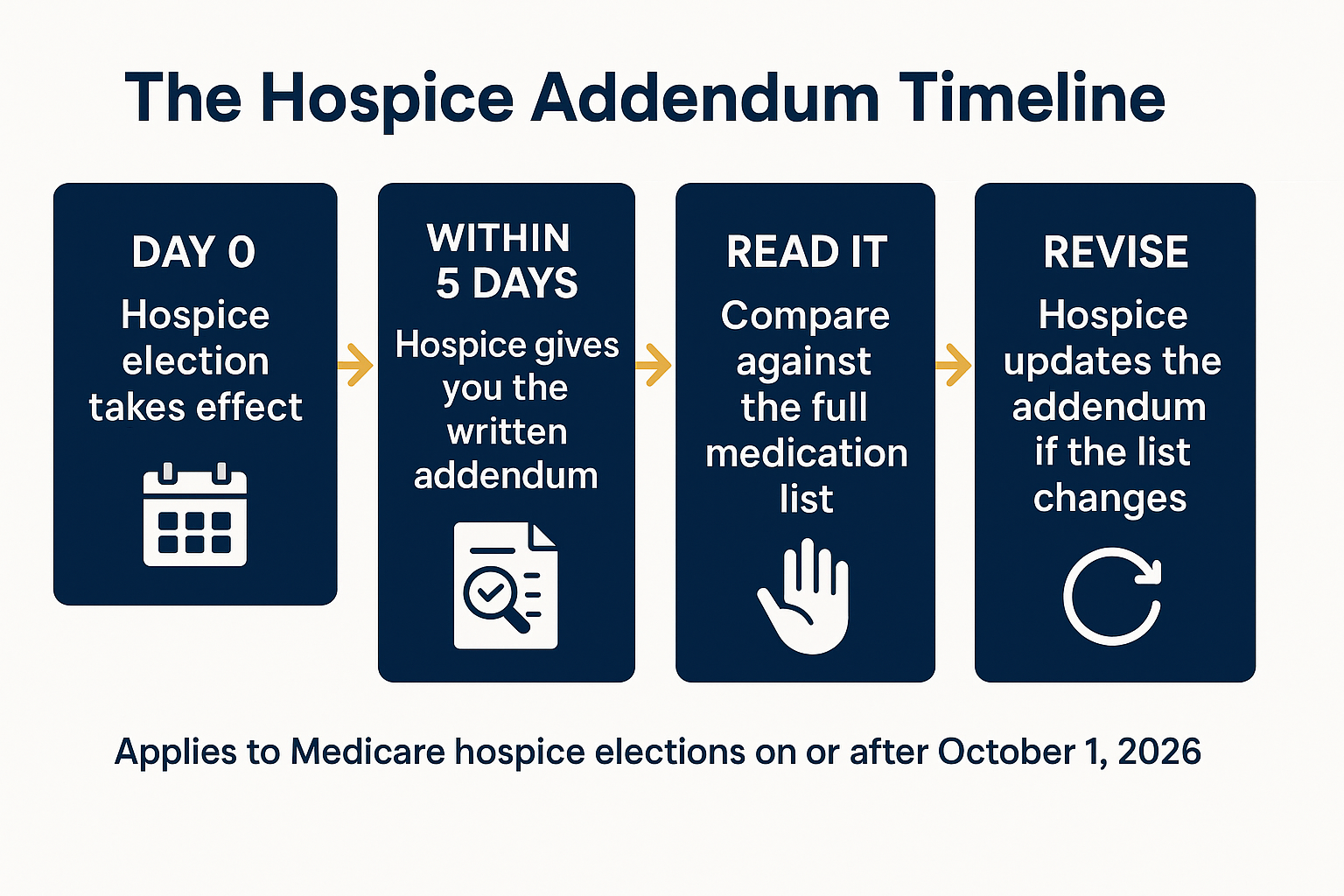
What to do in the first week after the addendum arrives
The form only helps if somebody reads it while there is still time to fix it. Set aside twenty minutes in that first week.
- Put the addendum next to the actual medication list. Pull every bottle from the cabinet, including the ones from specialists, and check each one against the list of excluded drugs.
- Look for anything missing. A drug that appears on neither list is a question worth asking out loud.
- Ask why, item by item. “Unrelated” is a clinical judgment. If your parent’s shortness of breath and their heart medication feel connected to you, say so.
- Ask what happens to the excluded items. Do they go back through Part D? Is there a copay? Who calls the pharmacy?
- Keep the copy. If a claim is denied later, that paper is your record of what you were told at the start.
Signing the addendum is generally treated as acknowledging that you received it, not that you agree with everything on it. That distinction matters. You can sign and still push back the same day.
And if the hospice changes its determination during the election, the addendum is supposed to be updated. Ask for the revised version in writing rather than taking it verbally over the phone.
How this fits the way families here actually make the decision
Hospice rarely starts on a calm Tuesday. Most calls come from an adult child in Monterey or Greenfield whose parent was discharged from the hospital two days ago, and who says some version of: we just need someone to come to the house and help us figure out what to do next.
In that state, a five-page document about non-covered drugs is easy to set aside. Do not. The addendum is one of the few moments where a hospice has to put its reasoning on paper before anything goes wrong.
It is also a useful read on the agency itself. A clearly written addendum, explained by a Registered Nurse or Medical Social Worker who will sit down and go through it, says something about how the whole team operates, from nurses and therapists to social workers, chaplains, volunteers, and other clinicians.
Industry groups including the Accreditation Commission for Health Care and trade publications such as McKnight’s Home Care have covered the rollout, and some providers have pushed back on the added reporting load. For families, the practical upside is simple: fewer unpleasant discoveries. If you are still weighing providers, how families in Monterey County can vet a hospice provider walks through the rest of the questions worth asking.
Frequently Asked Questions About the Hospice Election Statement Addendum
Does the addendum apply if hospice started before October 1, 2026?
The requirement applies to hospice elections beginning on or after October 1, 2026. If your loved one elected hospice before that date, the earlier rule still governs, which means the hospice provides the addendum upon request. You can ask for it.
What if I disagree with something on the list?
Raise it with the hospice team right away. The list reflects the hospice’s clinical determination about what is related to the terminal illness, and determinations can be reconsidered. Ask for the reasoning in plain language, and ask for a revised addendum in writing if the decision changes.
Does this mean we have to pay for everything on the addendum?
Not necessarily. Items the hospice benefit does not cover may still be covered by regular Medicare, Part D, Medi-Cal, Veterans benefits, or private insurance, usually with the normal copays. The addendum tells you what hospice will not pay for, not that no one will.
Is there an addendum for palliative care or home health?
No. This requirement is specific to the Medicare hospice benefit. Palliative care and home health are billed differently and have their own coverage rules, which is one reason families mix them up. Home health vs. hospice explains how the two differ.
Who should review the addendum if the patient cannot?
The patient’s representative, meaning whoever is legally authorized to make healthcare decisions. If nobody has been formally named yet, that is worth sorting out quickly, because it affects far more than this one form.
Want help reading the paperwork in front of you?
If you are holding a hospice election packet and trying to make sense of what is covered and what is not, a care coordinator can walk through it with you. Central Coast VNA & Hospice has served families across Monterey County, San Benito County, and the surrounding Central Coast since 1951, and accepts Medicare, Medi-Cal, and Veterans benefits. You can reach the office at 831-372-6668 or read more at ccvna.com.