
Direct Answer: Medicare open enrollment runs October 15 through December 7, and the plan chosen then decides which home health agencies a parent can use starting January 1.
Most families never think about home health coverage until a parent is being discharged and someone hands them a referral. Then come the two questions that show up on roughly one in ten calls that reach our phones, usually in the same breath: does Medicare cover this, and do we need a referral from the doctor first?
By then the answer is already locked in. The plan was chosen months earlier, during a quiet eight-week stretch in the fall, and it cannot be changed in the middle of a crisis.
This article moves that question up the calendar. Medicare open enrollment runs October 15 through December 7, and what a family picks in that window shapes who can walk through their parent’s door in Salinas, Monterey, Carmel or Hollister the following March.
What Medicare Open Enrollment Actually Decides About Home Health Coverage
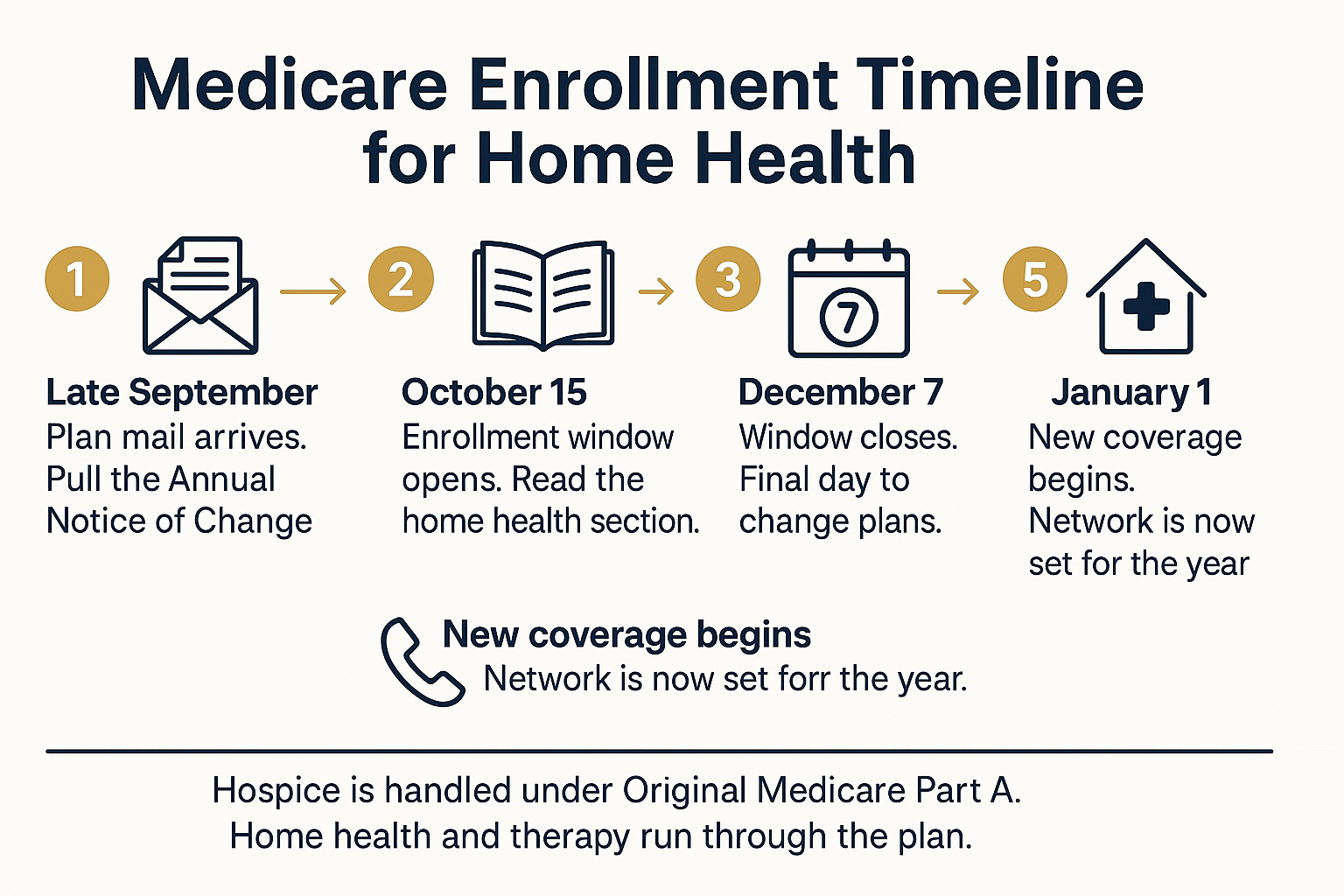
The Annual Enrollment Period runs October 15 through December 7 each year, and whatever is chosen takes effect January 1. Most people spend that window comparing drug copays, dental extras and gym benefits.
Almost nobody asks how the plan handles skilled nursing, physical therapy or wound care delivered at home. But that is the part that matters when a parent falls in February or comes home from Salinas Valley Health after a hip replacement.
Monterey County has roughly 65,000 residents aged 65 or older out of about 437,600 people. Every fall, thousands of those households quietly decide which home health agencies will be available to them for the next twelve months, without knowing that is what they are deciding.
A few things change with the plan a family picks:
- Which home health agencies are considered in-network for their specific address
- Whether home health visits require prior authorization before care can start
- How many visits the plan will approve at a time before a new review
- What happens if the only in-network agency does not serve their town
South County families feel this hardest. An agency can be in-network on paper and still not send clinicians to Greenfield or King City, which is a different problem from a coverage denial and needs a different question asked up front.

What to Read in October and November, and What to Ask by Phone
Plan documents arrive in the mail every fall and most of them go straight into a pile. The two worth pulling out are the Annual Notice of Change and the Evidence of Coverage, and the section to find is the one covering home health services.
Read it, then call the plan’s member services line anyway, because the booklet language is usually broader than the real rules. Ask these four questions and write the answers down with the date and the name of the person who answered:
- Does home health require prior authorization, and who submits it, the doctor or the agency?
- Does the plan publish a list of in-network home health agencies that serve my parent’s exact street address, not just the county?
- How many visits are approved at a time, and what triggers a new review?
- If the in-network agency does not cover our town, what is the process for an out-of-network exception?
Keep that page. When a discharge planner asks in March who your parent’s plan is, you will have the answer in hand instead of guessing.
If the network question turns into a real problem after the fact, that is a separate situation with its own steps. We covered it in what happens when a Medicare plan limits which home health agency you can use.
Four Questions to Ask a Plan Before December 7
Here is a simple way to keep track of what you learn on the phone. Fill in the third column yourself and keep it with the plan paperwork.
| Question to ask | Why it matters in March | Where to look first |
|---|---|---|
| Is prior authorization required for home health? | Authorization delays can stall the start of care for days after discharge | Evidence of Coverage, home health section |
| Which agencies are in-network for this street address? | County-level lists often overstate real coverage in South County towns | Plan provider directory, then confirm by phone |
| How many visits are approved per authorization? | Determines how often the plan re-reviews an ongoing therapy or nursing plan | Member services line |
| What is the out-of-network exception process? | Matters when the only in-network option does not drive to your town | Member services line, ask for it in writing |
| Is hospice handled by the plan or by Original Medicare? | Hospice is handled separately from the rest of the plan’s benefits | Evidence of Coverage, hospice section |
The Hospice Rule Most Families Never Hear Until They Need It
This one surprises people every year. For someone enrolled in a Medicare Advantage plan, the hospice benefit is handled under Original Medicare Part A, not through the plan.
Meanwhile home health visits, palliative care and physical, occupational and speech therapy are handled through the plan itself, with the plan’s own network and its own authorization rules.
That single split changes what a family should be comparing in the fall. If you are weighing plans partly because of a parent’s serious illness, the network question applies to home health and palliative care, while hospice sits on a different track.
Plan rules do vary, so confirm the specifics with your own plan rather than taking a general explanation as final. If you are still working out which kind of care fits the situation, home health versus hospice walks through how families tell the difference.
The Fall Timeline, Start to Finish
A quick view of when the decisions happen and when they take effect.
Make Sure You Are Shopping for the Right Kind of Care
Search for home health in Monterey or Salinas and half the results are non-medical companion agencies. Families end up calling about meals and errands when what the doctor actually ordered was skilled nursing, wound care or therapy.
The two are not the same thing, and Medicare treats them very differently.
Home health is physician-ordered, intermittent clinical care delivered in the home by Registered Nurses, Licensed Vocational Nurses, Physical Therapists, Occupational Therapists, Speech Therapists and Medical Social Workers, with support from chaplains, volunteers and other clinicians as needs change. Medicare covers it under specific conditions.
Non-medical home care covers bathing, meals, housekeeping and companionship. It is genuinely valuable, but it does not meet Medicare’s home health conditions, and it is paid for differently.
One more piece stops families cold every week: a doctor’s order and a face-to-face visit come first. Home health cannot start because a family requests it. A physician has to order it and document that visit.
People who do not know this often stall out or give up on the phone. If the roles are still fuzzy, IHSS, home health or private duty sorts out who does what, and why a physician referral is required explains how the order actually moves.
What Families Actually Pay, and Why It Is Hard to Pin Down
Nobody can hand you a single number, and anyone who does is guessing. What a family pays out of pocket depends on the plan type, whether the visits are authorized, whether the agency is in-network, and whether the patient is also on Medi-Cal.
The piece that is fixed and public is the Part B premium. The standard Part B premium is $202.90 a month for 2026. The 2026 Medicare Trustees Report projects roughly $209.50 for 2027, though CMS does not confirm the real figure until its fall announcement, and some private forecasters expect it to land higher.
Payment and coverage rules on the agency side are moving too. CMS has proposed updates to the home health payment system for 2027, effective for dates of service on or after January 1, 2027, the same year families are choosing plans this fall.
And do not assume you are outside the picture if you are not on a standard commercial plan. Home-based care through Medicare, Medi-Cal and Veterans benefits is available in this region, and dual eligibility changes the math considerably.
Monterey County has a meaningful veteran population and a real number of households where cost decides everything, with over-65 households reporting a median income well below the county median. Ask about all three rather than assuming you do not qualify. Veterans and home-based care covers benefits most families never think to ask about.
Frequently Asked Questions About Medicare Enrollment and Care at Home
Can I switch plans in the middle of the year if my parent suddenly needs home health?
Usually no. Outside of October 15 through December 7, changes generally require a Special Enrollment Period, which is triggered by specific events like a move, a loss of other coverage, or gaining Medi-Cal eligibility. A new diagnosis by itself does not open one.
Does Medicare cover home health, and do we need a referral from the doctor first?
Yes to both, in most situations. Medicare covers physician-ordered, intermittent skilled nursing and therapy at home when the patient meets the coverage conditions. A doctor’s order and a documented face-to-face visit come first, so the fastest path is usually a call to the primary care physician or the hospital discharge planner.
If my mom is on a Medicare Advantage plan, does she lose her plan when she elects hospice?
She does not lose the plan. The hospice benefit itself is handled under Original Medicare Part A, while the plan continues to cover other services. Confirm the details with her plan, because supplemental benefits and prior authorization rules are not uniform.
What if the only in-network agency does not drive to our town?
Ask the plan for its out-of-network exception process, in writing, before you need it. This comes up regularly in Greenfield, King City and parts of San Benito County, where distance rather than network status is the real limit.
Can services start before hospice is on the table?
Yes. Palliative care supports people with serious illness while they are still pursuing treatment, and grief support is open to anyone in the community, not only families who have been through hospice. Several callers each month are surprised to learn both are available earlier than they assumed.
Questions About Coverage Before the Window Closes?
Central Coast VNA & Hospice is a nonprofit that has been making home visits in Monterey County since 1951, holds a 4-Star CMS Home Health rating, and accepts Medicare, Medi-Cal and Veterans benefits across Monterey, San Benito, South Santa Clara and parts of Santa Cruz County. One family member described how it began for them: “Her PCP contacted VNA and I was blown away by the personalized care that she received.” – Claude C.
If you want to talk through how coverage works before you finalize a plan, a care coordinator can walk you through the questions at 831-372-6668 or at ccvna.com.