
Direct Answer: It is a written list of conditions, drugs, and services a hospice has decided are unrelated to the terminal illness, so they are not covered. Medicare requires it for all patients starting October 1, 2026.
Hospice admission almost never happens on a calm day. Someone has just come home from a hospital or rehab stay in Salinas or on the Monterey Peninsula, and a stack of paperwork lands on the kitchen table while the family is still absorbing what the doctor said.
Starting October 1, 2026, one page in that stack will be new to most families. It is called the hospice election statement addendum, and it lists the conditions, medications, and treatments the hospice has determined are not related to the terminal illness. Those items are not paid for under the hospice benefit.
Medicare finalized a rule that makes this form mandatory for every Medicare patient at the moment hospice begins. This article covers what is actually on it, who decided what, and how to read it line by line without guessing.
What the hospice election statement addendum actually is
The addendum is not brand new. It has existed for several years, but a family had to know to ask for it, and almost nobody knew to ask.
Under the FY 2027 hospice final rule, the hospice has to provide it to every Medicare beneficiary at the time of hospice election, requested or not. CMS confirms the change takes effect October 1, 2026.
The form generally spells out:
– Conditions the hospice determined are unrelated to the terminal diagnosis
– Items and services connected to those unrelated conditions
– Medications the hospice will not cover under the hospice benefit
– The patient’s name, the hospice’s name, and the date the determination was made
This is a transparency document, not a denial letter. Nobody is taking away a Medicare benefit. The point is to show the family, in writing and up front, where the hospice benefit stops, so a bill does not show up four months later as a surprise.
And that distinction matters when you are reading it at 8 p.m. in a house in King City with three other relatives on speakerphone. A list of exclusions looks alarming until you understand that it is a map, not a rejection.

Monterey County families are already asking this question before they sign anything
Coverage is one of the first things families here bring up. Roughly one in ten calls to a local home health and hospice line involves some version of “does Medicare cover this,” and it comes up long before anyone is looking at a form.
Callers new to all of this also mix up three different things. Home health, palliative care, and hospice are separate programs with separate rules, and people often use the words interchangeably on the phone. If that sounds familiar, the difference between home health and hospice is worth sorting out first.
The addendum is the moment the abstract question turns concrete. It stops being “I wonder what Medicare pays for” and becomes a piece of paper with your mother’s name at the top and a list under it.
That is uncomfortable, but it is better than the alternative. Families across Monterey County, San Benito County, and the Salinas Valley have historically found out about non-covered items the slow way, through an explanation of benefits that arrived weeks after a funeral.
What “unrelated” means, and why dialysis comes up so often
Hospice covers care related to the terminal illness. The hospice’s clinical team decides what counts as related, and that judgment is what fills the addendum.
One family described the decision plainly: he wants to stop dialysis and focus on comfort at home. That is the situation where the related and unrelated line gets real, because kidney failure may be the terminal diagnosis in one case and a separate long-standing condition in another.
The items that most often trigger this conversation:
– Dialysis, especially when a different illness is the terminal diagnosis
– Ongoing chemotherapy or radiation intended to treat rather than comfort
– A long-standing medication for an unrelated condition, like a thyroid drug or a statin
– Treatment for an unrelated injury, such as a fall that breaks a wrist
If something lands on the list and you do not understand why, ask two questions. Why was this considered unrelated, and does original Medicare still cover it separately outside the hospice benefit?
Sometimes the answer is yes, and the treatment continues through Part B or Part D with different billing. Sometimes the answer reframes the whole conversation. Families weighing that exact tradeoff often find it helpful to read about what happens at home after someone stops dialysis.
Where common items usually land
Every case is judged individually by the hospice’s clinical team, so treat this as general orientation rather than a rule. Use it to build your question list.
| Item or service | Where it usually falls | Question to ask the team |
|---|---|---|
| Pain and symptom medication for the terminal illness | Generally covered under the hospice benefit | Which of my parent’s current drugs are you taking over? |
| Visits from nurses, therapists, social workers, chaplains, and volunteers | Generally covered under the hospice benefit | How often will each of these visits happen? |
| Home medical equipment such as a hospital bed or oxygen | Usually covered when tied to the terminal illness | Is this equipment covered, and who delivers it? |
| Dialysis when a separate illness is terminal | Often listed as unrelated | Why was this placed on the list, and what are the alternatives? |
| Long-standing drug for an unrelated condition | Often listed as unrelated | Does original Medicare or Part D still cover this separately? |
| Room and board in a facility | Not part of the hospice benefit itself | Who bills for the room, and at what rate? |
How to read the form, step by step
A short sequence for working through the addendum with the care team instead of guessing at it alone.
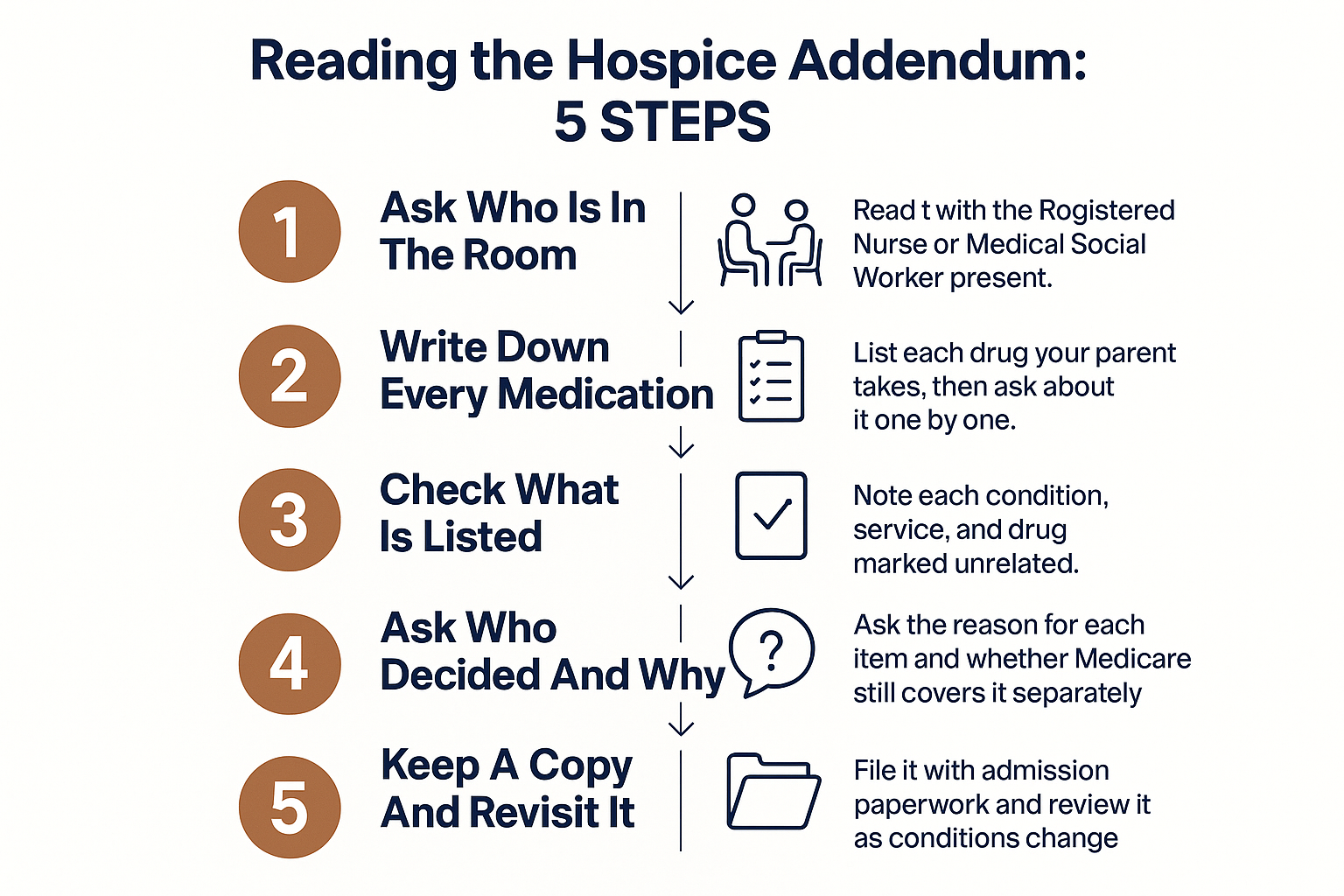
Do something with the form, not just to it
The worst way to read this document is alone at the kitchen table at 10 p.m. after everyone has gone home. By then the questions have nobody to land on.
A better approach:
– Read it with the Registered Nurse or Medical Social Worker present during a scheduled visit
– Bring a written list of every medication your parent currently takes, including over-the-counter ones, and ask about each
– Ask who made each determination and what the reasoning was
– Ask whether original Medicare, Part D, or Veterans benefits cover any listed item separately
– Keep a copy with the rest of the admission paperwork, not loose in a drawer
One more thing worth knowing. The addendum reflects one hospice’s clinical determination at one point in time, and conditions change.
A medication that seemed unrelated in November may be squarely tied to symptom management by February. Asking for a fresh look as care evolves is a normal request, not a confrontation.
Why California families are being told to read paperwork closely right now
There is a reason hospice paperwork is getting more attention across the Central Coast. California’s emergency hospice licensing rules took effect June 22, 2026, and state officials have said more than 280 hospice licenses were revoked over roughly the past two years.
Most of that activity has centered in Southern California, but the tightened rules apply statewide, including here in Monterey County and Hollister. Families are being advised, correctly, to look at what an agency puts in writing.
The new federal addendum requirement fits that pattern. It forces an agency to make its own coverage decisions visible on paper at the start of care, where a family can see them and question them.
If you are still comparing agencies, it pairs well with the other homework: how families here vet a hospice provider covers what to verify before anyone signs.
Who at an agency can explain the list to you
Hospice at home is delivered by a team, not one person. That team includes Registered Nurses, Licensed Vocational Nurses, Physical Therapists and other therapists, Medical Social Workers, Chaplains, Hospice Aides, and Volunteers.
For coverage and benefits questions, the Medical Social Worker is usually the right person to ask. That role exists partly to untangle exactly this kind of paperwork.
One Monterey Peninsula family described that help in a public review of Central Coast VNA & Hospice: “She helped us find the right agency to cancel her mom’s Medicaid in FL and recommended additional resources in the community.”
That is the kind of question a social worker handles regularly, alongside the addendum, the billing questions, and the forms nobody at home has seen before. When you get the form, ask who on the team owns coverage questions, and then bring your list to that person.
Frequently Asked Questions About the Hospice Election Statement Addendum
Does the addendum mean Medicare is denying my parent’s coverage?
No. It is a list, not a denial. It tells you which conditions and treatments the hospice has decided fall outside the terminal illness, so you know where hospice billing ends and other coverage may begin.
Can we disagree with something on the list?
Yes, and you should say so if something looks wrong. Ask the team why the item was considered unrelated and what they based that on. Determinations are clinical judgments, and a conversation about your parent’s full history sometimes changes them.
Do we have to sign it?
A signature generally confirms that you received and reviewed the document, not that you agree with every clinical determination on it. Ask the nurse or Medical Social Worker to note your questions before you sign so they are on the record.
What happens if my parent’s condition changes after admission?
The addendum reflects one point in time. If new symptoms appear or a condition progresses, ask the team to revisit which items are considered related. This is a reasonable thing to raise at any visit.
Does this apply to someone on a Medicare Advantage plan or Medi-Cal?
Hospice is generally paid through original Medicare even for people enrolled in a Medicare Advantage plan, so the addendum requirement applies broadly to Medicare beneficiaries electing hospice. Coverage layers vary by plan and by Medi-Cal status, so ask a care coordinator to walk through your specific situation.
Questions about what hospice covers for your family?
Central Coast VNA & Hospice is a nonprofit founded in 1951, marking 75 years in 2026, serving Monterey County including Salinas, King City, and the Monterey Peninsula, along with San Benito County and parts of the surrounding region. Medicare, Medi-Cal, and Veterans benefits are accepted. A care coordinator can talk through coverage questions at 831-372-6668 or at ccvna.com whenever you are ready.