
Direct Answer: Real home health and hospice care starts with a physician’s order, never a cold call. Verify by calling the agency’s published number, then the treating doctor, then checking Medicare claims.
The call comes on an ordinary Tuesday. Someone you have never heard of says they are following up about your mother’s care, and they use her full name like they already know her.
Or there is a knock at the door. A woman says she is with the hospital and mentions a hospice home your family never discussed. That happened to a family in south Monterey County this year, and they wrote in because they did not know what to make of it. Another caller said it more plainly: they had no way to tell if the agency was real, or if the person who contacted them actually worked there.
That unease is worth taking seriously. But it is also something you can settle in one afternoon with three or four phone calls, and this guide walks through them in order.
First, Know How Home Health and Hospice Legitimately Begin
This is the single clearest test, and it screens out most of what families are worried about.
In California, home health and hospice care both start with a physician’s order. A doctor who is treating your parent decides the care is appropriate, signs a referral, and sends it to an agency. Only then does anyone schedule a visit.
Roughly one in ten callers to local agencies do not know a doctor’s referral is required first. That gap is exactly what enrollment schemes rely on.
So here is your first filter. No real agency will:
- Sign a patient up in a parking lot, at a health fair table, or over the phone
- Ask for a Medicare number, Social Security number, or bank information before an in-person assessment has been scheduled and confirmed
- Offer free groceries, gift cards, housekeeping, or transportation in exchange for signing paperwork
- Show up unannounced without your parent’s doctor ever mentioning a referral
A legitimate first contact usually sounds boring. A scheduler calls to confirm an address and set a time for a nurse’s evaluation visit, and they can name the referring physician without hesitating.

The Verification Sequence, Step by Step
Work through these in order. Each one takes a few minutes, and you can finish the whole thing in a single sitting.
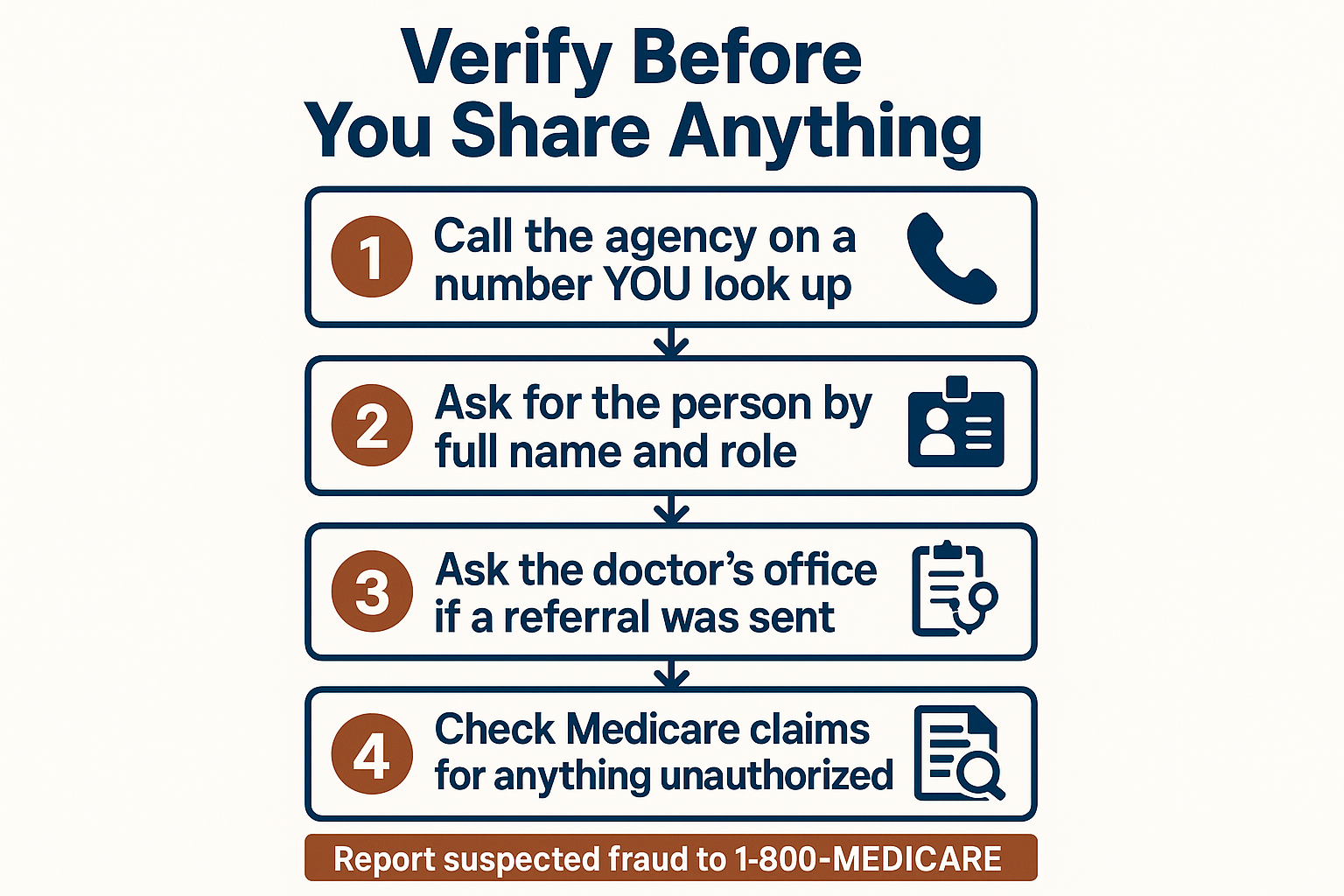
1. Call the agency back on a number you found yourself. Do not use the number the person handed over or left on voicemail. Look the agency up on its own website or its Google Business Profile and dial that number instead. A fake operation cannot control what happens when you call the real one.
2. Ask for the staff member by full name and role. Say you were contacted by a person claiming to be their Registered Nurse, scheduler, or liaison, and ask the front desk to confirm that person works there. Real agencies answer this in under a minute.
3. Call your parent’s treating physician’s office. Ask directly whether they sent a home health or hospice referral, when, and to which agency. If the answer is no, you have your answer.
4. Check what has been billed. Log into your parent’s account at medicare.gov, or read the most recent Medicare Summary Notice that came in the mail. You are looking for a home health or hospice claim nobody in the family authorized.
If something looks wrong, report it to 1-800-MEDICARE. California’s Senior Medicare Patrol and HICAP counselors will also sit down with you and read a claim statement you do not understand, at no cost.
Who to Call and What to Ask
Keep this next to the phone. Four calls, four specific questions.
| Who You Call | What You Ask | What a Clean Answer Sounds Like |
|---|---|---|
| The agency, on its published number | Does a staff member by this full name work here, and in what role? | Yes, that is one of our Registered Nurses, and here is the referral we received |
| The treating physician’s office | Did you send a home health or hospice referral for my parent, and to whom? | Yes, sent on this date to this agency, at the doctor’s direction |
| Medicare, at 1-800-MEDICARE | Has a hospice or home health claim been filed under my parent’s number? | A clear yes or no, plus how to dispute a claim you did not authorize |
| HICAP or Senior Medicare Patrol | Can you help me read this Medicare Summary Notice? | A free appointment with a trained counselor who walks the statement with you |
The Four-Call Check, in Order
A simple sequence a worried adult child can complete in one afternoon.
Why an Unauthorized Hospice Election Is Not Just Paperwork
This is the part families tend to underestimate.
Electing the hospice benefit is a voluntary choice that requires a physician’s certification, and it changes how Medicare and Medi-Cal pay for care connected to the terminal condition. The California Department of Health Care Services explains that hospice election replaces normal coverage for services related to that condition.
So a parent enrolled without knowing it can discover that coverage for treatment they are still actively pursuing has quietly shifted underneath them. Chemotherapy, dialysis, a surgical follow-up: the billing rules change, and the family usually finds out at the worst possible moment.
That is why an enrollment nobody remembers agreeing to is worth chasing down the same week you find it, not after the next billing cycle. It is also worth understanding the difference between the programs before you assume the worst, because home health and hospice serve very different situations and a referral for one is not a referral for the other.
What Has Been Happening in California This Year
Some background helps explain why families are on edge, and why the answer is usually reassuring here on the Central Coast.
In April 2026, federal agents suspended 447 hospices and 23 home health agencies in the greater Los Angeles area over an estimated $600 million in alleged Medicare fraud. California has barred new hospice licenses since January 1, 2022, and on June 11, 2026 the California Department of Public Health filed the state’s first full set of hospice licensing regulations after decades with no real operational rulebook behind a license.
Almost all of the enrollment schemes have been concentrated in Southern California. But phone calls and mailers do not respect county lines, and neither do the lists these operations buy.
For families in Monterey, Salinas, Seaside, King City, and Hollister, the practical takeaway is simple. An agency your parent has never heard of, contacting you first, deserves a second look. If you want the wider picture, we covered what the fraud crisis means for California families separately.
What an Established Local Agency Looks Like
This article is not about comparing agencies you are considering. It is about one situation: someone made contact first, and you need to confirm identity, confirm whether a referral exists, and confirm whether anything was billed. If you are further along and actually choosing, there is a separate process for vetting a provider.
Still, it helps to know what a long-standing organization looks like on paper. Look for how long the agency has served the area and who stands behind it.
Central Coast VNA & Hospice has operated here since 1951, became a Medicare-certified home health agency in 1963, and holds Joint Commission accreditation. Its board includes nursing leadership from local hospitals, and its clinicians, including Registered Nurses, Licensed Vocational Nurses, Physical Therapists, Occupational Therapists, Speech Therapists, Medical Social Workers, Chaplains, and Volunteers, are identifiable by name and role.
Staff identity can be confirmed by calling the main line at 831-372-6668 before anyone is let through the door. That is true of any reputable agency, and you should never feel awkward about asking.
Frequently Asked Questions About Hospice Enrollment Without Consent
Can someone enroll my parent in hospice without them signing anything?
They should not be able to. Hospice election is voluntary and requires a signed election statement plus a physician’s certification. But enrollment fraud usually works by getting a signature under false pretenses, or by using a Medicare number obtained some other way, which is why checking the claims record matters even when nobody remembers signing.
My parent already gave out their Medicare number. What now?
Call 1-800-MEDICARE and report it, then check the Medicare Summary Notice or the medicare.gov account for claims your family did not authorize. A HICAP counselor can help you read the statement and file a dispute if something is there.
A hospital case manager called me about hospice. Is that a red flag?
No. Hospital case managers and discharge planners contact families about home health and hospice all the time, and that is a normal part of leaving the hospital. The difference is that the case manager works for a hospital you can call back, and the referral traces to your parent’s treating physician. Verify the same way, just expect the answers to check out.
How quickly do I need to deal with this?
Within the same week. An unauthorized hospice election changes how care tied to the terminal condition is paid for, so the longer it sits, the more likely a family runs into a denied claim for treatment their parent is still receiving.
What if the person was legitimate and I offended them by checking?
You will not have. Every experienced agency in Monterey County fields identity verification calls, and a real Registered Nurse or scheduler expects them. If someone gets defensive when you say you want to call the main office first, that reaction is information.
Still Not Sure Who Contacted Your Parent?
If someone reached out about care for a parent in Monterey County and the story does not add up, a care coordinator can help you understand how a referral is supposed to arrive and what questions to ask next. Central Coast VNA & Hospice has answered questions like this from Central Coast families since 1951, and the main line is 831-372-6668.