
Direct Answer: Fraudulent hospice providers in California pressure families into enrollment without physician consent, avoid transparency about Medicare benefits, and lack verifiable community history. Nonprofit status, longevity, and accreditation are your clearest safeguards.
In April 2026, federal agents suspended 447 hospices and 23 home health agencies in the greater Los Angeles area, alleging roughly $600 million in Medicare fraud. That number is not a typo. California’s hospice fraud problem has grown into one of the largest healthcare crime waves in the country.
The fraud is not limited to Southern California, and it is not abstract. The California Hospice and Palliative Care Association has documented cases where scammers “deceptively and illegally enroll seniors in hospice and skilled home health programs they never consented to.” Families across the state, including those in Monterey County, need to understand what is happening before they accept a referral or sign any paperwork.
This article focuses on two things: what the fraud actually looks like in practice, and how families can tell the difference between a trustworthy provider and one they should walk away from.
What California’s Hospice Fraud Actually Looks Like
Hospice fraud does not always look like obvious crime. It often looks like a helpful person showing up at the right moment, offering relief to a family that is already exhausted and overwhelmed.
The scheme tends to follow a pattern. A recruiter, sometimes posing as a hospital worker or social services coordinator, approaches a senior or their family and steers them toward a specific hospice agency. The family signs documents they may not fully understand. The agency then bills Medicare for services it either never delivers or delivers poorly, while the patient loses access to treatments they could still benefit from.
The California Governor’s office confirmed expanded DHCS oversight of hospice services taking effect in July 2026, and emergency hospice regulations took effect on June 22, 2026, giving the California Department of Public Health broader authority to deny licensure, investigate complaints, and revoke licenses from illegitimate operators. This is a meaningful shift. But regulations alone do not replace a family’s own judgment.
The warning signs families should watch for include:
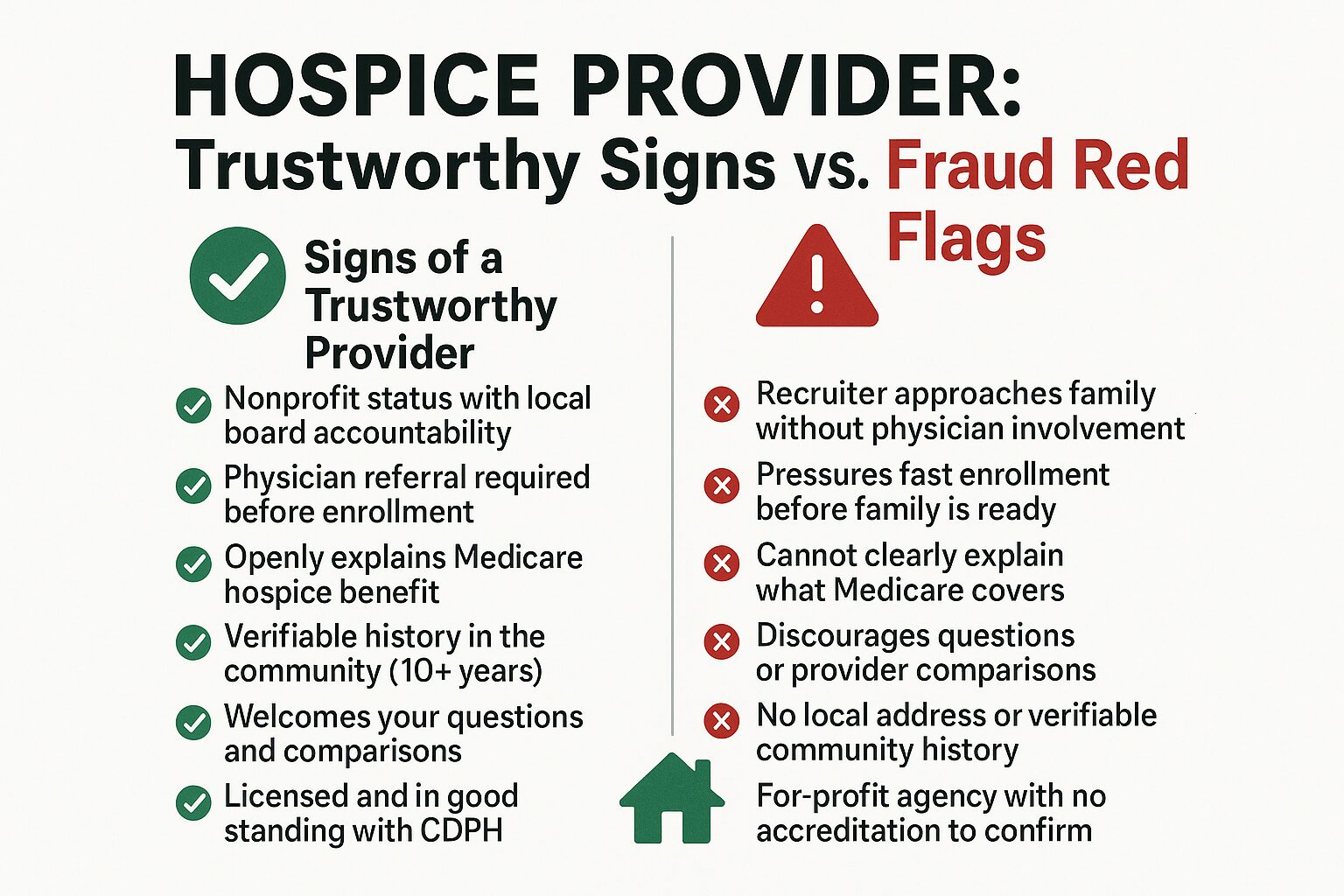
- Pressure to enroll before a physician has recommended it, a legitimate hospice never pushes enrollment
- Recruiters approaching you in non-medical settings, like at a senior center, a pharmacy, or through an unsolicited call
- An agency that cannot clearly explain what the Medicare hospice benefit covers or what your loved one would be giving up
- Discouraging you from asking questions or comparing providers
- No verifiable history in your community, no local address, no staff you can speak with directly, no track record you can confirm
If any of these apply to a provider you are considering, stop and ask more questions before moving forward.

Why Referrals Alone Are Not Enough
Many families assume that if a hospital or physician refers them to a hospice provider, that provider must be reputable. This is understandable, but it is not always true.
Hospital discharge planners work under real time pressure. They may default to whichever agency responds fastest or is most familiar to their team, not necessarily the one with the strongest record of care. A referral is a starting point, not a guarantee.
Families have every right to ask:
- “Who else could we consider for hospice care in this area?”
- “How long has this agency operated in Monterey County or the surrounding region?”
- “Is this provider accredited and in good standing with the California Department of Public Health?”
- “Is this a nonprofit or a for-profit agency?”
Asking those questions is not rude. It is exactly what a thoughtful family should do. A trustworthy provider will welcome them. One with something to hide will not.
For families navigating this for the first time, it also helps to understand what hospice actually involves before any agency visit or paperwork conversation. Articles like how to know when it may be time to consider hospice care and what families often miss when planning a hospital discharge to home can help you go into those conversations with the right questions already in mind.
Trustworthy Hospice Provider vs. Fraud Red Flags
Use this side-by-side comparison to quickly evaluate any hospice provider you are considering.
What Longevity and Nonprofit Status Actually Signal
One of the most reliable ways to evaluate a hospice provider is to ask how long they have been operating in your specific community, and whether they are a nonprofit.
Fraud operations are built to bill Medicare quickly and then disappear or rebrand before regulators catch up. They cannot fabricate decades of community presence. A nonprofit organization accountable to a local board of directors has a fundamentally different structure than a billing operation set up to exploit the Medicare hospice benefit.
This is not to say that all for-profit hospice agencies are fraudulent, or that all nonprofits are above criticism. But when a provider has been delivering care in the same communities since before most of today’s families were born, that history is verifiable. Patients and families from Salinas, Pacific Grove, King City, and Hollister can speak to the care they received. Neighbors can vouch or not vouch. That kind of local accountability does not exist when a provider showed up recently with no track record you can trace.
Families evaluating their options should also consider whether a provider accepts Medicare and Medi-Cal on a transparent basis. Legitimate providers are straightforward about coverage. If an agency is vague about billing or steers you away from using Medicare, that is a reason to pause.
For a broader look at how to evaluate a provider’s credibility, how to tell if a hospice provider is actually trustworthy covers the specific questions worth asking before you commit.
Questions to Ask Any Hospice Provider Before Enrolling
Before agreeing to hospice services for a loved one, work through this checklist with any provider you are considering.
| Question to Ask | What a Good Answer Looks Like | Why It Matters |
|---|---|---|
| How long has your agency operated in this county? | Specific founding year, verifiable local history | Fraud operations cannot fake a long local track record |
| Is this agency nonprofit or for-profit? | Clear, direct answer with no deflection | Nonprofit status signals community accountability over profit motive |
| Did my physician recommend hospice and refer us to you specifically? | Enrollment should follow a physician recommendation | Unsolicited recruitment is a primary fraud tactic |
| What exactly does the Medicare hospice benefit cover? | Plain explanation of covered services and what changes at enrollment | Legitimate providers explain this clearly without hesitation |
| Are you licensed and in good standing with the California Department of Public Health? | Confirmed licensure, ability to provide accreditation details | New regulations give CDPH authority to revoke fraudulent operators |
| Can I speak with a care coordinator before we decide anything? | Yes, with no pressure to sign first | Trustworthy agencies welcome questions before commitment |
What the New California Regulations Mean for Families
The emergency hospice regulations that took effect June 22, 2026 represent a real shift in how California oversees hospice licensure. The California Department of Public Health now has broader authority to deny new licenses, investigate complaints more aggressively, and revoke the licenses of providers found to be operating fraudulently.
This matters for families because it means the accountability gap that allowed hundreds of fraudulent agencies to operate in California is beginning to close. The expanded DHCS oversight taking effect July 2026 adds another layer of scrutiny at the state level.
But regulatory change moves slowly compared to how quickly a family in crisis needs to make a decision. If your parent is being discharged from Natividad Medical Center or Community Hospital of the Monterey Peninsula and a hospice referral is on the table, you may have hours, not weeks, to evaluate your options. Knowing the warning signs in advance is the practical advantage that regulations alone cannot give you.
Families who want to understand more about what hospice actually involves, separate from the fraud question, will find it useful to read hospice care is not what most families think it is before they are in a time-pressured situation.
Frequently Asked Questions About Hospice Fraud in California
Can I switch hospice providers if I realize I enrolled with the wrong one?
Yes. Under the Medicare hospice benefit, a patient has the right to change hospice providers. You can request a transfer to a different agency without losing your hospice eligibility. If you believe you were enrolled without proper consent or under false pretenses, you can also report the provider to the California Department of Public Health and to Medicare directly.
Does the hospice fraud crisis affect providers in Monterey County, or just Southern California?
The large-scale suspensions in April 2026 centered on the Los Angeles area, but the patterns that enable fraud, including loose oversight and aggressive recruiting, are not geographically limited. Families throughout California, including the Central Coast, should apply the same due diligence regardless of location.
What does a patient give up when they enroll in hospice?
Under the Medicare hospice benefit, a patient agrees to shift focus from curative treatment to comfort-focused care. This means Medicare generally stops covering treatments aimed at curing the underlying illness. This is a significant decision that should happen only when a physician has determined that curative treatment is no longer the goal, and only after a full conversation with the patient and family. Any provider that enrolls a patient without that conversation is not operating ethically. For more on this, comfort care vs. hospice: why the difference matters explains the distinction clearly.
How do I verify a hospice provider’s license in California?
The California Department of Public Health maintains a public database of licensed healthcare providers. You can search by provider name or license number to confirm current status. If a provider cannot give you a license number or discourages you from checking, that is a significant warning sign.
Is a physician referral required to start hospice?
Yes. Legitimate hospice enrollment requires a physician to certify that the patient has a terminal diagnosis with a life expectancy of six months or less if the illness follows its expected course. No reputable hospice agency will enroll a patient without that physician certification in place. If someone is pushing enrollment before that step has happened, stop and ask why.
Want to Ask Questions Without Any Pressure?
Central Coast VNA & Hospice has been serving families in Monterey County, San Benito County, and surrounding Central Coast communities since 1951, and a care coordinator is available to answer your questions at whatever pace you need. You can call the team at 831-372-6668 or visit ccvna.com to learn more about hospice and palliative care services, how the enrollment process actually works, and what families in this region typically want to know before they decide.