
Direct Answer: When a serious illness keeps progressing despite treatment and a doctor estimates life expectancy at six months or less, hospice care becomes an option worth discussing — and asking the question doesn’t commit anyone to anything.
Most families on the Monterey Peninsula don’t avoid this question because they don’t care. They avoid it because asking feels like giving up — like the moment you say the word ‘hospice,’ something shifts and can’t be undone. That feeling is real, and it’s also one of the most common reasons families wait far too long.
But asking when hospice might be appropriate doesn’t close any doors. It opens a conversation with a doctor, with your family, and with people who have helped thousands of Central Coast families think through exactly this moment. The question is not a verdict.
This article is for families in Monterey County, Salinas, King City, Hollister, and surrounding communities who are watching a loved one decline and wondering — quietly, sometimes in the middle of the night — whether the time has come to ask.
The Clinical Signs That Prompt the Hospice Conversation
There’s no single moment that signals it’s time. But there are patterns — things that, when clinicians and physicians see them together, suggest that treatment is no longer changing the course of an illness in a meaningful way.
Families who’ve been through this process describe a gradual accumulation: a hospitalization, then another, then a third for the same condition. Weight that keeps dropping despite eating. Pain that the current medications aren’t touching. A doctor who starts framing things differently.
The clinical signals that most often prompt the hospice discussion include:
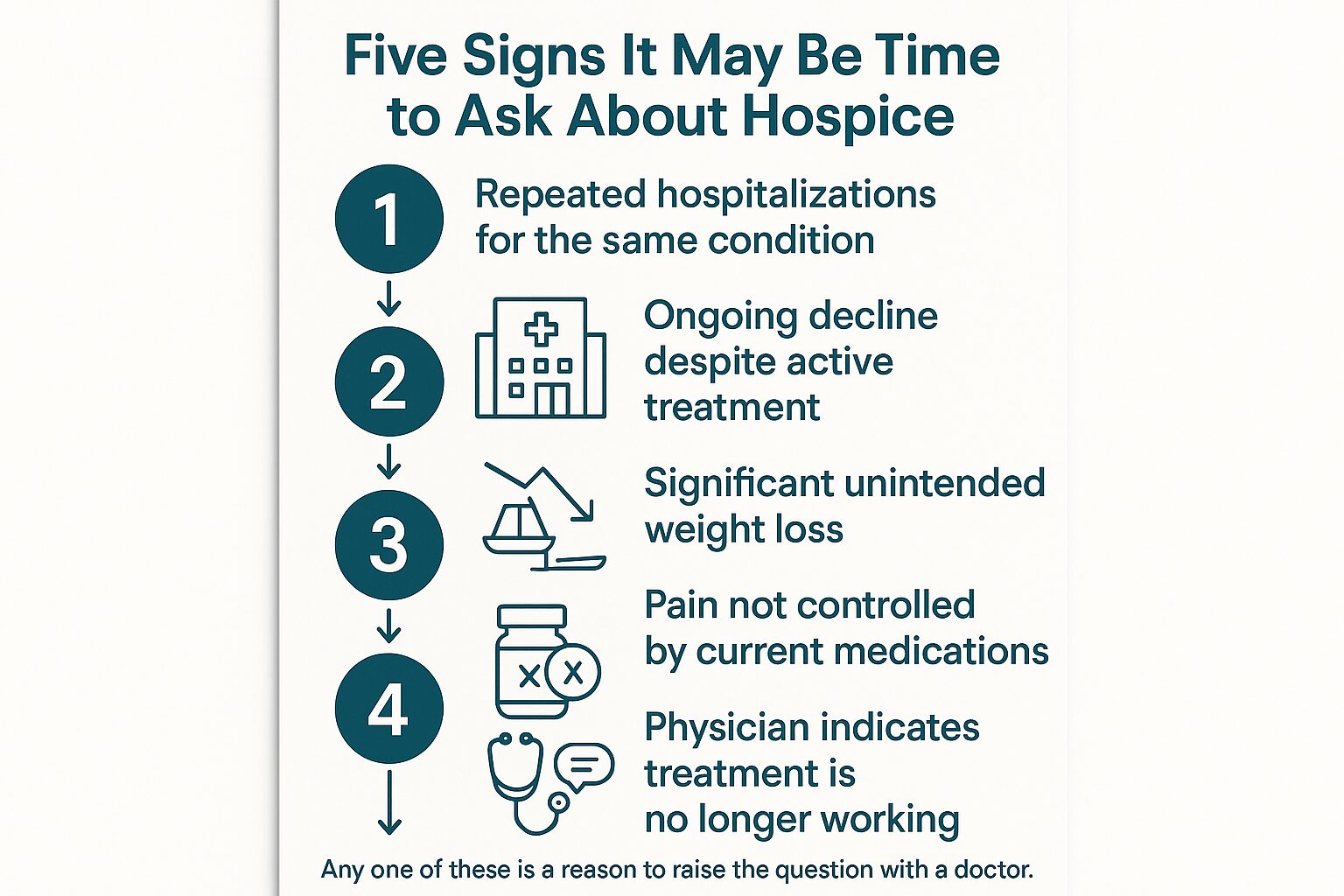
- Repeated hospitalizations for the same condition, with less recovery each time
- Ongoing decline despite active treatment — when the illness keeps progressing regardless of what medicine is being tried
- Significant unintended weight loss, which often signals the body is no longer responding to nutrition the way it once did
- Pain or symptoms that aren’t being controlled by current medications or interventions
- A physician indicating that treatment is no longer working as intended — sometimes stated directly, sometimes in how the conversation shifts
Any one of these is a reason to raise the question with a doctor. You don’t need all five. And raising the question doesn’t mean treatment stops — it means you’re asking whether a different kind of support might serve your loved one better right now.
For more on how families navigate this threshold, how families describe the moment they chose hospice captures the experience in their own words.

Timing Matters More Than Most Families Realize
The most common thing families say after a loved one’s death — heard consistently from families across Monterey County — is some version of: ‘We waited too long.’
That’s not a guilt statement. It’s an honest reflection on what hospice can actually provide when it’s brought in with enough time to make a difference.
When a patient is enrolled in hospice while they still have weeks or months ahead — rather than days — the full team has time to actually work. That means:
- Registered Nurses visiting regularly to assess and manage symptoms before they become crises
- Medical Social Workers helping the family navigate decisions, paperwork, and the emotional weight of what’s happening
- Chaplains providing spiritual care to patients and family members who want it — and quietly being present for those who don’t
- Hospice Aides supporting comfort and daily needs at home
- Volunteers offering companionship and respite, giving family members a chance to rest
When a family waits until a loved one is hospitalized, unresponsive, or in their final hours, most of that support never gets the chance to help. The pain management, the honest family conversations, the spiritual care, the guidance on what to expect — all of it is most effective when there’s time to build a rhythm around the patient’s needs.
This is not about rushing a decision. It’s about understanding what gets lost when the decision comes too late. What comfort-focused care really means goes deeper on how that shift in focus changes the day-to-day experience for patients and families.
Five Signs It May Be Time to Ask Your Doctor About Hospice
These five clinical signals — taken from real physician and hospice intake conversations — are the ones most likely to come up when a family is approaching this decision.
How to Actually Start the Conversation With Your Doctor
One of the most common barriers families face isn’t the decision itself — it’s not knowing how to bring it up. Many people worry that asking about hospice will upset their physician or signal that they’re giving up on their loved one.
In practice, most physicians respond honestly when asked directly. The question that tends to work — and removes a lot of the awkwardness — is this:
‘Would you consider my loved one appropriate for a hospice evaluation?’
That’s it. That one sentence opens the door without requiring the family to reach a conclusion they’re not ready for. It puts the clinical judgment where it belongs — with the physician — while making clear that the family is ready to hear an honest answer.
For hospice care to begin, a physician must certify that the patient’s life expectancy is six months or less if the illness follows its natural course. That certification is a medical determination, not a prediction. Physicians understand that — and most will give a thoughtful answer when asked respectfully.
If the doctor says it’s not time yet, that’s useful information. If they say it’s worth exploring, that’s the beginning of a conversation that could meaningfully change what the next weeks or months look like for your loved one.
The hospice eligibility question most families are afraid to ask breaks down the medical criteria in plain language, which can help families go into that physician conversation feeling more prepared.
Hospice vs. Continued Treatment: What the Decision Actually Involves
Families often assume choosing hospice means choosing between living and giving up. The actual decision looks more like this.
| Factor | Continued Curative Treatment | Hospice Care |
|---|---|---|
| Goal of care | Slow, stop, or reverse the illness | Manage symptoms and maximize comfort |
| Where care happens | Hospital, clinic, or outpatient setting | Home, or wherever the patient lives |
| Who is involved | Treating physician and specialists | Nurses, therapists, social workers, chaplains, aides, and volunteers |
| Medicare coverage | Standard Medicare benefits apply | Medicare Hospice Benefit covers most services |
| Can you change course? | Treatment can be adjusted or stopped | Hospice can be revoked at any time to resume curative treatment |
| Focus on family | Variable — depends on provider | Family support, guidance, and bereavement care are built in |
One Thing Families Often Don’t Know: Hospice Is Reversible
A lot of families stay frozen in the hospice decision — not because they don’t see the need, but because they believe it’s permanent. That belief is one of the most consistent barriers that delays enrollment, and it’s worth addressing directly.
Patients and families can revoke hospice at any time. If someone enrolled in hospice decides they want to pursue curative treatment again, they can leave hospice and resume that treatment. Medicare allows this. It’s a choice that can be unmade.
Understanding this changes the weight of the decision considerably. Exploring hospice isn’t closing a door — it’s opening one. And if it turns out the timing isn’t right, or circumstances change, the path back to active treatment remains open.
The Medicare hospice benefit outlines this in detail, including how revocation works and what happens to coverage when a patient transitions back to curative care.
For families in Monterey County weighing this for the first time, hospice care is not what most families think it is addresses several of the most common misconceptions directly — including the assumption that choosing hospice means a loved one will receive less care, not more.
Frequently Asked Questions About When to Consider Hospice Care
What if my loved one’s doctor hasn’t brought up hospice — does that mean it’s too early?
Not necessarily. Physicians are often waiting for the family to signal they’re ready for that conversation. Many families in Monterey County have found that asking directly — ‘Would my parent be appropriate for a hospice evaluation?’ — opens a door the doctor was hesitant to open first. You don’t have to wait for the physician to raise it.
Does choosing hospice mean my loved one will stop receiving medical care?
No. Hospice is medical care — it just shifts the focus from treating the underlying illness to managing pain, symptoms, and quality of life. Registered Nurses, Nurse Practitioners, Medical Social Workers, Chaplains, and Hospice Aides all continue to visit and provide support. The care doesn’t stop; it changes in character.
What does Medicare actually cover for hospice?
Medicare covers most hospice services under the Medicare Hospice Benefit, including nursing visits, medications related to the terminal diagnosis, medical equipment, aide services, chaplain visits, and bereavement support for the family after the patient’s death. VNA accepts Medicare, Medi-Cal, and Veterans benefits — a care coordinator can walk families through what coverage applies to their specific situation.
Can my loved one receive hospice care at home?
Yes. The majority of hospice care is delivered at home — in the patient’s own house, or wherever they live. For families across Monterey County, Salinas, King City, and Hollister, that means the care team comes to them.
What if we choose hospice and then change our minds?
Hospice can be revoked at any time. If a patient decides to pursue curative treatment again, they can leave hospice and return to standard Medicare coverage. There’s no penalty and no permanent commitment. This is one of the most important things for families to understand before making the decision.
What support is available for family members — not just the patient?
Quite a bit. Medical Social Workers help families navigate decisions and manage emotional stress. Chaplains offer spiritual care to family members as well as patients. Volunteers can sit with a patient so a family member can rest. And Bereavement Specialists continue to provide grief support for families for months after a loved one’s death. The care is built around the whole family, not just the patient.
Ready to Talk Through What This Looks Like for Your Family?
If you’re asking this question — whether in a quiet moment or in the middle of a crisis — that’s reason enough to reach out. Central Coast VNA & Hospice has been walking alongside families across Monterey County, Salinas, King City, Hollister, and the surrounding Central Coast for over 70 years. A care coordinator can help you understand what your loved one might qualify for, what the process looks like, and what questions to bring to your doctor. You can call 831-372-6668 or visit ccvna.com to start that conversation at your own pace.