
Direct Answer: Under current California law, the Medi-Cal asset limit drops on July 1, 2027 to $21,000 for one person and $31,000 for a married couple, affecting people 65 or older, disabled, or needing long term care.
If your mother qualifies for Medi-Cal today with a modest savings account, she may not qualify in the summer of 2027. Under current California law, the asset limit drops sharply on July 1, 2027, and the change hits exactly the people who rely on it most: seniors, disabled adults, and anyone who needs nursing home or other long term care.
For families across the Monterey Peninsula, Salinas, King City, and Hollister, this is not an abstract policy debate. It changes how you plan for in-home nursing, long term care, and the support that comes with a serious illness.
Here is what changes, who it applies to, and what matters in the months before the date arrives.
What the 2027 Medi-Cal asset limit change actually says
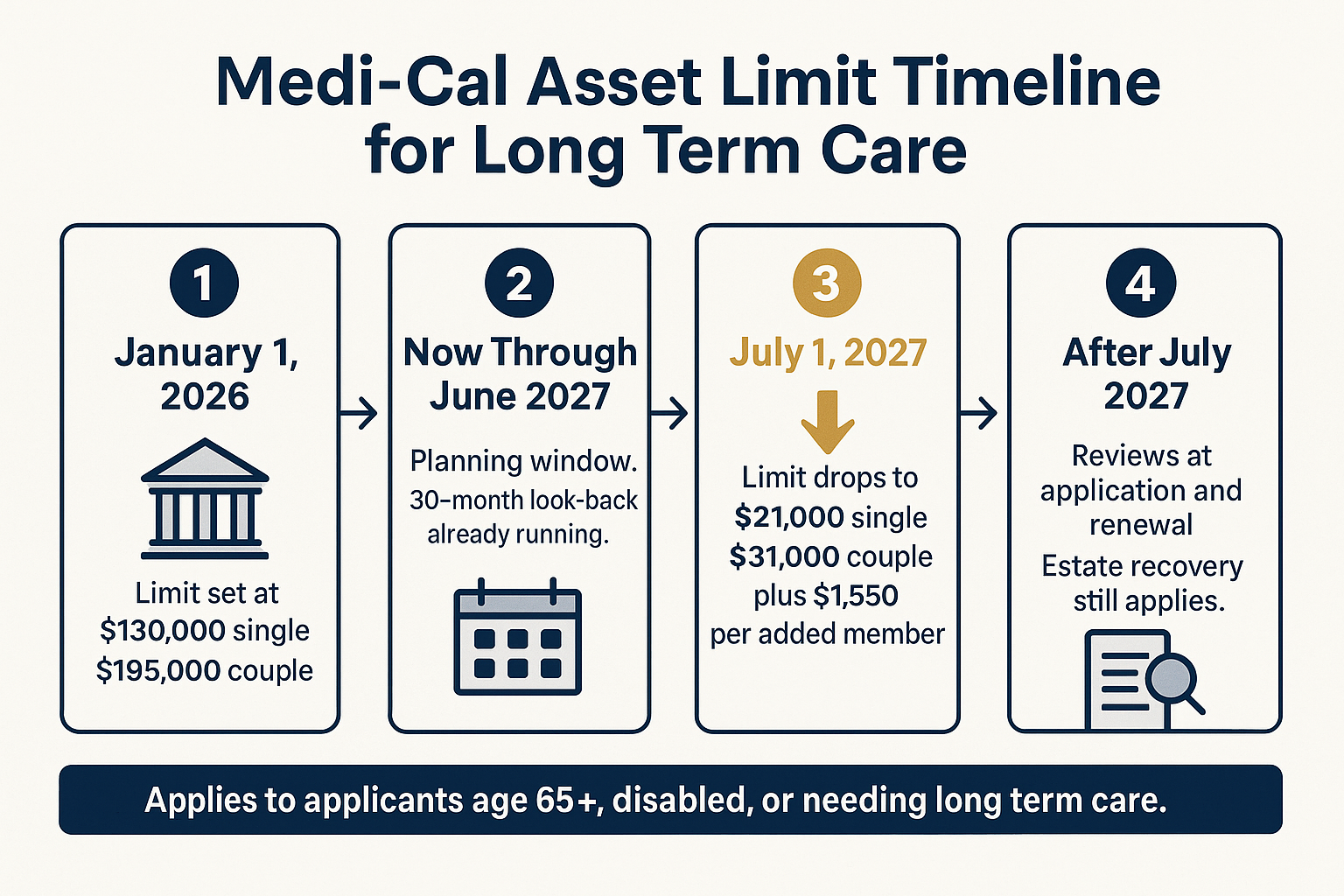
California eliminated most asset counting in 2024, then brought a limit back. The current limit of $130,000 for an individual and $195,000 for a couple took effect January 1, 2026.
Starting July 1, 2027, that limit drops to:
- $21,000 for an individual
- $31,000 for a married couple
- Plus $1,550 for each additional qualifying household member, up to 10 people
That is a drop of $109,000 for a single person. Someone who qualifies comfortably today could be over the line overnight.
Who does it apply to? The change primarily affects Medi-Cal applicants and members who qualify based on age (65 or older), a disability, or a need for nursing home or other long-term care. It is not aimed at working-age adults who qualify through income-based categories.
One detail worth holding onto: implementation is tied to the Department of Health Care Services having its systems ready, and the change can occur no sooner than July 1, 2027. DHCS has posted the schedule on its consumer Medi-Cal Help Center and asset limit FAQ pages. You can check current guidance directly with the California Department of Health Care Services. Analyses from elder law practices including Orange County Elder Law and Ridley Law Offices describe the same schedule.

The 30-month look-back is why timing matters now
Families often assume the answer is simple: move the money. It is not that simple, and the reason is the look-back period.
In California, the look-back for nursing facility level of care is 30 months. That means when someone applies, the county can review asset transfers made during the two and a half years before the application.
Do the math backward from July 1, 2027. Transfers made today already sit inside a 30-month window for an application filed in 2028 or 2029.
A few things families get wrong:
- Revocable living trusts do not hide assets. DHCS counts revocable trust assets as available to you while you are alive. The benefit shows up later, by keeping assets out of probate and therefore out of the state’s estate recovery claim.
- Gifting to adult children is not a free move. An untimed transfer can create a penalty period right when care is needed.
- Spend down is not the same as spending. Paying off a mortgage, repairing a roof, or buying needed medical equipment is different from handing cash to a relative.
This is attorney territory, not blog territory. If your family is weighing long term care in Monterey County, an elder law attorney licensed in California should look at the actual numbers before anyone moves a dollar.
Current limit versus the July 1, 2027 limit
Here is the side-by-side, based on the schedule in current California law.
| Household | Now (since Jan 1, 2026) | Starting July 1, 2027 |
|---|---|---|
| One person | $130,000 | $21,000 |
| Married couple | $195,000 | $31,000 |
| Each additional qualifying member | Not applied the same way | Add $1,550, up to 10 people |
| Who it applies to | Age 65+, disabled, or long term care need | Same groups |
| Look-back for nursing facility level of care | 30 months | 30 months |
The timeline families should be working from
A simple view of the dates that matter and what belongs in each window.
What this means for care at home on the Central Coast
Most families in Monterey County are not planning for a nursing home. They are trying to keep a parent in the house in Marina, Seaside, Greenfield, or Carmel for as long as it is safe.
That distinction matters, because Medi-Cal and Medicare cover different things.
- Medicare covers physician-ordered, intermittent skilled home health: nursing visits, wound care, medication management, physical therapy, occupational therapy, speech therapy. It also covers the hospice benefit.
- Medi-Cal is the program that carries long term care costs, including nursing facility care, and it fills gaps for people who are dual eligible.
- Non-medical help with cooking, cleaning, and rides to appointments is a separate category, and it is the one families most often pay for out of pocket.
In Monterey County, most Medi-Cal members get their care through the Central Coast Alliance for Health. Plan rules shape which agencies a family can use, which is a separate headache from eligibility. We cover that issue in when your Medicare plan limits which home health agency you can use.
Private-pay in-home help is expensive on the Peninsula. Rates vary a lot by hours, overnight coverage, and agency, so get a written quote rather than trusting a number you read online. If a family drops off Medi-Cal in 2027 and has to self-fund, that gap is where savings disappear fastest. How long you can age in place usually comes down to exactly this math.
Four things worth doing before July 2027
You do not need to solve everything this month. You do need to stop treating 2027 as far away.
- Find out which Medi-Cal category your parent is in. Age-based, disability-based, and long term care eligibility are the categories affected. A county eligibility worker can confirm it.
- Write down the actual assets. Checking, savings, CDs, a second vehicle, life insurance cash value. The primary residence is treated differently from cash, and that difference drives most planning.
- Talk to a California elder law attorney, not a general financial advisor. The 30-month look-back makes timing the whole game, and bad timing is expensive to undo.
- Get the care paperwork in order while your parent can still participate. Advance directives, a POLST, and a named decision-maker. Advance care planning is not just paperwork, and it is far easier to complete before a hospital stay than during one.
If your parent is a veteran, add one more item to the list. VA benefits sit alongside Medicare and Medi-Cal, and families routinely miss them. Veterans and home-based care walks through what to ask about.
Frequently Asked Questions About the 2027 Medi-Cal Asset Limit
Will my mom automatically lose Medi-Cal on July 1, 2027?
Not automatically. The limit changes, and eligibility gets reviewed at application and at renewal. But if her countable assets sit above $21,000 at that point, she is at real risk of losing coverage, which is why families are looking at this now rather than in 2027.
Does the house count toward the $21,000 limit?
A primary residence has historically been treated differently from cash and investments, and rules around it are detailed. Do not assume either way. Confirm with the county or an elder law attorney before making any decision about the home, especially if estate recovery is a concern.
Can I just put everything in a living trust?
A revocable living trust will not get assets below the limit. DHCS counts revocable trust assets as available to you while you are alive. The trust’s value shows up later, by keeping assets out of probate and therefore out of the state’s recovery claim. Those are two different goals.
Does this change affect hospice coverage?
Hospice for most patients 65 and older is covered through the Medicare hospice benefit, which is a separate program from Medi-Cal. The asset limit change matters more for long term care and for dual eligible patients. If your family is weighing options, how to know when it is time to consider hospice is a better starting point than the finances.
What is the look-back period if we move money now?
30 months for nursing facility level of care in California. Count backward from the application date, not from today. A transfer made in late 2026 is still inside the window for an application filed in early 2029.
Could the state push the date back again?
Possibly. Implementation is tied to the Department of Health Care Services having its systems ready, and the change can occur no sooner than July 1, 2027. Plan for the date in current law, and check DHCS guidance before you rely on a delay.
Sorting out care at home while the rules are changing
Eligibility questions are for the county and an elder law attorney. Questions about what skilled nursing, therapy, palliative care, or hospice at home actually looks like in Monterey County are ones a care coordinator can talk through with you, without pressure. Central Coast VNA & Hospice has been part of this region since 1951 and accepts Medicare, Medi-Cal, and Veterans benefits. You can reach a care coordinator at 831-372-6668 or read more at ccvna.com.