
Direct Answer: Call the agency’s clinical manager or patient care supervisor, not the visiting nurse. State what you want changed, and ask that the preference be written into the plan of care.
Nobody wants to be the difficult family. Your mother is in her own bed in Pacific Grove, a nurse is coming to the house, and the whole arrangement feels fragile. So when something is not working, one question stops most families cold: if I say something, will they cut back her care or drop her completely?
That worry keeps a lot of families on the Monterey Peninsula quiet for weeks. They feel like complaining about people who are in their home helping would be a betrayal. It isn’t. Federal home health rules prohibit reprisal against a patient for voicing a grievance, and every licensed agency is required to have a process for hearing one.
This guide walks through exactly how to request a different home health nurse, who to call, what to say, and what to do if the first call goes nowhere.
First, understand why asking is safe
Reprisal has a specific meaning in home health. It means treating a patient differently after a complaint without a medical reason for the change. Fewer visits, a worse schedule, a sudden discharge, all of that is off the table as a response to feedback.
Agencies are also surveyed on how they handle grievances. A family that calls with a concern is not a nuisance to a well run agency. It is a required part of how the care plan gets adjusted.
It helps to reframe what you are doing. You are not filing a complaint about a person. You are asking for a change to a care plan that belongs to your parent, the same way you would ask a physician to change a medication that is not working.
And the request does not have to be dramatic. Most of what families want falls into three buckets:
- A different clinician for a specific task, like personal care or catheter care
- A different schedule, like a narrower arrival window or a call ahead
- More consistency, meaning the same handful of faces instead of a new person every week
Step 1: Find the folder on the kitchen counter
There is almost certainly a packet in the house that nobody has opened since admission. It is usually a folder or binder left behind at the first visit, and it has more in it than most families realize.
Medicare requires a home health agency to give the patient a written copy of their rights. The agency has to give at least verbal notice of those rights by the end of the second skilled visit, and written notice to the patient’s chosen representative within a few business days of the initial evaluation.
Flip to the patient rights page. Then look for two other things in the same packet:
- The agency’s complaint or grievance line, which is often different from the main office number
- The agency’s written policy on transfer and discharge, which spells out the only reasons care can end
Reading those two pages takes ten minutes and removes most of the guesswork. You will know what you are entitled to ask for before you pick up the phone.

Step 2: Call the right person, not the nurse at the door
Most families raise the issue with the visiting nurse. That is the most natural thing to do and the least likely to work. The visiting clinician does not assign staff, build routes, or set schedules.
The ask belongs to the clinical manager, case manager, or patient care supervisor. When you call the office, say you want to speak with the clinical supervisor about your mother’s plan of care. That one sentence routes you correctly.
Then be plain. Scripts that work sound like this:
- “I would like to request a different Registered Nurse for my mother’s personal care visits. She is not comfortable with the current arrangement.”
- “We need a two hour arrival window instead of waiting all day. Can that be added to the schedule?”
- “Please have the clinician call ahead before every visit. Unannounced arrivals upset my father.”
Scheduling questions are one of the most common reasons families of current patients call home health offices in Monterey County. Vague arrival estimates are usually a communication problem rather than a care problem, which means one conversation often fixes them. If visit frequency itself is the issue, it helps to understand how home health visit schedules get set before you call.
Write down the date, the name of the person you spoke with, and what they agreed to. That record matters if you ever need to escalate.
What to ask for, and who to ask
Matching the request to the right person saves a week of phone tag. Here is how the common asks break down.
| What you want changed | Who to call | How to phrase it |
|---|---|---|
| A different nurse or aide | Clinical manager or patient care supervisor | “I’m requesting a different clinician for these visits. Please note the reason in the plan of care.” |
| Arrival times and call-aheads | Scheduler or case manager | “We need a two hour window and a call before each visit.” |
| Same faces each week | Case manager | “My father has dementia. Consistency matters. Can we limit how many different clinicians come?” |
| Spanish-speaking clinician | Clinical manager | “The household speaks Spanish. Please assign clinicians who can communicate directly with my mother.” |
| Gender preference for personal care | Clinical manager | “My mother is only comfortable with a female nurse for personal care. Please add this to her record.” |
| Care appears to be ending early | Agency administrator, then Medicare appeal line | “We received written notice. We are requesting a fast appeal.” |
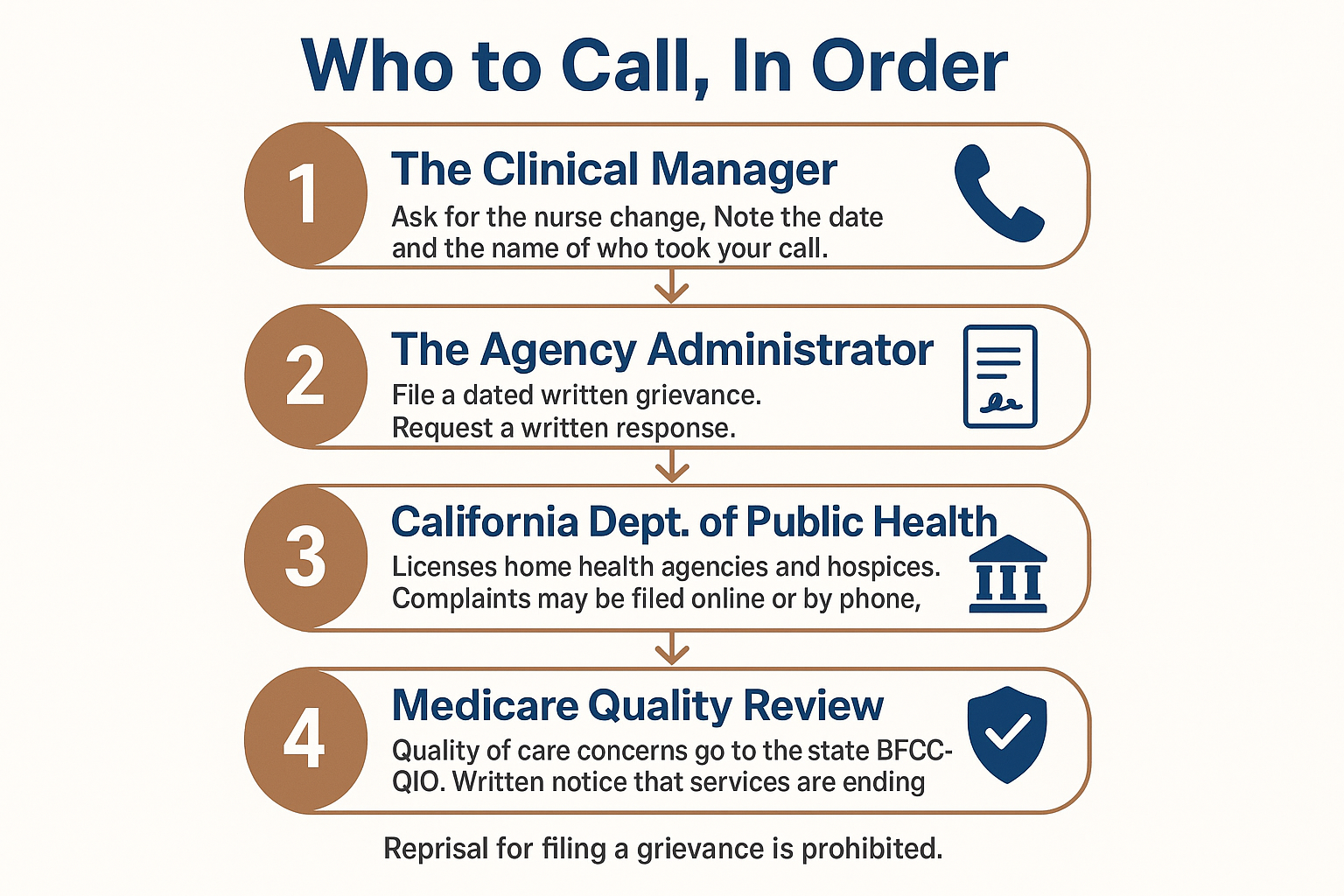
The escalation ladder, in order
Start at the bottom rung. Most situations never go past the first one.
The requests families are embarrassed to say out loud
These come up far more often than families think, and they are all reasonable.
One local reviewer described a patient who was uncomfortable having a male nurse handle catheter care, and noted that visits arrived unannounced and irritated the patient. Neither of those is a character flaw in anyone. Both are fixable scheduling and assignment decisions.
The same goes for language. In households in Salinas, King City, Greenfield, or Hollister, having a clinician who speaks Spanish directly with the patient changes what gets reported and what gets missed. That request belongs in the record, not in a hallway. Families in that situation often find it useful to read about hospice in a Spanish-speaking household.
For a patient with dementia, a rotating cast of new faces can undo a week of progress. Asking for consistency is a clinical request, not a personal preference.
Here is the part that gives these requests weight: patients have the right to take part in and be informed about their assessments and plan of care, and the right to refuse a specific treatment. A stated preference belongs in the written plan of care. Once it is documented, it survives staffing changes and does not depend on whether one supervisor remembers the conversation.
If the agency does not respond, here is what each rung does
Give the agency a real chance first. A dated, documented grievance to the administrator, with a request for a written response, resolves most of what does not get fixed on the first call.
If that goes nowhere, the California Department of Public Health licenses both home health agencies and hospices in the state. CDPH accepts complaints through its Cal Health Find database or by phone to the district office, and complaints can be filed anonymously.
There is a separate track for Medicare patients. Quality of care concerns go to the state’s Beneficiary and Family Centered Care Quality Improvement Organization, which reviews the care itself rather than the agency’s license.
And if you receive written notice that Medicare covered services are ending sooner than you expected, you can request a fast appeal. The notice itself tells you the deadline and the number to call, so do not throw it away.
Do you have to switch agencies? Usually not
Underneath all of this is a practical fear, and it is a fair one. The Central Coast is not a big market. Monterey County has roughly 65,000 residents age 65 or older, and the number of agencies covering Salinas Valley, South County, and San Benito County is small.
So families worry that pushing back means losing their only option. In most cases, a single call to the right supervisor solves the problem without starting over.
But changing agencies is allowed, and a physician order can follow a patient to a new provider. If you are considering it, a few things are worth knowing:
- Your Medicare plan type may limit which agencies you can use, which is worth checking before you call anyone. See when your Medicare plan limits which agency you can use.
- Geography matters more here than in a big city, and not every agency covers every address in the county.
- For hospice families, transferring to a different hospice is permitted, and any hospice intake team can explain how a transfer is handled.
What a working response to a family concern looks like
A good agency treats your call as information, not an accusation. The supervisor asks what happened, says what they can and cannot change, puts the preference in the plan of care, and tells you who to call next time.
It also shows up in who arrives at the house. A full home health team includes Registered Nurses, Licensed Vocational Nurses, Physical Therapists, Occupational Therapists, Speech Therapists, Medical Social Workers, Hospice Aides, Chaplains, Bereavement Specialists, and Volunteers. When one role is not the right fit, there is usually another one who is.
Central Coast VNA & Hospice, a nonprofit that has been making home visits in this region since 1951, launched a Service Excellence Initiative built around understanding the patient and family experience, which is the kind of internal work that makes these calls easier to make. One family in Monterey described the mix of people who came for a 91 year old mother this way: “A team made of nurses, physical therapists and Medical social worker came to help us.” – Claude C.
If you are unsure which team member should be handling a given problem, it often helps to know what a Medical Social Worker actually does.
Frequently Asked Questions About Requesting a Different Home Health Nurse
Can an agency drop my mother because I complained?
No. Reprisal against a patient for voicing a grievance is prohibited under federal home health rules. An agency can only discharge a patient for the reasons listed in its written transfer and discharge policy, which is in the admission packet, and a medical reason has to be behind any change to her care.
Do I have to give a reason for wanting a different nurse?
You do not owe anyone a detailed story. A short, factual reason helps the supervisor make a better assignment, though. “She is uncomfortable with a male clinician for personal care” is enough.
Will I have to tell the nurse directly?
No. The request goes to the clinical manager or case manager, and staffing changes are handled as an internal assignment. You do not have to have that conversation at the door.
What if my real problem is that nobody will tell me when the nurse is coming?
That is usually a communication issue, not a care issue, and it is one of the most common things families call about. Ask the scheduler for a two hour window and a call ahead, and ask for it to be noted in the record so it carries over when staff change.
Can I file a complaint without the agency knowing it was me?
Yes. The California Department of Public Health accepts complaints about home health agencies and hospices online or by phone to the district office, and anonymous complaints are accepted.
Is any of this different for hospice?
The basics are the same. Hospices are licensed by CDPH too, patients have the same rights to take part in the plan of care, and transferring to a different hospice is allowed. Any hospice intake team can walk you through how a transfer works.
Still not sure who to call about your parent’s care?
Families across Monterey County, from the Peninsula to Salinas and King City, run into this and assume they are stuck. A care coordinator can talk through how plan of care changes and clinician assignments are handled, with no pressure to switch anything. Central Coast VNA & Hospice can be reached at 831-372-6668, or at ccvna.com.