
Direct Answer: You register through a recognized therapy animal organization. The path is usually a temperament and obedience evaluation, one or more supervised visits, then formal registration with proof of vaccinations and a recent vet exam.
You have watched your dog work a room. He leans into strangers, ignores the vacuum, and has never once flinched at a wheelchair at the Monterey Bay Coastal Trail. Someone has probably told you he would make a great therapy dog.
Then you look into it and hit a wall of acronyms. TDI, ATD, Pet Partners, CGC. It is not clear which one matters, what the test involves, or whether your dog would actually pass.
That confusion shows up in the numbers. Pet therapy volunteer posts get more engagement than any other volunteer content local hospice programs share, but the applications never match the interest. This guide walks through what certification really requires, what evaluators look for, and what visiting looks like once you are approved.
What “certified therapy dog” actually means
There is no state license for therapy dogs in California and no government registry. When people say “certified,” what they usually mean is registered with a national therapy animal organization that tested your dog and carries liability insurance for your visits.
That registration is what hospitals, skilled nursing facilities, and home-based hospice programs across Monterey County ask to see before you walk in the door. Without it, most programs cannot accept you, no matter how sweet your dog is.
It also helps to know what a therapy dog is not:
- Service dog: individually trained to do tasks for one person with a disability. Has public access rights under the ADA.
- Emotional support animal: provides comfort to its owner. No task training, no public access rights.
A therapy dog, by contrast, is trained and evaluated to visit other people, by invitation, in a facility or private home. No public access rights.
That last distinction matters. A therapy dog goes where he is invited, on a schedule, as part of a care team. The American Veterinary Medical Association keeps a clear breakdown of these animal-assisted intervention definitions if you want the clinical version.
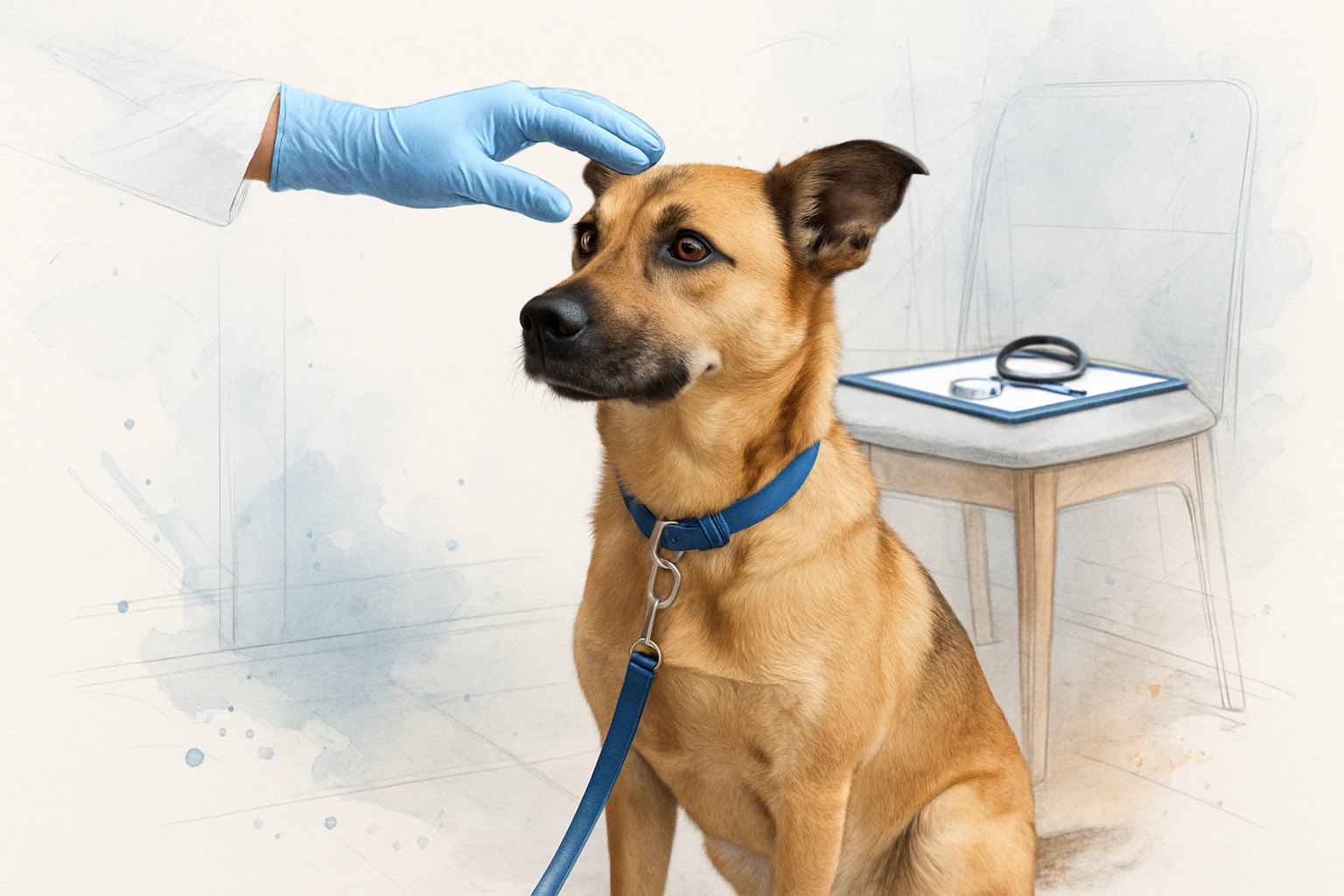
The three organizations most Central Coast handlers use
Three registries come up again and again: Therapy Dogs International (TDI), Alliance of Therapy Dogs (ATD), and Pet Partners. All three are recognized by facilities on the Peninsula. They just get you there differently.
Therapy Dogs International runs a single hands-on test with a certified evaluator. The test borrows heavily from the AKC Canine Good Citizen exam and adds exposure to medical equipment like crutches and wheelchairs. Dogs generally must be at least one year old and have a current vet health record on file.
Alliance of Therapy Dogs tests the handler and dog together, then requires a set of supervised visits with a tester observing before you are registered. If you learn better by doing, this path gives you real practice before you are on your own.
Pet Partners asks the handler to complete a course first, then evaluates the team. It registers species beyond dogs and typically renews every two years rather than annually.
One practical Monterey County note: evaluators are not on every corner. Depending on the organization and the season, you may need to drive to Salinas, San Jose, or a scheduled group test date to get evaluated. Start by asking each organization where its nearest tester is before you commit.
Comparing the three main registration paths
Fees and requirements change, so treat this as general market context and confirm current details directly with each organization.
| Organization | How evaluation works | Typical cost and renewal |
|---|---|---|
| Therapy Dogs International | One in-person test with a certified evaluator, including exposure to medical equipment and unfamiliar people | Costs vary, but testing plus first-year membership commonly lands in the low to mid double digits. Annual renewal. |
| Alliance of Therapy Dogs | Handler and dog tested together, followed by supervised visits observed by a tester | Application and membership fees are usually modest, often somewhere in the $30 to $100 range combined. Annual renewal. |
| Pet Partners | Handler completes a course first, then the team is evaluated together | Course plus team evaluation and registration typically runs higher than the other two. Renews about every two years. |
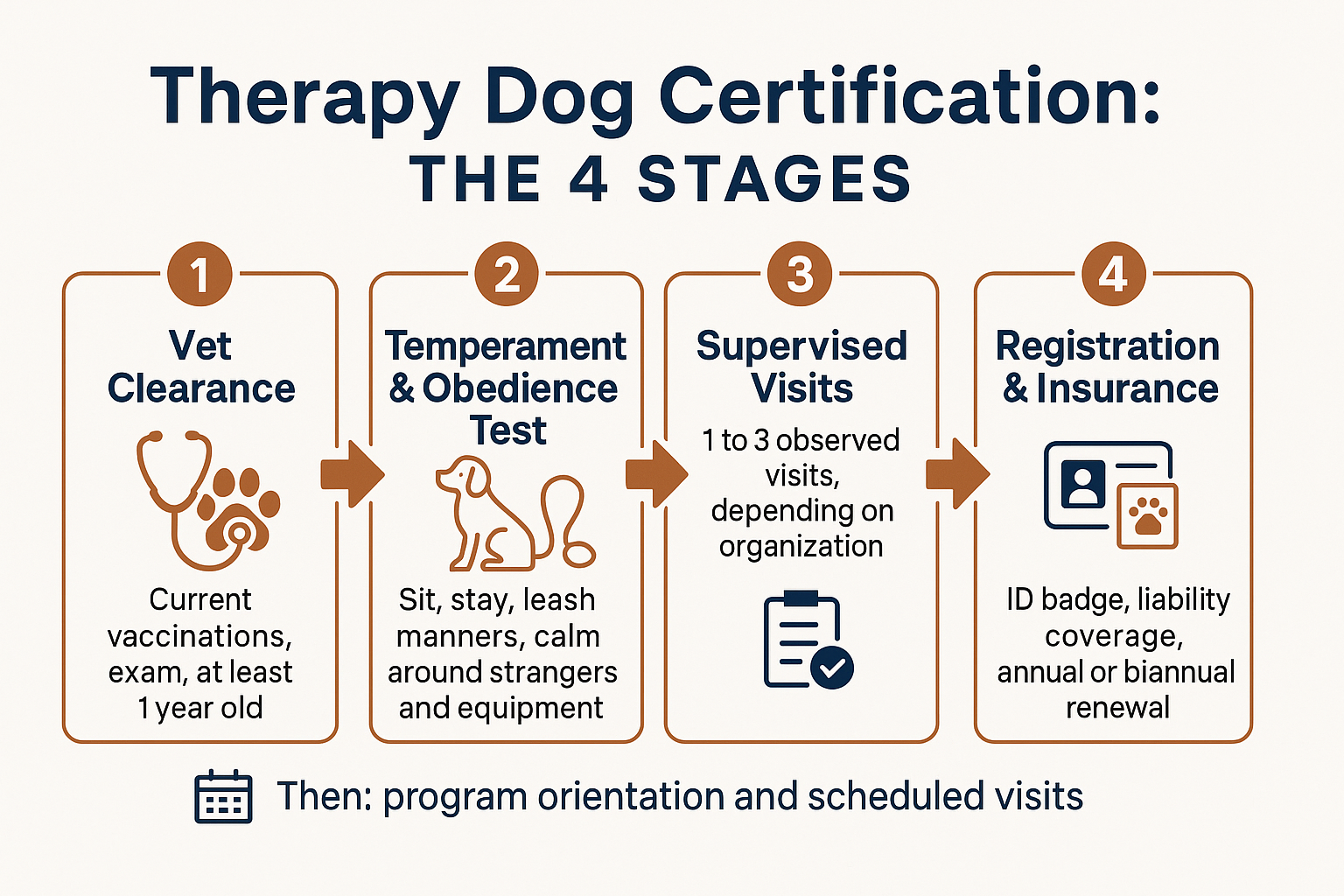
The certification path, step by step
Most first-time handlers move through four stages. Knowing the order up front keeps the process from feeling like a maze.
What evaluators are really looking for
Before you pay any fees, sit down and assess your dog honestly. Evaluators are not looking for tricks or a competition-level heel. They are looking for a dog who stays calm when things get strange.
Here is what tends to decide pass or fail:
- Neutral response to strangers. The dog accepts petting from someone unfamiliar without jumping, mouthing, or shrinking away.
- Comfort around medical equipment. Walkers, wheelchairs, oxygen tubing, hospital beds, and the beeping that comes with them.
- Reliable basic obedience. Sit, down, stay, come, and walking on a loose leash without pulling.
- Recovery after a startle. A dropped tray or a raised voice happens. The dog can flinch. He needs to settle within seconds.
- No interest in food on the floor. Dropped pills and dropped snacks are real hazards in a patient’s home.
- Tolerance of clumsy handling. Hands that grip fur too hard or pat too heavily are common from someone with limited strength or dementia.
A dog who barks at the door, guards you, or gets wound up around other dogs is not disqualified for life. He is just not ready. Six months of steady work with a local trainer, plus practice walks near busy spots like the Del Monte Center parking lot, can change that answer.
One honest filter: therapy work asks more of the handler than the dog. You are reading the room, watching your dog for stress signals, and knowing when to end a visit early.
What visiting actually looks like once you are registered
Registration is the paperwork. The part people underestimate is what comes after.
Most local hospice and home health programs add their own onboarding on top of your national registration. Expect a volunteer application, a background check, a TB test, an orientation covering patient privacy and infection control, and a match with a volunteer coordinator who knows the families.
Then you get scheduled. Pet therapy visits in a program like Central Coast VNA & Hospice usually happen in private homes across Monterey, Carmel, Seaside, Salinas, and out to King City and Hollister, not in a facility lobby. You visit the same patients over time, which is the whole point.
You are also one part of a larger team. Registered Nurses, Licensed Vocational Nurses, Physical Therapists, Occupational Therapists, Speech Therapists, Medical Social Workers, Hospice Aides, Chaplains, and other Volunteers are all working the same care plan. Your visit gets coordinated around theirs, which is why home health visit schedules tend to be set in advance rather than day of.
The work itself is quieter than people expect. A dog resting his head on a bed rail while a patient who cannot speak easily strokes his ears. Companionship for a spouse who has not left the house in a week. Presence during a long afternoon.
In 2025 alone, volunteers across this region contributed close to 40,000 hours and more than 1,080 visits, accounting for over 5% of all direct hospice care. That is not a side program. It is built into how care gets delivered.
Frequently Asked Questions About Therapy Dog Certification
How long does the whole process take from start to finish?
Plan on two to four months for most people. The evaluation itself is under an hour, but scheduling with an evaluator, completing supervised visits, and getting through a program’s volunteer onboarding takes the bulk of the time. If your dog needs obedience work first, add several months to that.
Does my dog need to be a specific breed or size?
No. Temperament decides it, not breed. Small dogs work well for bedside visits because they can be lifted onto a lap or bed, and large calm dogs work well for patients who want to reach down and pet without bending. What matters is that the dog is at least a year old, has lived with you long enough for you to read him honestly, and stays steady in a strange room.
Do I need a Canine Good Citizen title first?
It is not required, but it helps. The CGC test overlaps heavily with therapy dog evaluations, so passing it first is good practice and tells you whether the real test is worth scheduling.
Can my dog visit hospice patients if he is certified but I am not affiliated with a program?
Generally no. Visits to patients happen through an established program that handles patient consent, privacy rules, infection control, and scheduling. Showing up independently is not an option, which is why registration and volunteer onboarding go together.
What if my dog fails the evaluation?
Most organizations let you retest after a waiting period, usually several months. Ask the evaluator exactly what the dog struggled with. Reactivity around other dogs and startle recovery are the two most common issues, and both respond well to focused training with a local trainer.
Are there volunteer roles if my dog is not a good fit?
Yes, and they are needed. Vigil sitting, companionship visits, reading aloud, respite so a family member can run errands, and office support are all real roles. One long-time VNA volunteer described the work simply: sitting bedside, providing comfort, being present when it matters most.
Thinking about pet therapy volunteering on the Central Coast?
VNA has been serving families in Monterey, San Benito, Santa Cruz, and South Santa Clara counties since 1951, and 2026 marks its 75th year. A new pet therapy volunteer joins a program with decades of structure behind it, not one being figured out from scratch. If you want to talk through whether your dog is a fit, or ask about other volunteer roles, you can reach a coordinator at 831-241-8423 or find details at ccvna.com.