
Direct Answer: Home health after a stroke starts with a nurse evaluation at home, usually within a day or two of discharge. Therapy evaluations follow, then regular visits build a plan around the house and the person.
He comes home with weakness on one side, a folder of discharge papers, and a list of medications that changed three times during the hospital stay. By the second night, somebody in the family is lying awake wondering whether bringing him home was a mistake.
That worry is the real question underneath most calls. Families across Monterey County call within days of a hospital or rehab discharge, and many say some version of the same thing: we just need someone to come to the house and help us figure out what to do next.
The honest answer is that the first month has a shape to it. This is what that month usually contains, who knocks on the door and when, and what home health care after a stroke does and does not cover.
What the First Month of Home Health Care After a Stroke Looks Like, Week by Week
The first visit is an evaluation, not a treatment session. That surprises families who expect therapy to start the moment the car pulls into the driveway in Salinas or Seaside.
A Registered Nurse comes first, usually within a day or two of discharge once physician orders and insurance are confirmed. That visit is long. The nurse goes through medications, takes vital signs, looks at the bathroom and the bedroom, and asks who is in the house overnight.
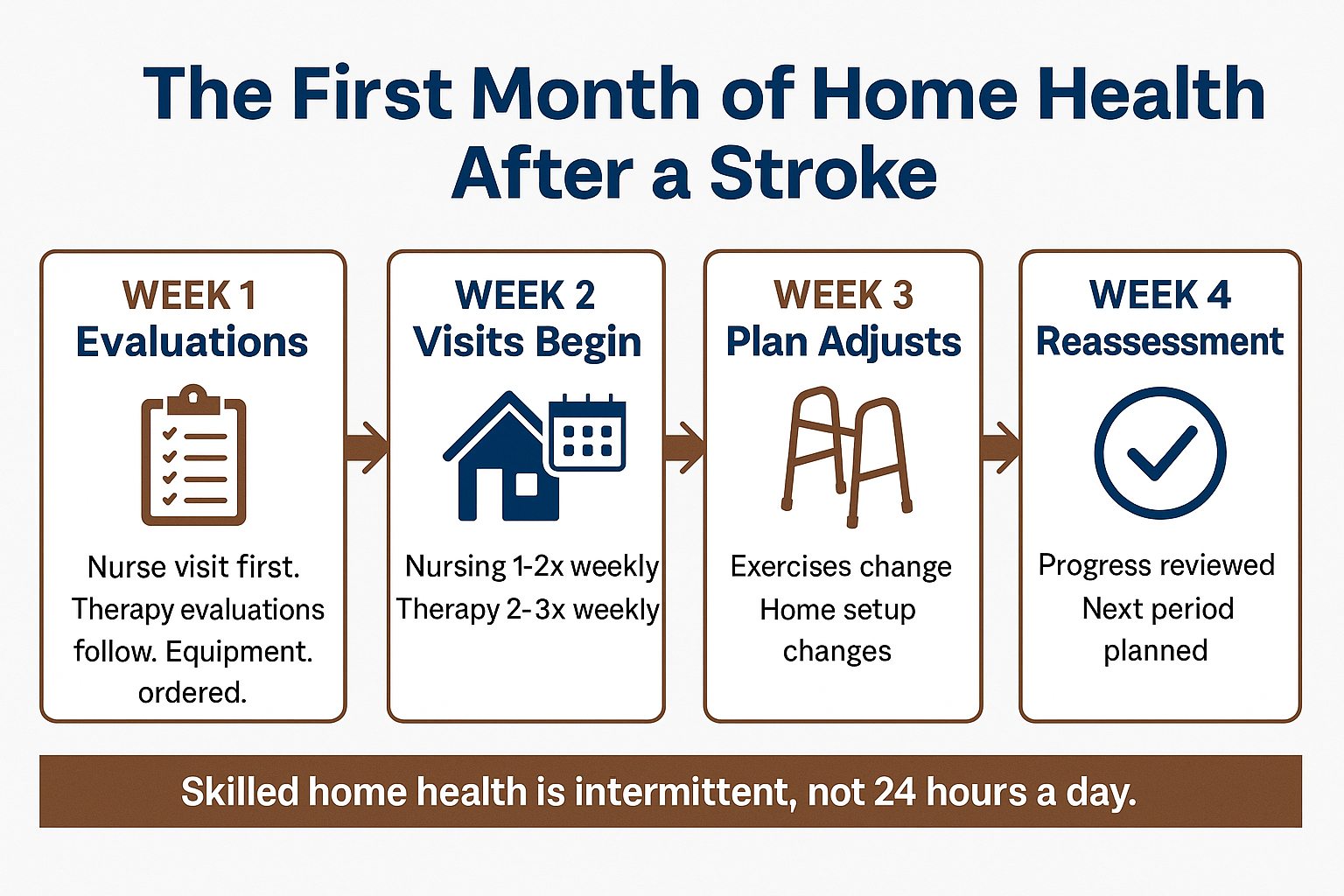
Here is the usual rhythm of the first four weeks:
- Week 1: nurse evaluation, then separate evaluation visits from a Physical Therapist, and often an Occupational Therapist and Speech Therapist. Equipment gets ordered. A plan of care goes back to the physician for signature.
- Week 2: visits settle into a pattern. Nursing once or twice a week, therapy two or three times a week depending on what the evaluations found.
- Week 3: the plan gets adjusted. Exercises get harder, or the therapist backs off because the house turned out to be harder to move through than it looked.
- Week 4: reassessment. The team documents progress and decides what the next certification period should include.
If the discharge is still fresh, the walkthrough in the first 72 hours of home health after a hospital stay covers what happens before any of this starts.
Most Families Expect a Physical Therapist and Are Surprised by the Other Two
Walk through one ordinary morning and the division of labor gets clear fast.
Getting out of bed and standing up is Physical Therapy. The Physical Therapist works on transfers, balance, walking, and the stairs or the one step down into the garage. They build an exercise plan and then make it harder as strength returns.
Getting into the bathroom and getting dressed is Occupational Therapy. The Occupational Therapist works in the actual bathroom and kitchen the person uses, not a gym. One-handed shirt technique, a transfer bench in that specific tub, how to reach the coffee mug when the left arm will not cooperate. More on that in occupational therapy at home.
Breakfast is where Speech Therapy earns its keep. After a stroke, the Speech Therapist covers two different things:
- Language changes, including trouble finding words, understanding what is said, or reading
- Swallowing safety, including food textures, liquid thickness, and how upright someone needs to sit to eat
Swallowing is the piece families do not see coming, and it is the one most likely to send someone back to the hospital with pneumonia. Speech therapy at home explains who qualifies.
A Monterey Peninsula family described the sequence in a five-star review: “A team made of nurses, physical therapists and Medical social worker came to help us.” That stacking of roles is normal after a neurological event. Research summarized by the National Institute of Neurological Disorders and Stroke has found that home-based rehabilitation can match clinic-delivered therapy for motor recovery.
Who Handles What After a Stroke
Families often assume one clinician covers everything. Here is how the work typically splits during the first month at home.
| Clinician | What they work on | What it looks like in the house |
|---|---|---|
| Registered Nurse / Licensed Vocational Nurse | Blood pressure, medications, skin, teaching | Sorting every pill bottle, checking pressure points, training the family |
| Physical Therapist | Standing, transfers, walking, balance | Getting from bed to wheelchair, practicing the hallway and the front step |
| Occupational Therapist | Dressing, bathing, one-handed technique | Working in the real bathroom and kitchen, recommending equipment |
| Speech Therapist | Language and swallowing safety | Word-finding practice, food texture and seating changes at meals |
| Medical Social Worker | Benefits, paperwork, community resources | Sorting out coverage questions and connecting families to local programs |
The Nursing Work Is Mostly About Preventing the Second Stroke
Nobody says that out loud at discharge, but it is the center of month one.
A stroke survivor usually comes home with new blood thinners or antiplatelet medication, changed blood pressure prescriptions, and sometimes a new diabetes plan. Medication confusion after a discharge is one of the most common problems families describe when they call. Rehab changed one drug, the hospital changed two others, and the bottles from before the hospital are still in the cabinet.
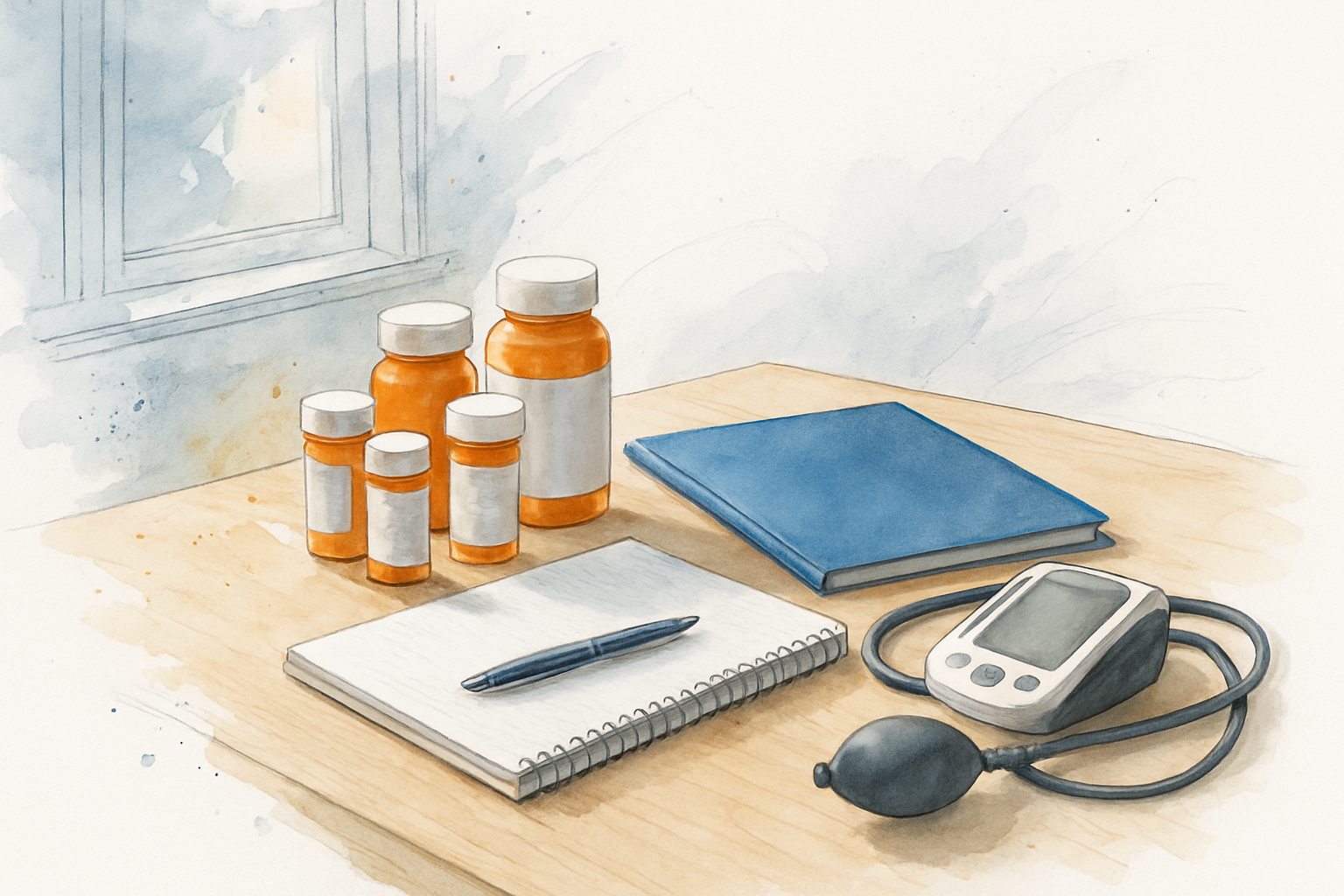
Before the first nurse visit, do one thing: write down every bottle in the house. Not just the new ones. The old prescriptions, the vitamins, the eye drops, the leftover pain medication from a surgery two years ago.
A nurse comparing the old list to the new one is often the highest value thing that happens in week one.
The rest of the nursing work in month one tends to be:
- Blood pressure checks at nearly every visit, since pressure control is the main lever against a second stroke
- Skin checks for someone who cannot reposition easily, especially heels, hips, and the tailbone
- Swallowing precautions reinforced at mealtimes, working alongside the Speech Therapist
- Teaching the family what warning signs mean a call to the physician and what means a call to 911
If a change happens at 10pm in Marina or King City, knowing who to call after hours matters as much as the visit schedule itself.
The First Month at a Glance
A simple view of how the four weeks after a stroke discharge usually unfold at home.
Skilled Home Health Is Intermittent, Not Round-the-Clock
This is the correction that saves families the most heartache, and it should come early.
Skilled home health visits are scheduled and intermittent. A nurse or therapist comes, works for 45 minutes to an hour, teaches, and leaves. Nobody stays overnight.
For a stroke survivor with weakness or paralysis on one side, that leaves real hours to fill. Bathing, toileting, meals, and getting back to bed are hands-on tasks that happen between visits, and a family in Hollister or Greenfield usually has to cover them somehow.
That gap gets filled three ways, and they can be layered:
- Family and friends, often with training from the Occupational Therapist on safe transfers
- IHSS, the county-administered In-Home Supportive Services program, for those who qualify financially
- Private duty personal care, paid hourly out of pocket or through a long-term care policy
Cost for the non-medical piece depends mostly on hours per day, whether overnight coverage is needed, and whether a county program applies. One public reviewer described a patient paying roughly $8,000 a month out of pocket for her own personal care help, which is one family’s account rather than a Monterey County benchmark.
Medicare, Medi-Cal, and Veterans benefits generally cover the skilled home health piece when a physician orders it. Personal care is a separate question with a separate answer. The breakdown in IHSS, home health, or private duty sorts out which is which, and a care coordinator can walk through a specific situation.
For Discharge Planners: What Has to Be in Place Before Therapy Starts
Case managers placing a stroke patient need certainty, not description. Three things gate the start date.
- Physician orders. Home health is physician-directed. Without signed orders, nothing starts.
- A confirmed address inside the service area. The four-county footprint runs from the Monterey Peninsula through Salinas, Greenfield, and King City, into San Benito County including Hollister, plus parts of Santa Cruz and South Santa Clara counties.
- Verified insurance. Medicare, Medi-Cal, and most private plans, with Veterans benefits handled separately.
Address gets answered first, not last. Service area questions end more calls than anything else, and a patient going home to an outlying address deserves a yes or no before the family starts packing the room.
Referrals do sometimes sit in transit, and families call back because nothing has appeared in the system yet. Why a physician referral is required explains the handoff and who confirms receipt.
Frequently Asked Questions About Home Health After a Stroke
How soon after discharge should the first visit happen?
Usually within a day or two of coming home, once orders and insurance are confirmed. If more than 48 hours pass with no contact, call and ask where the referral stands rather than waiting.
Does Medicare cover all of this?
Medicare generally covers skilled nursing and therapy visits at home when a physician orders them and the patient meets homebound criteria. Personal care and homemaker help are not part of that benefit. Coverage details vary by plan, so it is worth confirming before the first visit.
How long does home health last after a stroke?
Care is authorized in certification periods and reassessed at the end of each one. Some stroke patients finish in four to six weeks. Others continue longer if they are still making measurable progress toward goals. The reviewer who described six weeks of weekly Physical Therapy visits is a fairly typical arc.
What if the person needs help at 3am?
Skilled home health does not staff overnight. That coverage comes from family, IHSS, or private duty help. A 24/7 phone line exists for clinical questions and changes in condition, but a clinician is not sitting in the house.
What should I have ready before the first nurse visit?
Every medication bottle in the house, the discharge paperwork, the insurance cards, and the names of the hospital physician and the primary care doctor. Also think through who is in the house overnight and which rooms are hard to get into.
Can therapy really work at home instead of an outpatient clinic?
For many stroke survivors, yes. Research from the National Institute of Neurological Disorders and Stroke indicates home-based therapy can match clinic-delivered therapy for motor recovery, and it has the advantage of happening in the actual bathroom, hallway, and kitchen the person has to use.
Talking Through Whether Home Health Fits
Stroke recovery pulls in nursing, three therapy disciplines, a Medical Social Worker, volunteers, and equipment all at once, which is why having one team coordinating it tends to make the month easier on a family. Central Coast VNA & Hospice is a nonprofit founded in Monterey in 1951, now in its 75th year, and made more than 73,000 visits to over 3,800 patients across the region last year with a 4-Star Home Health rating from Medicare’s Care Compare. If you want to talk through whether home health fits your situation in Monterey County or the surrounding counties, a care coordinator can walk you through it at 831-372-6668 or at ccvna.com.