
Direct Answer: Repeat heart failure admissions usually come from fluid building at home between visits. In-home skilled nursing catches weight and breathing changes early, and Medicare covers it with a physician’s order.
Your dad goes into the hospital short of breath. Three or four days later he is stable, the swelling is down, and he comes home with a folder of paperwork.
Then, a few weeks later, it happens again. Families across Monterey County read each of those admissions as a separate emergency, when it is usually one long decline showing up in pieces.
This article walks through why the cycle repeats, what changes when a clinician comes to the house instead of the other way around, and the questions worth asking well before the fourth admission.
Why Heart Failure Hospital Readmissions Keep Happening
Advanced heart failure means the heart cannot move blood forward the way it should. Fluid backs up into the lungs, the ankles, the abdomen. In the hospital, IV diuretics pull that fluid off fast.
At home, the same job falls to oral medication. And oral medication works slower than fluid builds when someone eats a salty meal, skips a dose, or has a rough week.
Three things usually go wrong in the gap:
- Nobody is weighing him daily. A two or three pound overnight gain is fluid, not food, and it is the earliest warning sign available.
- The medication list changed in the hospital and nobody reconciled it at home. Doses get adjusted on the ward, the old bottles are still in the cabinet, and both versions end up in play.
- The first cardiology follow-up is two or three weeks out. That stretch between discharge day and that appointment is where most of the damage happens.
By the time breathing gets bad enough to call 911, the fluid has been building for days. The admission was preventable, but only if someone was watching. Medication tracking alone trips up more families than anything else after a cardiac stay.
On the Central Coast, Distance Is Part of the Problem
Heart failure care depends on frequent check-ins. Geography here works against that.
About 15 percent of Monterey County residents are 65 or older, which is somewhere near 65,000 people. The cardiologists, meanwhile, cluster on the Peninsula and in Salinas.
So a family in King City or south county may be driving close to an hour each way for a twenty minute follow-up. A household in Hollister or east Salinas juggling work shifts often cannot make a weekday appointment at all without someone losing a day of pay.
When a visit is that expensive in time and gas, it gets postponed. And postponed visits are how a manageable fluid gain turns into an ambulance ride down Highway 101.
In-home skilled nursing changes that math in a plain way. The clinician drives to the house instead.
On a visit, a Registered Nurse or Licensed Vocational Nurse typically:
- Checks weight, blood pressure, pulse, and oxygen
- Listens to the lungs and looks at ankle and leg swelling
- Reviews what medications were actually taken this week, not what was prescribed
- Calls the physician when the numbers move the wrong way
That phone call, made on a Tuesday afternoon about a two pound gain, is often the whole difference. If you are unsure what these visits involve, skilled nursing at home is different from what most people picture.
Does Medicare Cover This, and Do We Need a Doctor’s Referral First?
These are the two questions that stall families more than any others. Roughly one in ten callers to home care agencies gets stuck right here.
Here are the direct answers.
Yes, a physician’s order is required. Medicare-certified home health is physician-directed care. It also requires a face-to-face visit with a physician or Nurse Practitioner tied to the condition being treated.
Medicare, Medi-Cal, and Veterans benefits all have pathways for home health. What your specific plan covers depends on the plan, the diagnosis, and whether the patient meets homebound criteria, so an agency’s intake staff is the right place to confirm details rather than a blog post.
The fastest route after a cardiac admission is to ask the hospital discharge planner or the treating cardiologist to place the order before your parent leaves the building. Waiting until you are home turns a same-week start into a two-week scramble.
If the referral process itself is unfamiliar, here is why a physician referral is required and how it works.
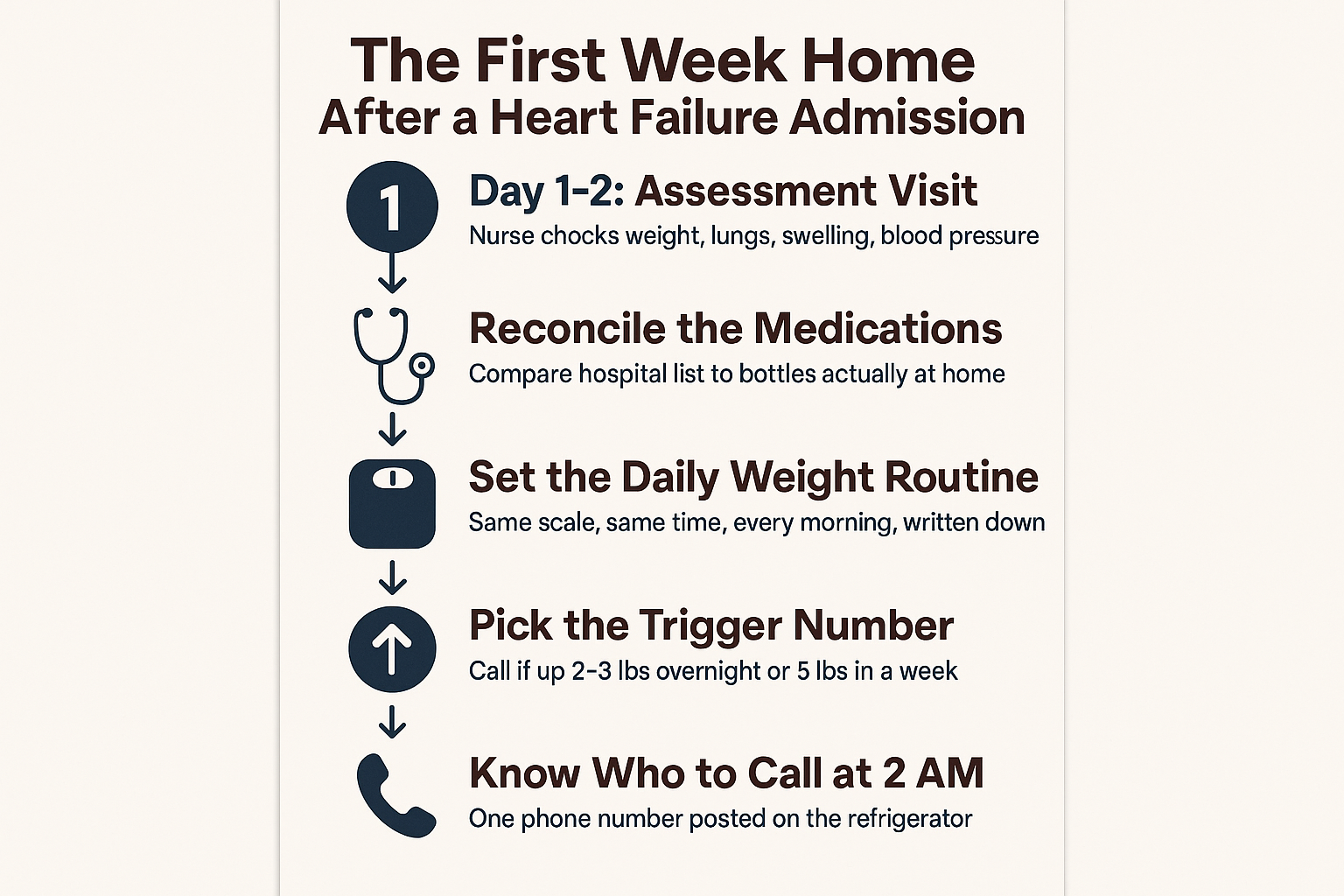
The First Week Home After a Heart Failure Admission
This is the sequence that keeps a discharge from turning into a readmission. Print it and hand it to a sibling.
What a Strong First Week at Home Actually Looks Like
Families consistently describe the same moment. Someone was just discharged, and they need a person to come to the house and help them figure out what happens next.
A solid first week has four moving parts.
An assessment visit within a day or two. A nurse comes out, gets a baseline weight and vitals, walks the house for fall risks, and writes the care plan the rest of the week runs on.
A medication list reconciled against what was actually sent home. Not the discharge summary. The bottles on the counter. Old doses get pulled out of circulation.
A daily weight routine with a specific trigger number. Same scale, same time each morning, before breakfast, written down. Ask the clinician for the exact number that means pick up the phone. For many patients it is 2 to 3 pounds overnight or 5 pounds in a week, but that is a physician’s call for your parent specifically.
One phone number for overnight symptom changes. Written on paper, taped to the refrigerator, where a visiting grandchild can find it. The first 72 hours set the tone for everything that follows.
Three Kinds of Home-Based Support for a Cardiac Parent
These are not competing choices so much as stages. Many families move through more than one as things change.
| Type of care | What it focuses on | Who starts it | Curative treatment continues? |
|---|---|---|---|
| Home health | Recovery, strength, medication stability, avoiding readmission | Physician order after a hospital stay or decline | Yes |
| Home-based palliative care | Breathlessness, fatigue, symptom control, care planning | Physician referral, can run alongside cardiology | Yes |
| Hospice care at home | Comfort, pain and breathing control, family and spiritual support | Physician certifies a six month prognosis if the illness runs its usual course | No, the goal shifts to comfort |
The Harder Turn Most Cardiac Families Never Hear About
Circulatory and heart conditions are the single most common reason people enter hospice nationally, close to 30 percent of stays. Most families with a cardiac parent are never told that.
There is a stretch, sometimes long, where the goal quietly shifts. It stops being about regaining function and starts being about fewer hospital trips and easier breathing at home.
That stretch can include home health first, then home-based palliative support running alongside cardiology, and later hospice if the trajectory continues. Palliative care does not require giving anything up, and it can start much earlier than families assume.
Hospice eligibility is a physician’s clinical judgment about prognosis, not a form a family fills out. Medicare’s coverage policy on determining terminal status lists cardiac indicators such as an ejection fraction of 20 percent or less as supporting documentation, while stating plainly that some patients who do not meet the published guidelines may still have a six month prognosis.
So it is a conversation, not a checklist. And asking the question early commits nobody to anything. It is information families deserve before the fourth admission, not after it.
What the Home Team Actually Looks Like
Families picture one nurse. What usually arrives is a group.
One Monterey Peninsula family described what happened after their 91 year old mother’s physician made the referral: “A team made of nurses, physical therapists and Medical social worker came to help us.” A nurse evaluated first, a second nurse came weekly for a month, and a Physical Therapist built an exercise plan that kept going after the visits ended.
Home-based cardiac support in this region is delivered by Registered Nurses, Licensed Vocational Nurses, Physical Therapists, Occupational Therapists, Speech Therapists, Medical Social Workers, Chaplains, Volunteers, and other clinicians. On cardiac cases, they work from protocols built with local cardiologists and coordinate back to the treating physician.
The Medical Social Worker matters more than families expect. That is the person who sorts out benefits questions, connects families to community resources, and helps when the paperwork side of things gets tangled.
Central Coast VNA & Hospice has been a nonprofit rooted in this region since 1951, which means the organization answers to the community here rather than to shareholders.
Frequently Asked Questions About Heart Failure Readmissions and Home Care
How fast can home health start after a hospital discharge?
When the order is placed before discharge, an assessment visit commonly happens within a day or two of arriving home. The delay families run into is almost always the referral, not the scheduling. Ask the discharge planner to send it while your parent is still in the bed.
Does my parent have to be bedbound to qualify for home health?
No. Medicare’s homebound standard means leaving home takes a considerable and taxing effort, not that someone never leaves. Plenty of heart failure patients who can get to a doctor’s appointment with help still qualify.
We live in King City. Do home health agencies actually drive that far?
Coverage areas vary by agency, and this is worth confirming before anything else. Central Coast VNA & Hospice serves all of Monterey County including King City and Greenfield, plus San Benito County, South Santa Clara County, and parts of Santa Cruz County. If an agency says no, ask them for a name of one that says yes.
Can we get palliative care while my mom is still seeing her cardiologist?
Yes. That is the whole point of it. Palliative care runs alongside treatment and focuses on symptoms like breathlessness, fatigue, and sleep. Several families each month are surprised to learn it does not require stopping anything.
What is the difference between home health and the help we need with bathing and meals?
Home health is skilled medical care ordered by a physician and covered under Medicare. Daily personal help with bathing, meals, and errands is a different category, often handled through IHSS or private duty agencies. Many families end up using both.
Thinking through the next step for a parent with heart failure?
If your family is somewhere in this cycle, in Salinas, Hollister, Carmel, King City, or anywhere across Monterey County, a care coordinator can talk through what home health, palliative support, and hospice each involve and what your parent’s coverage looks like. There is no pressure and no commitment in asking. You can reach a coordinator at 831-372-6668 or find more at ccvna.com.