
Direct Answer: Hospice patients call the hospice on-call line, staffed by a nurse around the clock, and a nurse can come to the house. Home health patients reach an on-call clinician for urgent clinical questions only.
It is the middle of the night. Your mother’s breathing sounds different than it did at dinner, or your father just tried to stand and went down in the hallway. The office is closed and you are standing there with a phone in your hand, trying to decide between a number on a folder and 911.
This happens constantly across Monterey County. Roughly a third of families who call in are an adult child or spouse reaching out within hours or days of a discharge from Community Hospital of the Monterey Peninsula or Salinas Valley Health. One caller put it simply: she was just discharged and we need someone to come to the house.
The worry peaks on evenings and weekends, when nobody is around to explain what is normal. This guide covers who actually answers after hours, what counts as urgent enough to call at 2 a.m., and the exact words that get you help fastest.
Hospice After Hours and Home Health After Hours Are Not the Same Thing
Families mix these two up on the phone all the time, and the difference decides who picks up in the middle of the night.
Hospice includes access to a nurse by phone around the clock. If symptoms change, a Registered Nurse can talk you through it and can come to the house overnight when the situation calls for it. That is part of the Medicare hospice benefit, not an extra service you have to ask for. You can read how the benefit is structured directly from Medicare’s own hospice coverage page.
Home health works differently. It is physician-ordered, intermittent skilled care: a nurse or therapist comes out on a set schedule to treat a wound, manage medications, or rebuild strength after surgery. There is an on-call clinician for urgent clinical questions after hours, but that person is not there to schedule visits or send supplies.
So at 2 a.m. on home health, an on-call nurse can help you decide whether a symptom needs the emergency room tonight. What waits until morning:
- Rescheduling or confirming a visit time
- Supply and equipment requests
- New orders from the physician
- Insurance and billing questions
- Adding a therapy discipline to the plan
If you are still sorting out which type of care your parent is actually on, this breakdown of home health versus hospice explains where the line falls.
Who Answers After Hours, and What They Can Do
A quick reference for the moment you are holding the phone and cannot remember which line to try.
| Situation | Hospice patient | Home health patient |
|---|---|---|
| Nurse available by phone overnight | Yes, around the clock | On-call clinician for urgent clinical questions |
| Nurse can come to the house overnight | Yes, when symptoms change | Not typically, visits are scheduled and physician-ordered |
| Sudden pain or breathing change | Call the on-call line first | Call the on-call line, be ready for a 911 recommendation |
| Supplies, scheduling, new orders | Business hours | Business hours |
| Chest pain, stroke signs, major fall injury | Call the on-call nurse, 911 if unsafe to wait | Call 911 |
What Actually Justifies a Middle of the Night Call
Families hesitate because they do not want to bother anyone. That hesitation costs more than the call does.
Call the on-call line when you see:
- A sharp jump in pain that the usual medication is not touching
- New shortness of breath or breathing that sounds different
- A fall, even if your loved one says they are fine
- A catheter or feeding tube that stops working or leaks
- Bleeding through a wound dressing that does not stop with pressure
- Sudden confusion in someone who was clear earlier that day
- A doubled or missed medication dose
These can usually wait for business hours:
- A visit time you want to shift next week
- Gauze, briefs, or equipment you are running low on but not out of
- A question about a bill or a Medicare statement
- Mild, familiar symptoms that have not changed in days
When you are unsure, make the call. An on-call Registered Nurse would rather spend four minutes ruling something out than hear about it two days later. And if the answer is genuinely 911, they will tell you plainly.
What to Say When You Call
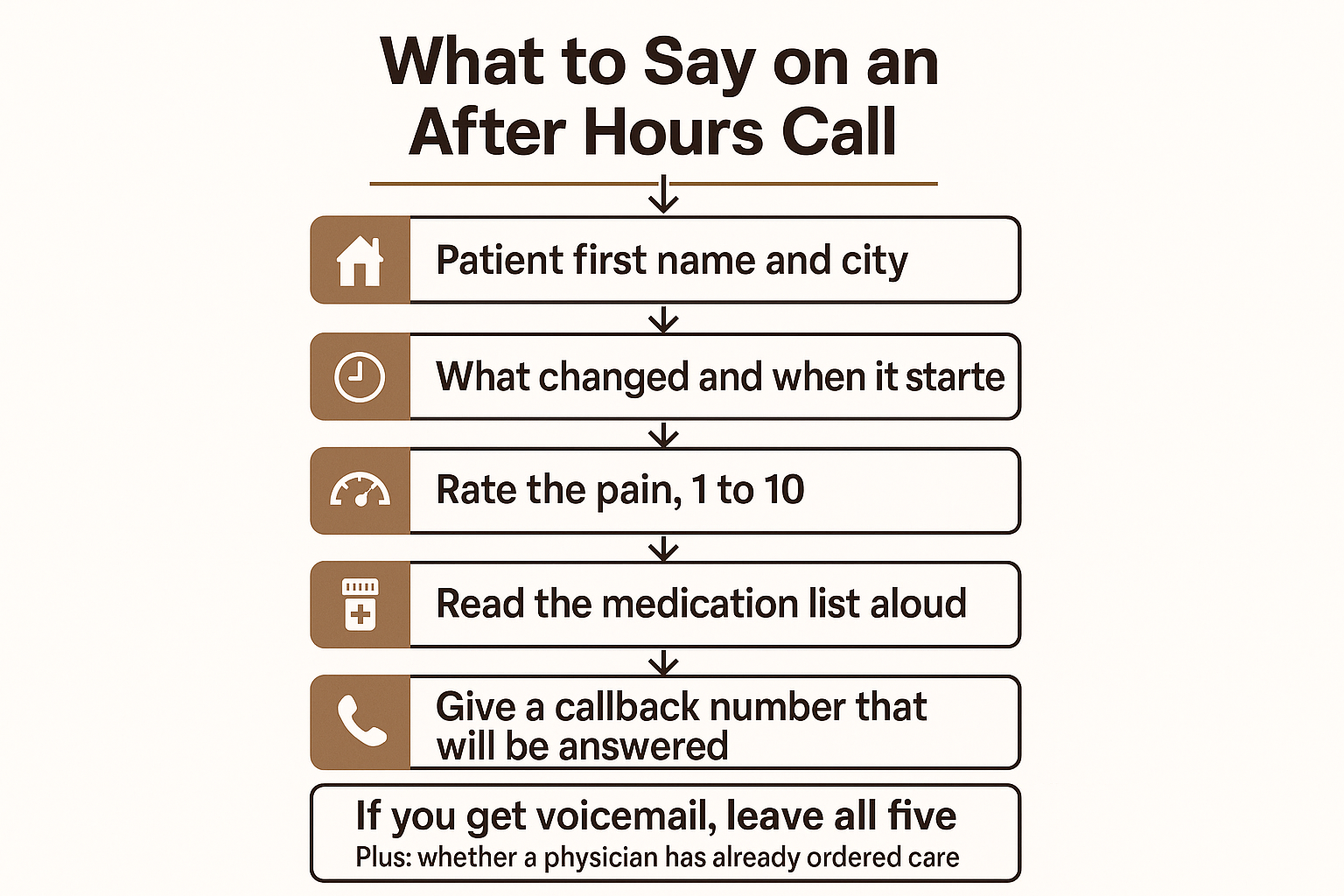
Having these five things ready lets an on-call nurse sort out the problem in minutes instead of half an hour.
Give the Nurse Something to Work With
The call goes faster when you lead with facts instead of fear. That is not coldness, it is efficiency at an hour when minutes matter.
Say the pain number out loud. A 4 that jumped to a 9 in two hours tells a nurse something completely different than “she seems uncomfortable.” Name what changed and when it started, down to the hour if you can.
Keep the medication list within arm’s reach of the phone, not in a drawer. The nurse will ask what was given, how much, and at what time.
And if you reach voicemail, do not hang up. Families do this constantly and lose the entire night waiting for a callback that was never triggered. Leave:
- The patient’s first name
- The city, such as Salinas, Seaside, or Gonzales
- What changed and when
- A callback number that someone will actually answer
- Whether a physician has already ordered care
If you are in the first days after a hospital stay and none of this is set up yet, the first 72 hours of home health explains what should be in place before the first weekend arrives.
Geography Changes the Math Out Here
In a dense city, the emergency room is ten minutes away and the decision is easy. Monterey County is not built that way.
A family in King City or Greenfield sits a long drive from the hospitals in Salinas or Monterey, and it gets longer at night on Highway 101. Families out past Hollister in San Benito County face the same stretch of road.
That distance matters more than people expect. A 1 a.m. ambulance ride can undo a comfort plan that took weeks to build, and it often ends with a night in a hallway, a set of tests, and a discharge back home by morning with nothing changed.
For a hospice patient, a call to the on-call nurse can frequently settle at home what an emergency room visit would not improve. Pain medication can be adjusted. A catheter can be flushed. Breathing can be managed with what is already in the house.
But some situations still call for 911. Chest pain, signs of a stroke, an injury from a fall, uncontrolled bleeding, or anything where waiting feels unsafe. Nobody will second guess you for making that call.
When Your Loved One Is Already on Service
About one in five after hours callers are relatives of a patient already receiving care. They are not in crisis. They are calling because a supply never showed up, a visit shifted without warning, or a symptom appeared that nobody explained in advance.
These calls deserve a straight answer too. Before you hang up, ask for three things:
- The name of the person who will call you back
- A specific timeframe, not “soon”
- Confirmation that your request was documented in the chart
That last one is the piece families skip, and it is the reason a request can vanish between shifts. Reviews reflect both sides of this. One family described visits that felt inconsistent and unannounced. Another wrote: “I appreciate everything that was provided to us from information on how to cope with a deteriorating health situation to who to contact 24/7 if more assistance was needed.” That is David H., writing about his mother’s care.
The difference between those two experiences usually comes down to whether the family knew who to reach and what to ask for. Write the after hours number on the refrigerator the day service starts. Not in your phone, on the refrigerator, where whoever is in the house at 2 a.m. can find it.
Frequently Asked Questions About After Hours Care at Home
Will a nurse actually come to the house overnight?
For hospice patients, yes, when symptoms change and a phone call is not enough. For home health patients, generally no. Home health visits are physician-ordered and scheduled, and the after hours clinician is there for urgent clinical questions rather than unscheduled visits.
If I call 911, does that end hospice care?
No. Calling 911 does not automatically remove someone from hospice. It can lead to treatments that work against the comfort plan, though, which is why a call to the on-call nurse first is usually worth the two minutes. If the situation is clearly an emergency, call 911.
My parent is not on hospice and not on home health yet. Who do I call at night?
Your first calls are the physician’s answering service and, if the situation is serious, 911. Home health requires a physician order before anyone can come out, which is covered in more detail in how the referral process works.
Is after hours support included, or is it billed separately?
Under the Medicare hospice benefit, around the clock nurse access is part of the benefit rather than an add on. Home health coverage depends on your plan and your physician’s orders. Medicare, Medi-Cal, and Veterans benefits all cover home based care differently, so ask a care coordinator to walk through your specific situation.
How long should I wait for a callback before trying again?
Ask for a timeframe when you call, then hold them to it. If 30 minutes pass on an urgent symptom with no callback, call again. And if the symptom is getting worse while you wait, do not keep waiting.
Questions About After Hours Support on the Central Coast
Central Coast VNA & Hospice is a nonprofit that has been making home visits in Monterey County since 1951 and marks 75 years in 2026, with more than 73,000 visits across the county in 2025. Care is delivered by nurses, therapists, social workers, chaplains, volunteers, and other clinicians, with a Care Team line staffed around the clock. Families with questions about what after hours support looks like can call 831-372-6668 or read more at ccvna.com.