
Direct Answer: Home health is physician-ordered skilled nursing and therapy visits covered by insurance. IHSS is county-run help with bathing, meals, and daily tasks for Medi-Cal recipients. Private duty is hourly help you pay for.
In one recent month, about a dozen calls came into a nonprofit home health line in Monterey from people who were actually trying to reach something else. They wanted IHSS. Or the Alliance on Aging. Or a Medi-Cal insurance plan. Or their parent’s primary care office.
Those callers were not confused about wanting help at home. They were confused about which program does which job, and which phone number solves which problem.
So this is a map, not a pitch. Here is what home health, IHSS, and private duty each actually cover on the Central Coast, who pays for each one, how each door opens, and why most families in Monterey County end up using two of the three at once.
IHSS vs Home Health Care vs Private Duty: Three Different Jobs
The fastest way to sort this out is to stop thinking about companies and start thinking about tasks. Each program is built to handle a different kind of help.
- Home health is medical care ordered by a physician. Registered Nurses, Licensed Vocational Nurses, Physical Therapists, Occupational Therapists, Speech Therapists, and Medical Social Workers come to the house on a visit schedule to handle wound care, medication management, chronic disease teaching, and rehab after surgery or a hospital stay.
- IHSS (In-Home Supportive Services) is a county-administered program that pays a provider, often a family member, to help a Medi-Cal recipient with bathing, dressing, meals, housework, and supervision so they can stay safely at home instead of moving into a facility.
- Private duty is an hourly home care agency or independent worker you hire and pay directly. Same kind of hands-on help as IHSS, no eligibility test, and the bill comes to you.
The dividing line is simple. If a task needs a nursing license or a therapy license, it lives under home health. If it is help with the ordinary business of getting through a day, it lives under IHSS or private duty.
If you are still deciding whether home is the right setting at all, the difference between needing help and needing a facility is the question to settle first.
“We Need Daily Care, Not Just a Few Visits a Week”
This is one of the most common things families say on a first phone call, and it is worth answering plainly.
Skilled home health under Medicare is intermittent. That means visits, not shifts. A nurse might come twice a week for a few weeks, a Physical Therapist might come three times a week during rehab, and a Medical Social Worker might come once to sort out resources. Nobody stays through the day.
That is not a limitation an agency invented. It is how the benefit is written, and it is why skilled nursing care at home is different from what most people picture.
So when the real need is somebody there at 7 a.m. to help Dad shower, somebody making lunch, and somebody nearby in the afternoon so he does not fall getting up from the recliner, that is IHSS or private duty work, not home health work.
Most families in Salinas, Seaside, and Carmel end up running both at the same time:
- The home health team manages the medical side: wounds, new medications, blood pressure, therapy goals, coordination with the doctor.
- The IHSS provider or private aide covers the hours in between: bathing, dressing, meals, laundry, supervision.
One program does not replace the other. They are stacked.
How Each Door Actually Opens
The sequence matters most in the days right after a hospital discharge, when everyone is tired and the clock feels loud.
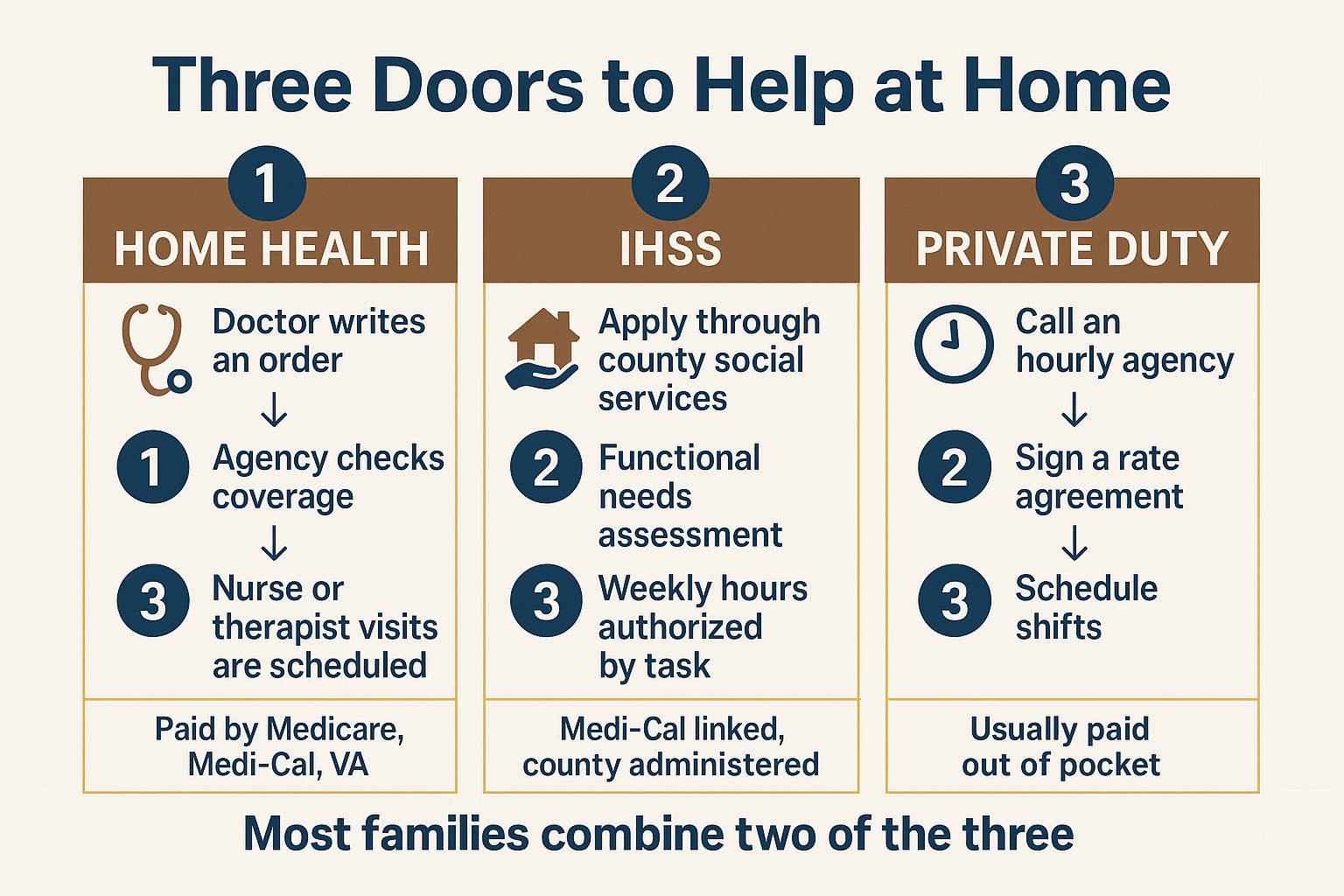
Home health starts with a physician order. A doctor has to order the care, and the agency then checks coverage before scheduling anything. About one in ten callers does not know this, and that gap delays intake. Some families give up entirely at that point, which is a shame, because the order is usually a single phone call to the discharging doctor. The full picture is here: why a physician referral is required for home health.
IHSS starts with an application through county social services. Monterey County, San Benito County, and Santa Cruz County each run their own intake. After the application comes a functional needs assessment, and applicants should expect an interview and, in some cases, a home visit or a virtual assessment. Hours are then authorized by task, which is why two people with the same diagnosis can end up with very different weekly totals.
Private duty starts with a phone call and an hourly rate agreement. No physician order, no eligibility test. That is why it is usually the fastest option, and also why it is the one families pay for out of pocket.
If the discharge already happened, the first 72 hours of home health after a hospital stay walks through what should be happening right now.
Three Doors, Three Starting Points
A quick look at how each type of help gets approved and how fast it typically moves.
Side by Side: Who Authorizes, Who Pays, What You Get
Here is the same information in one place, for the moment when you are on the phone and trying to figure out whether you are talking to the right office.
| Home Health | IHSS | Private Duty | |
|---|---|---|---|
| What it covers | Skilled nursing, wound care, medication management, physical, occupational, and speech therapy, medical social services | Bathing, dressing, meals, housework, errands, supervision | Bathing, dressing, meals, companionship, overnight or live-in coverage |
| Who authorizes it | A physician, plus a coverage check by the agency | County social services after a functional needs assessment | You do, by signing a rate agreement |
| Who pays | Generally Medicare, Medi-Cal, or Veterans benefits | Medi-Cal funded, county administered | The family, out of pocket, unless long-term care insurance applies |
| Schedule | Intermittent visits set by the care plan | Authorized hours per week, spread as needed | Hourly shifts you choose |
| Typical start time | Days, once the order is in hand | Weeks, because of the assessment step | Often the fastest of the three |
What Actually Drives the Cost of Daily Help
Nobody can quote you a real number over the internet, and anyone who does is guessing. But the factors that move the number are the same for every family on the Peninsula.
- Hours per week. A few mornings a week and around-the-clock coverage are not the same product.
- Overnight and live-in arrangements. These are priced differently than daytime hourly help.
- Weekend and holiday rates. Many agencies charge more for both.
- Whether the person is on Medi-Cal. If they are, IHSS hours may cover a meaningful share of what the family would otherwise pay for privately.
The strain is real. In a public review, a Monterey area family described paying roughly $8,000 per month out of pocket for personal care and noted that with Medicaid coverage it would have been free. That is one family’s situation, not a market rate, but it shows how quickly private hourly care adds up when someone needs hands-on help through the whole day.
Home health lands very differently at the mailbox. Physician-ordered home health visits are generally covered by Medicare, Medi-Cal, and Veterans benefits, which is why the two categories feel so unlike each other financially even though the person walks through the same front door.
What Changed Going Into 2026
Rumors move fast in caregiver groups, so it is worth being precise about the three changes that touch this decision.
IHSS provider wages went up in many California counties on January 1, 2026, with pay moving toward a $20 per hour floor statewide. That helps IHSS providers, and it also nudges private-duty market rates upward, since both draw from the same local labor pool in Monterey and Salinas.
Medi-Cal asset limits are being reinstated starting January 1, 2026, after California eliminated them for many programs in 2024. If somebody told your parent years ago that they would not qualify, that answer may be out of date in either direction. Verify current rules with the county rather than assuming.
And the enacted 2026-27 state budget kept the IHSS Backup Provider System in place and did not adopt the proposed Medi-Cal-linked termination change. The program is projected to serve roughly 875,000 people in fiscal year 2026-27. If you want the underlying detail, the Legislative Analyst’s Office published a full analysis of IHSS in the 2026-27 budget.
Ask About Your Town, Not Your County
Roughly 8 percent of callers ask whether their address is covered, and some learn mid-call that it is not. That is avoidable, because boundaries work differently for each program.
IHSS is county-administered. Monterey County, San Benito County, and Santa Cruz County each run separate intake, with their own phone numbers and their own timelines. Where your parent lives decides which office handles the application.
Medicare-certified home health agencies each have their own footprint. A footprint may include the Monterey Peninsula, Salinas, King City, and Hollister without including every address in between. Greenfield, Marina, and the ranch roads south of King City are exactly where this gets uncertain.
So on the first call, give the specific town or ZIP code, not the county name. And if the answer is no, ask for a referral to a provider who does cover that address. A good intake person will have names ready.
Who to Call for What on the Central Coast
Here is the short list worth taping inside a kitchen cabinet.
- County social services in Monterey, San Benito, or Santa Cruz County for an IHSS application and needs assessment.
- The Alliance on Aging in Monterey County for benefits questions and free Medicare counseling.
- The local Medi-Cal plan for case management questions and covered services under the plan.
- Community nonprofits running Meals on Wheels and volunteer transportation, for the gaps no clinical program fills.
- A home health agency once you have the physician order in hand.
The person who usually untangles all of this for a family is a Medical Social Worker. They are part of the home health team alongside nurses, therapists, chaplains, volunteers, and other clinicians, and their job includes knowing which local office handles what.
One local family, in a five-star review, credited the Medical Social Worker on their mother’s home health team with helping them cancel out-of-state Medicaid coverage and pointing them toward community resources they had not known existed. That kind of help does not show up on a service list, but it is often the thing families remember.
If the person doing all the daily lifting right now is you, respite care for family caregivers is worth reading before you hit the wall.
Frequently Asked Questions About IHSS vs Home Health Care
Can my parent have IHSS and home health at the same time?
Yes, and many families do exactly that. The programs are funded and authorized separately, so IHSS hours cover bathing, meals, and daily supervision while a physician-ordered home health team handles nursing, wound care, and therapy. Neither one cancels the other out.
Do I need a doctor’s order for IHSS too?
No. IHSS runs on a county functional needs assessment, not a physician order. A doctor’s input can support the application, but the county caseworker makes the hours determination. Home health is the one that cannot begin without an order.
How long does IHSS take to start compared to home health?
IHSS generally takes longer, because the application has to be processed and a needs assessment scheduled, which can mean weeks. Home health can often begin within days once the physician order and coverage check are complete. Private duty is usually the quickest, which is why some families bridge the gap with paid hours while an IHSS application is pending.
What if my parent does not qualify for Medi-Cal?
Then IHSS is likely off the table, and hands-on daily help would come from a private-duty agency paid out of pocket. Physician-ordered home health visits are a separate question and are generally covered by Medicare or Veterans benefits regardless of Medi-Cal status. And since asset rules changed again in January 2026, an old denial is worth rechecking with the county.
Does home health cover a home health aide for bathing?
Some aide support can be part of a home health plan when it is tied to skilled care already in place, but it is limited and scheduled, not daily shift coverage. If the real need is help every morning and evening, that is IHSS or private duty territory.
Still Not Sure Which Program Fits Your Family?
Central Coast VNA & Hospice has been a nonprofit serving Monterey County and the surrounding Central Coast since 1951, reaching 75 years in 2026, with teams of Registered Nurses, Licensed Vocational Nurses, therapists, Medical Social Workers, Chaplains, and Volunteers, and it accepts Medicare, Medi-Cal, and Veterans benefits. A care coordinator can help you sort out which program handles which part of the need before anything is scheduled, including pointing you toward the county or community office that actually handles your question. You can reach the team at 831-372-6668 or read more at ccvna.com.