
Direct Answer: Medicare’s hospice benefit does not pay room and board. The family or the resident pays housing costs, though Medi-Cal may cover nursing home room and board for patients eligible for both programs.
A discharge planner says the sentence families remember for weeks: Medicare covers hospice. It sounds like the bills are handled, and for a few days it feels that way.
Then the assisted living invoice arrives for the full month, the same amount as always, and nobody warned you. Or your father is back home in Pacific Grove and you realize the nurse comes twice a week, not twice a day.
This article answers one narrow question: who pays for the housing and the hands-on daily hours when someone is on hospice. It is not a full walkthrough of the Medicare hospice benefit, and it is not about how hospice agencies get funded.
What the Hospice Benefit Pays For, and What It Leaves Alone
The hospice benefit is built around a team and the things that team needs to keep someone comfortable. It is not a housing benefit, and that distinction catches almost every family off guard.
What it generally covers:
- Visits from the care team, including nurses, therapists, social workers, chaplains, volunteers, and other clinicians
- Medications tied to the terminal diagnosis and to comfort
- Medical equipment such as a hospital bed, wheelchair, walker, or oxygen concentrator
- Medical supplies related to the diagnosis
What it does not cover:
- Rent, mortgage, or a monthly residency charge
- Meals and food service
- The daily room and board fee at a facility
Medicare states this plainly: room and board is not covered when hospice care is given at home, in a nursing home, or in a hospice inpatient facility.
So the housing question never disappears when hospice starts. It just keeps running on its own track, and it is worth understanding what hospice actually includes before the first invoice lands.

Who Pays for Hospice Room and Board Depends on Where Your Loved One Lives
Where the person sleeps changes the answer completely. Three settings cover almost every family calling from Monterey County.
At home. In a house in Pacific Grove, Salinas, Carmel, or King City, there is no room and board bill at all. The hospice team comes to the house, and the daily hands-on hours are the family’s to arrange and pay for.
In a licensed board and care or assisted living residence. The team comes to the resident, right in their room. The monthly residency charge continues unchanged, because that charge covers housing, meals, and the facility’s own staff, none of which the hospice benefit touches.
In a skilled nursing facility. The facility’s daily housing charge is separate from hospice and keeps billing on its own. For patients who qualify for both Medicare and Medi-Cal, Medi-Cal may cover facility room and board. That one is worth verifying directly with the county and with the hospice team rather than assuming either way.
If you are still sorting out whether hospice is even the right program yet, the difference between home health and hospice is usually where families need to start.
Room and Board and Daily Care by Setting
Here is how the two separate bills break down depending on where your loved one is living.
| Setting | Who pays for housing and meals | Who covers the daily hands-on hours |
|---|---|---|
| Private home | No room and board bill exists | Family, private-duty agency, IHSS, or a mix |
| Board and care or assisted living | Resident or family, monthly charge continues | Facility staff, plus family or private-duty for extra hours |
| Skilled nursing facility | Resident or family; Medi-Cal may cover it for dual-eligible patients | Facility staff as part of the daily rate |
| Short-term inpatient or respite stay | Medicare, when the hospice team arranges it | Facility staff during that limited stay |
The One Exception: Short-Term Inpatient and Respite Stays
There is a real exception, and families should know about it. It is short term and it is arranged by the team, not requested like a hotel booking.
When the hospice team determines a patient needs short-term inpatient care for symptoms that cannot be managed at home, Medicare covers that stay in the facility the hospice arranges. The same applies to a respite stay, a brief break so an exhausted family can sleep and reset.
Medicare rules also allow small charges in specific situations:
- A modest coinsurance share for an inpatient respite stay
- A small copay per prescription for comfort medications
This is a limited, clinically driven exception. It is not an open-ended way to have housing covered, and it is not something a family can lean on for months of long-term care.
A lot of what families expect from hospice turns out to be different in practice, which is one reason hospice is not what most families think it is.
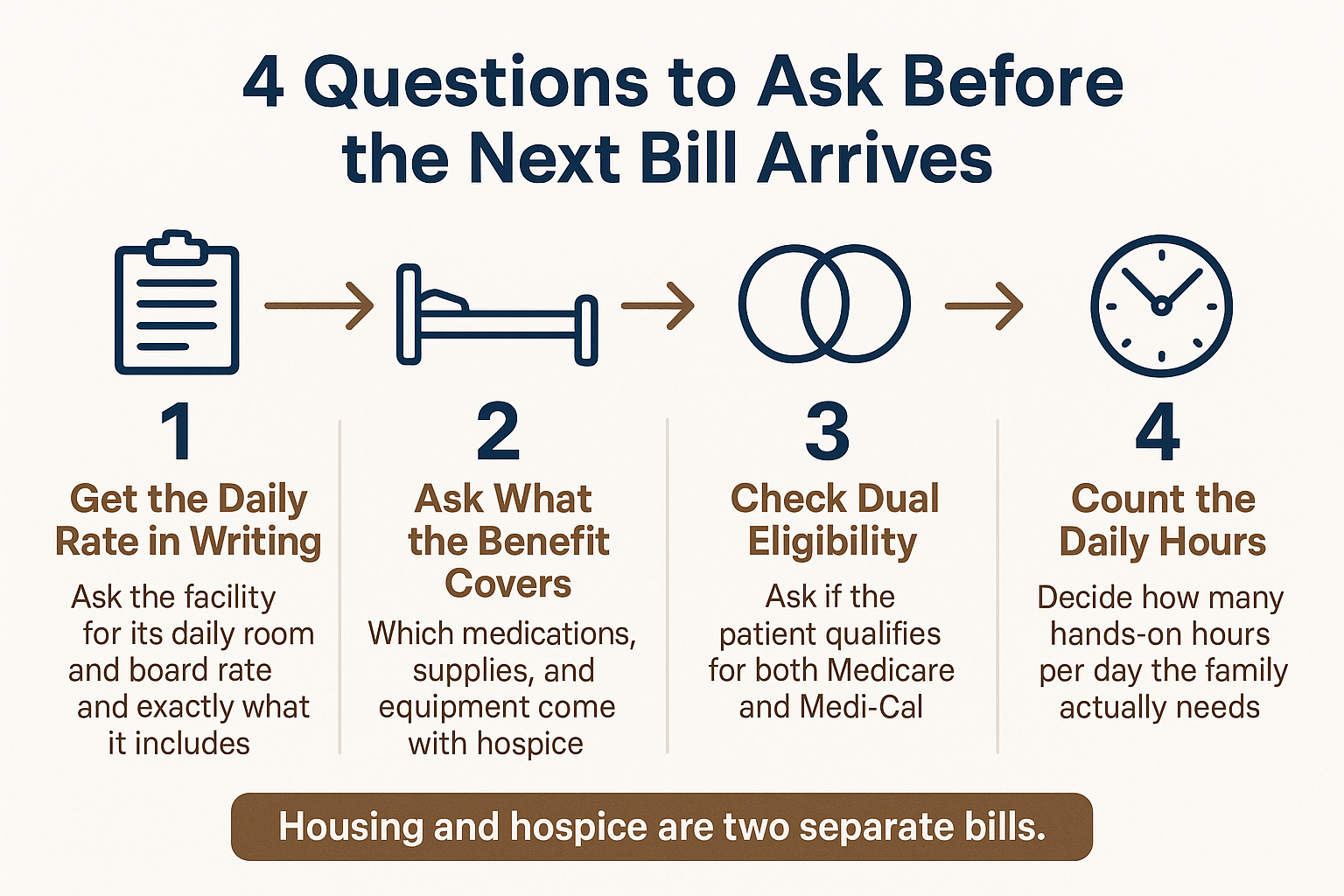
Four Questions to Ask Before the Next Bill Arrives
Asking these four things early tends to prevent the surprise invoice that catches most families off guard.
The Real Gap: “We Need Daily Care, Not a Few Visits a Week”
This is the sentence that drives most of these calls. Families are stunned to learn that hospice visits are scheduled, intermittent, and clinical, not around-the-clock attendant coverage.
A nurse may come twice a week. A Hospice Aide may come for bathing and personal care on set days. Nobody is sitting in the living room at 3 a.m.
That overnight and all-day coverage is private-duty care, and families across Monterey County describe paying in the thousands per month out of pocket for it. One public review from a Peninsula family mentioned a figure near $8,000 a month for personal attendants. Treat numbers like that as general market context, not a quote, because what a household actually pays swings widely.
What drives the number:
- Hours per day, and whether coverage is daily or a few days a week
- Whether overnight coverage has to be awake rather than sleeping
- Whether transfers take two people, which doubles staffing for those visits
- Weekend and holiday rates
- How rural the address is, since drive time to King City or Hollister factors in
Other pieces families use to close the gap include long-term care insurance, IHSS for those who qualify, VA programs for veterans, and rotating family shifts. The hospice team can usually name local private-duty agencies, so ask rather than starting from a search engine.
You Do Not Have to Solve the Money First
Money questions and clinical questions arrive in the same breath. One caller asked it exactly that way: does Medicare cover this, and do we need a referral from the doctor first?
Both answers matter, and yes, a physician’s order is part of getting started. But waiting until the finances are figured out is what hurts families most, because delay costs comfort time that does not come back.
A short list worth handling on the front end:
- Request the facility’s daily rate in writing, along with what it includes
- Ask the hospice team which medications, supplies, and equipment come with the benefit
- Ask whether the patient is eligible for both Medicare and Medi-Cal, because that single answer changes the housing math more than anything else
That last one is often where a Medical Social Worker earns their place on the team. At Central Coast VNA & Hospice, a nonprofit that has served Monterey County since 1951 and reaches its 75th year in 2026, Medical Social Workers work alongside nurses, therapists, chaplains, volunteers, and other clinicians, and that role is frequently what untangles coverage questions.
One family put it simply in a public review: “She helped us find the right agency to cancel her mom’s Medicaid in FL and recommended additional resources in the community.” (Claude C.)
If you are earlier in the process, the eligibility question families are often afraid to ask is a reasonable next read.
Frequently Asked Questions About Hospice Room and Board
If my mom is in assisted living in Monterey and goes on hospice, does her monthly bill go down?
No. The monthly residency charge continues unchanged, because it pays for her apartment, meals, and the facility’s own staff. Hospice adds a visiting team on top of what she already has, and the two bills stay separate.
Does Medi-Cal ever pay for room and board in a nursing home?
It can, for patients who qualify for both Medicare and Medi-Cal. This is one of the few situations where housing costs get covered for an extended period. Verify it with the county and the hospice team before making any decisions based on it, since eligibility rules are specific.
Why can’t hospice just send someone every day?
Hospice visits are clinical and intermittent by design. Nurses, therapists, Hospice Aides, social workers, chaplains, and volunteers each come on a schedule built around the patient’s needs, not as continuous attendant coverage. Daily hands-on hours are usually filled by family, a private-duty agency, or IHSS.
Are there any costs at all under the hospice benefit?
Medicare rules allow small charges in specific situations, including a modest coinsurance share for an inpatient respite stay and a small copay per prescription for comfort medications. These are limited amounts, not open-ended bills.
Do we need a doctor’s referral before anyone will talk to us?
A physician’s order is needed before care can be scheduled, but you do not need it in hand to start asking questions. Families call all the time just to understand how coverage works, and that conversation costs nothing.
Sorting Out the Housing and Care Math
Families across Monterey County work through these same two bills every week, and none of it is obvious the first time you face it. A Medical Social Worker on the VNA team can walk through what the benefit covers, what dual eligibility would mean for your situation, and where the daily care hours might come from. You can reach a care coordinator at 831-372-6668 or read more at ccvna.com.