
Direct Answer: With Original Medicare, you may choose any Medicare-certified home health agency serving your ZIP code. With Medicare Advantage, your plan may limit you to in-network agencies, require prior authorization, and approve fewer visits.
Your mom is being discharged tomorrow. The hospital case manager hands you a list and says she needs a nurse at the house within a day or two. Then someone asks which Medicare plan she has, and you realize you have no idea.
This happens constantly in Monterey County. Families call about home health hours after a discharge, and the very first question they ask is whether Medicare covers this. That question has two different answers depending on which kind of Medicare your parent signed up for.
With Original Medicare, you can pick any Medicare-certified agency that serves your address. With Medicare Advantage, the plan itself may decide for you. Here is how that works, what it means at the moment of discharge, and the one question worth asking long before you need an answer.
Two kinds of Medicare, two very different sets of options
Original Medicare is the federal program. Home health is covered under Part A and Part B, and a patient can choose any Medicare-certified agency serving their ZIP code, whether that is Pacific Grove, Salinas, or King City.
Medicare Advantage is different. It is a private plan that replaces Original Medicare, and it comes with a network. That network is the part families never think about until a discharge planner asks for a preference.
Under a Medicare Advantage plan, you may run into:
- A short in-network list of approved home health agencies in your county
- Prior authorization before a Registered Nurse or Physical Therapist can make the first visit
- Fewer approved visits than Original Medicare would allow for the same diagnosis
- More frequent care plan reviews, with changes requested mid-recovery
- Reauthorization if therapy needs to continue past the first approved block
Research from the Center for Medicare Advocacy found that Medicare Advantage plans commonly deny or limit services through prior authorization, approve fewer visits, and require more care plan changes than Original Medicare. For a family waiting on a nurse to check a surgical wound, that is not paperwork. That is days.
Original Medicare vs Medicare Advantage for home health
A side by side look at how the two plan types treat home health differently. Your specific plan documents always control the details.
| What matters | Original Medicare | Medicare Advantage |
|---|---|---|
| Choice of agency | Any Medicare-certified agency serving your ZIP code | Usually limited to in-network agencies on the plan’s list |
| Prior authorization | Generally not required to start | Often required before the first visit |
| Number of visits | Based on physician orders and clinical need | May be capped or approved in shorter blocks |
| Care plan changes | Driven by the clinical team and physician | Plan may request changes or additional review |
| Speed to first visit | Often within 24 to 48 hours of the order | Can be delayed while authorization is processed |
Why these restrictions hurt most at the moment of discharge
Network limits are manageable when you have time. They are brutal when you have none.
Most families reach out within hours or days of a hospital discharge. They are stressed, unfamiliar with how home health works, and trying to figure out whether someone will come today or next week. Comparison shopping is the last thing on their minds.
Geography makes it tighter here. A family in Hollister or King City may be an hour or more from the discharging hospital, and there are fewer agencies covering those ZIP codes to begin with. If the plan’s in-network list has two names on it and neither one covers South Monterey County, you have a real problem at nine o’clock at night.
Delays also carry risk. Home health exists in large part to catch the problems that send people back to the emergency room, things like a wound that is not healing, a blood pressure reading that is off, or a medication list that does not match what is actually in the cabinet.
If you want a clearer picture of how the first days should go, the first 72 hours after a hospital stay covers what a properly running start looks like.
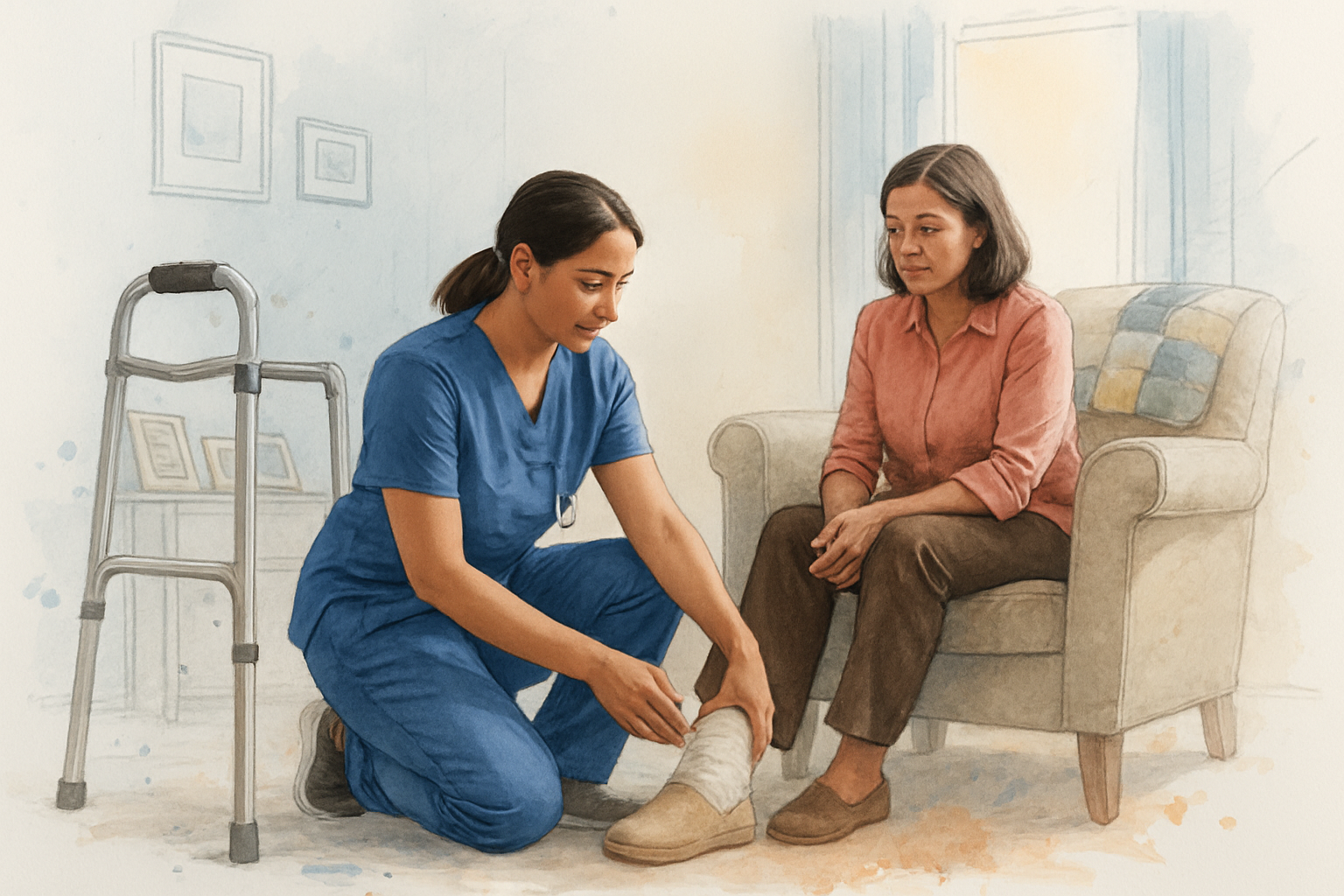
The referral step families do not see coming
A large share of first-time callers are surprised to learn that home health cannot simply be scheduled. It takes a physician order first. Several families each month say some version of “I didn’t know we needed a doctor’s order.”
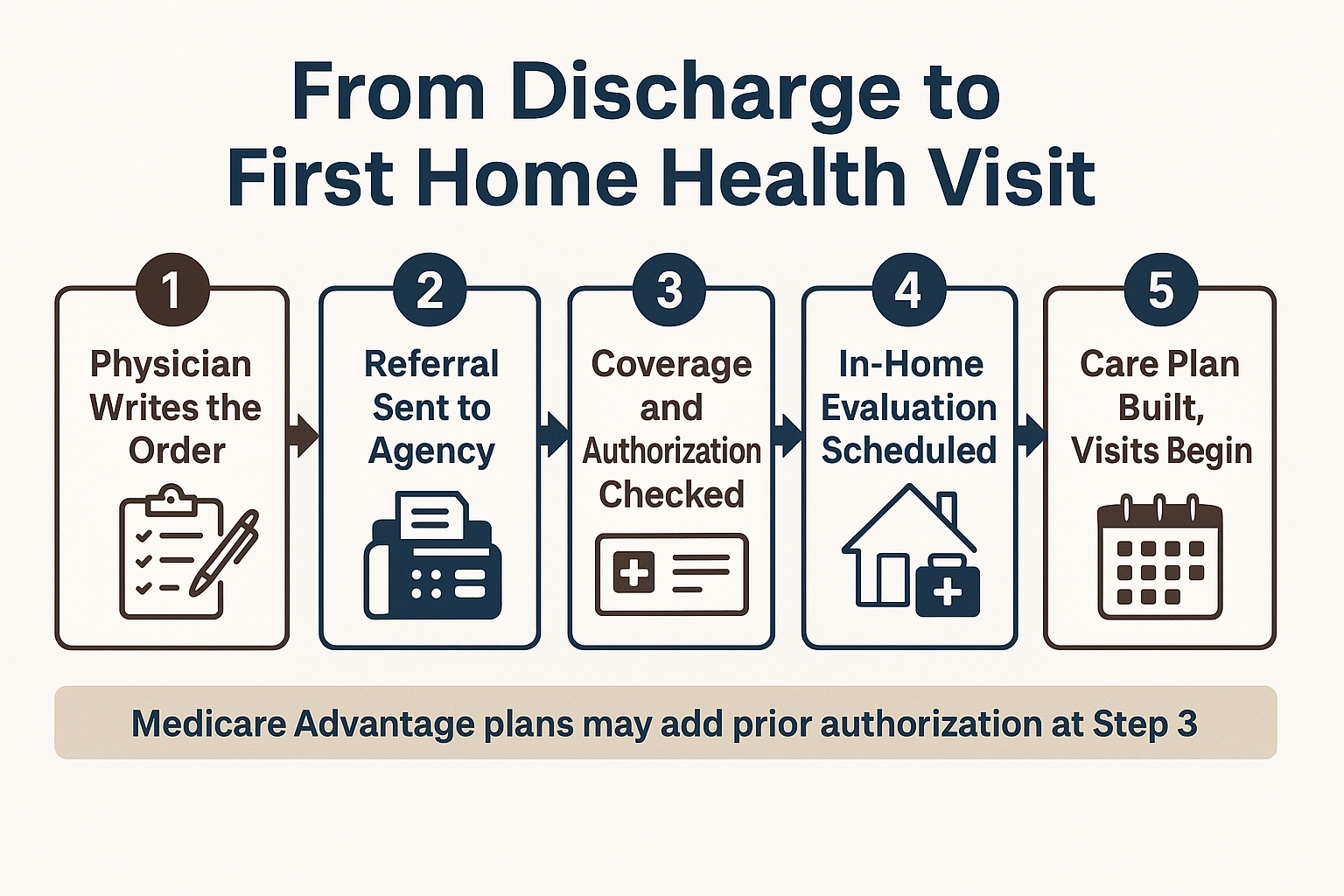
The basic pathway looks like this:
- A physician writes the order for home health
- The agency receives the referral, usually by fax from the hospital or clinic
- Insurance and eligibility are checked, including any plan authorization
- A clinician schedules an initial in-home evaluation
- A care plan is built and visits begin
Every one of those steps can stall. The order gets faxed to the wrong number. The plan asks for more documentation. A weekend lands in the middle of it.
Some agencies, including community nonprofits serving Monterey County, will chase the physician order on the family’s behalf rather than leaving you to call the doctor’s office three times. That single act often removes two or three days of waiting. Here is how the referral requirement actually works if you want the detail before you are in the middle of it.
The path from hospital bed to first home visit
Five steps stand between a discharge order and a nurse at the door. Knowing them helps you spot where things are stuck.
The one question to ask before you need the answer
Most people ask an agency, “Do you accept Medicare?” That is the wrong question if your parent has a Medicare Advantage plan.
Ask instead: “Are you in-network with this specific plan?” Then give the plan name and the plan type exactly as it appears on the insurance card. Accepting Medicare generally and being contracted with one particular Advantage plan are two separate things.
The ideal time to ask is when nothing is wrong. Before a scheduled knee replacement. During a stable stretch with a chronic condition. While you are still sitting in the surgeon’s office talking about recovery.
A few things worth pinning down in that call:
- Whether the agency is contracted with the exact plan on the card
- Whether the agency serves your specific ZIP code, not just the county
- Whether prior authorization is typically required and how long it takes
- How quickly a first visit usually happens once the order arrives
- What happens if approved visits run out before recovery is finished
If you are still sorting out what type of care fits, this comparison of home health and hospice clears up the terms families most often mix up on that first phone call.
Why not every agency answers these questions the same way
Home health agencies are under real financial pressure. The 2026 Medicare home health payment rule finalized a 1.3% cut to aggregate Medicare payments, softened from a proposed 6.4% cut, amounting to roughly $220 million less in reimbursement nationally.
When margins tighten, some agencies respond by narrowing which payer types they accept or which geographies they cover. Rural and outlying areas usually feel that first.
A nonprofit community agency answers to the community rather than to shareholders, which can lead to different decisions about who gets accepted and how far the team will drive. Central Coast VNA & Hospice has been serving Monterey County since 1951, along with San Benito County, South Santa Clara County, and parts of Santa Cruz County, and accepts Medicare, Medi-Cal, and Veterans benefits.
One more thing worth knowing. Home health covers skilled, intermittent visits, not daily hands-on help. Many callers need both. A public reviewer described paying somewhere around $8,000 a month out of pocket for private-duty help alongside clinical care, which is a useful reminder that costs vary widely and are worth asking about early. If daily personal care is the gap, most agencies can point you toward private-duty providers who fill it.
Frequently Asked Questions About Medicare Advantage Home Health Restrictions
How do I find out which type of Medicare my parent has?
Look at the insurance card. Original Medicare cards are red, white, and blue and say Medicare Health Insurance. A Medicare Advantage card carries a private insurer’s name and logo, and usually lists copays and a member services number on the back. If you only have one card and it has a company name on it, that is almost certainly an Advantage plan.
Can I switch plans if my preferred agency is out of network?
Plan changes are generally limited to the annual enrollment window each fall or a qualifying special enrollment period, so switching mid-recovery is rarely an option. Call your plan’s member services line to ask about your specific situation.
Does prior authorization mean my parent will be denied?
No. It means the plan reviews the request before care starts. Most requests go through, but the review adds time, and that is exactly the delay families cannot afford right after a discharge. Asking about typical turnaround up front helps you plan around it.
What if the approved visits run out before recovery is done?
The clinical team can request additional visits with supporting documentation from the physician. Approval is not automatic under an Advantage plan. If more help is still needed after home health ends, a Medical Social Worker can help you look at community resources and other options.
Do Veterans have different options for home-based care?
Often yes. VA programs can cover home-based services in ways that differ from both Original Medicare and Advantage plans, and many families never think to ask. It is worth raising with the discharge planner and with any agency you call.
Sorting out your options before the discharge date
If you are trying to understand which home health options are open to your family under a particular Medicare plan, a care coordinator can walk you through the questions without any pressure to sign up for anything. VNA has been caring for families across Monterey County, Salinas, King City, Hollister, and the surrounding Central Coast for 75 years, with teams of nurses, therapists, social workers, chaplains, volunteers, and other clinicians. You can reach someone at 831-372-6668 or read more at ccvna.com.