
Direct Answer: Palliative care is specialized medical support that relieves the symptoms and stress of serious illness. It can start at diagnosis and run alongside curative treatment, it is not the same as hospice.
On a Tuesday afternoon, palliative care might look like a Registered Nurse reviewing a pain management plan at a kitchen table in Salinas. It might look like a Medical Social Worker helping a family figure out why their father keeps ending up in the emergency room. It might look like a simple phone call that finally gives a spouse the words she needs to describe what her husband is going through to his oncologist. That is the palliative care meaning that matters, not the policy definition, but what it actually does for a person on an ordinary day.
Most families on the Central Coast first hear the phrase during a hospital stay or a difficult appointment. And most of them assume it means something is ending. It usually doesn’t. Palliative care can begin the day a serious illness is diagnosed, whether that’s Parkinson’s disease, heart failure, COPD, or cancer, and it can continue for months or years while a patient is still pursuing treatment.
This article explains what palliative care actually is, who it’s for, what the team looks like in a home-based setting, and how families in Monterey County can ask for it without waiting until things get worse.
What Palliative Care Means, in Plain Language
Palliative care is specialized medical support focused on relieving the symptoms and stress caused by serious illness. The goal is not to treat the underlying disease, that’s the job of the patient’s primary physicians, but to make the experience of living with that disease more manageable.
Symptoms that palliative care commonly addresses include:
- Pain that isn’t well controlled by a primary care plan
- Shortness of breath, especially common in heart failure and COPD
- Fatigue and sleep disruption that leave patients exhausted and families worn down
- Anxiety and depression that develop alongside serious illness
- Nausea, appetite loss, and medication side effects
- Confusion about care options and what decisions need to be made
That last one matters more than people expect. A significant part of palliative care is helping patients and families understand what is happening, what choices exist, and how to communicate those choices to the broader care team. One family described calling their loved one’s physician’s office and not knowing which questions to even ask, a palliative care team addresses exactly that gap.
For families wondering about coverage, what Medicare covering palliative care could mean for your family is worth reading before you assume cost is a barrier.

Is Palliative Care the Same as Hospice?
This question comes up in nearly every family conversation about serious illness, and the confusion is completely understandable.
Palliative care is the broader category. Hospice is one specific type of palliative care. Here is the clearest way to think about it:
- Palliative care can begin at any stage of illness, runs alongside curative treatment, and has no required prognosis. A patient can receive palliative care for two years while actively treating cancer.
- Hospice care is for patients who have decided to stop pursuing curative treatment and whose physician estimates a prognosis of six months or less if the illness runs its natural course.
Someone on palliative care is not giving up. They are getting help managing symptoms so they can tolerate treatment, stay out of the emergency room, and keep living at home. That distinction changes everything about how families receive the idea.
If you are already weighing where hospice fits into the picture, how do you know when it’s time to consider hospice care covers that question with the same directness.
The National Institute on Aging also describes the distinction clearly and is worth bookmarking for family conversations.
Palliative Care vs. Hospice: Side by Side
This table shows the practical differences between palliative care and hospice, two terms that are often used interchangeably but mean very different things.
| Palliative Care | Hospice Care | |
|---|---|---|
| When it starts | At diagnosis, any stage of illness | When curative treatment has stopped |
| Prognosis required? | No | Yes, 6 months or less |
| Can patient still pursue treatment? | Yes | No, hospice is comfort-focused only |
| Focus | Symptom relief and care planning alongside treatment | Comfort, dignity, and quality of life at end of life |
| How long it lasts | Months to years | Up to 6 months (renewable if eligible) |
| Medicare coverage | Varies by plan and setting | Covered under Medicare Hospice Benefit |
Why Starting Earlier Almost Always Helps
Most families wait too long. The pattern is familiar to anyone who has worked with seriously ill patients on the Central Coast, a spouse managing a husband’s Parkinson’s progression alone, an adult child flying in from out of state to handle a parent’s heart failure crisis, a family member in Pacific Grove who didn’t know palliative care was even an option until the third ER visit in two months.
Earlier palliative care involvement is tied to fewer ER visits, better sleep, reduced anxiety, and longer time at home. Those outcomes are not accidental. When a palliative team is involved early, medication plans are adjusted before symptoms spiral. Emotional support is in place before families hit a wall. Care decisions get made with time to think, not in a hospital hallway at midnight.
For families managing chronic, progressive illnesses like COPD, advanced heart failure, or neurodegenerative conditions, the question is rarely “is it time for palliative care?”, it’s “why haven’t we started yet?”
If you’re navigating whether your situation calls for this kind of support, when caring for an aging parent becomes more than you can do alone describes the signs families often recognize too late.
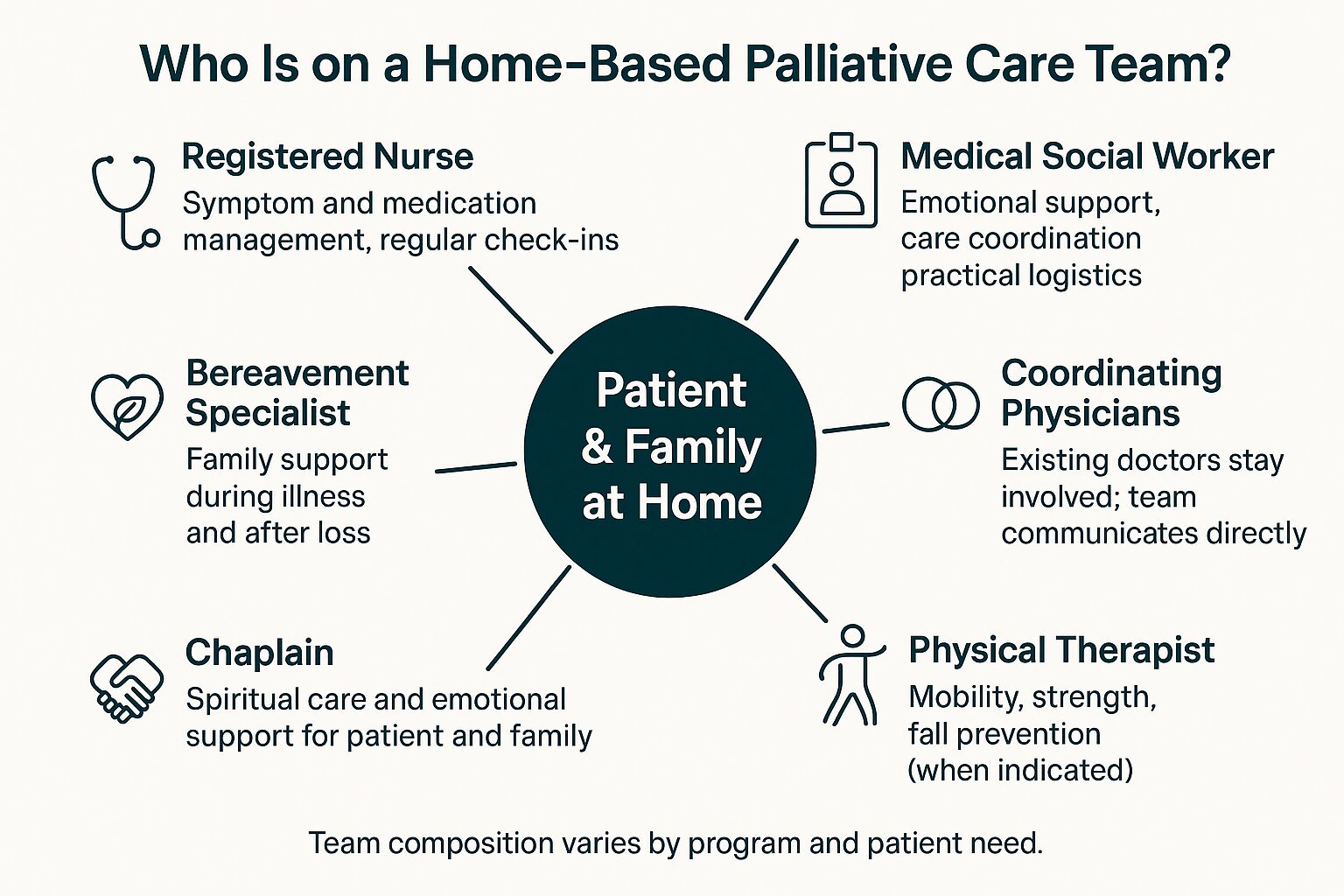
What the Palliative Care Team Actually Looks Like
Home-based palliative care involves more than one nurse checking in. This shows who is on the team and what each person does.
How to Ask Your Doctor for a Palliative Care Referral
One of the most common things families say after getting connected to palliative care is that they didn’t know they could ask for it. Many assume a specialist has to bring it up first.
Any patient with a serious illness can ask their primary care physician or specialist for a palliative care referral. You don’t need to be near the end of life. You don’t need to have stopped treatment. You just need to be dealing with a serious illness that is affecting quality of life.
A straightforward way to start the conversation with a physician:
- “My [husband/mother/father] is having a hard time managing [pain/fatigue/shortness of breath] alongside treatment. Is a palliative care referral something we should consider?”
- “We’re feeling overwhelmed trying to coordinate all of this at home. Is there a palliative care team that could help us with care planning?”
- “I’ve heard palliative care can help people stay out of the ER. Would that be appropriate given where we are?”
After a referral is placed, the process typically involves an initial home visit to assess the patient’s symptoms, medications, and overall situation. From there, the team develops a plan and begins coordinating with existing physicians. In a home-based program, the team comes to the patient, whether that’s a home in King City, an apartment in Salinas, or a residence in Pacific Grove. That matters a great deal for older adults who find clinic visits exhausting or physically difficult.
For those who aren’t sure whether their situation calls for palliative care or something closer to home health, skilled nursing care at home is different from what most people picture explains that distinction clearly.
Frequently Asked Questions About Palliative Care
Does palliative care mean my loved one is dying?
No. Palliative care can start at any stage of a serious illness, including shortly after diagnosis, and it runs alongside curative treatment. Many patients receive palliative care for a year or more while still actively treating their illness. It is focused on quality of life, managing symptoms, reducing stress, and supporting the whole family, not on end-of-life preparation.
Who pays for palliative care at home?
Coverage depends on the setting and your specific plan. Medicare, Medi-Cal, and Veterans benefits may cover various components of home-based palliative care, though the rules differ from hospice coverage. A care coordinator can walk through what applies to your situation before any services begin. Central Coast VNA & Hospice accepts Medicare, Medi-Cal, and Veterans benefits.
Can my loved one receive palliative care and still see their regular doctors?
Yes, and that’s actually the point. Palliative care is designed to coordinate with, not replace, the patient’s existing care team. Registered Nurses and Medical Social Workers communicate directly with the treating physicians so the whole picture stays connected.
How do I know if palliative care is the right fit right now versus hospice?
If your loved one is still pursuing curative or disease-managing treatment, palliative care is almost certainly the right conversation to start. Hospice applies when curative treatment has stopped and a physician estimates six months or less. The table above in this article breaks down the practical differences, and comfort care vs. hospice: why the difference matters goes deeper on where the lines are.
What if I’m not sure my loved one qualifies or where to start?
That uncertainty is exactly where a care coordinator can help. Many families call not knowing whether they qualify, what a physician referral requires, or whether their area is covered. A single phone call can answer those questions without any commitment. Central Coast VNA & Hospice serves all of Monterey County, including Salinas, King City, the Monterey Peninsula, and surrounding communities, as well as parts of San Benito and South Santa Clara counties.
Ready to Talk Through Whether Palliative Care Fits Your Situation?
If you are managing a serious illness, yours or a loved one’s, and you’re not sure whether palliative care is an option yet, a conversation with a care coordinator is the simplest first step. Central Coast VNA & Hospice has served families across Monterey County, Salinas, King City, the Monterey Peninsula, and surrounding communities since 1951, and that kind of local experience makes a real difference when you’re trying to understand what is available and where to start. You can reach their team at 831-372-6668 or learn more at ccvna.com.