
Direct Answer: The vaccines have not changed. The groups recommending them are not aligned this year. For a homebound parent, ask their own physician what to get and whether a shot can happen at home.
A daughter in Pacific Grove calls her mother’s doctor, stops by the pharmacy counter, catches a headline on the evening news, and ends up with three different answers about what her 88 year old mom should get this fall.
She is not confused because she missed something. The 2026-2027 respiratory season genuinely has more than one set of recommendations, and the people answering the phone at a retail pharmacy may not know which one applies to a woman who rarely leaves her house.
This article covers what actually changed, what physician groups are advising for adults 65 and older, and the part almost nobody writes about: how a parent who cannot stand in a pharmacy line gets vaccinated at all.
Why the advice sounds different depending on who you ask
The shots are the same shots. The difference this year is who is doing the recommending.
For the 2026-2027 season, the CDC carried its July 2025 flu recommendations forward but has not issued new guidance for COVID-19 or RSV. That left a gap heading into fall.
On September 2, 2026, four physician organizations stepped in and released their own recommendations to fill it. So a family in Salinas can hear one thing from a federal web page, another from a professional medical group, and a third from whoever is staffing the vaccine counter that afternoon.
None of that means a shot is unsafe or that somebody is wrong. It means the usual single clear answer does not exist right now, and the person who resolves it is your parent’s own physician, the one who knows their kidney function, their heart failure history, and what they tolerated last year.
Over the late summer, several Central Coast households reached out simply trying to find out when seasonal clinics would open and whether a parent qualified, often with no clear sense of who to ask first. One caller described it plainly: they just needed someone to come to the house and help them figure out what to do next.
What physician groups are advising for adults 65 and older
The September guidance gives families something concrete to bring to a doctor’s appointment. According to the recommendations from the four physician organizations reported by the American Medical Association, the American Academy of Family Physicians advises:
- An annual flu vaccine for everyone 6 months and older
- One of the updated COVID-19 vaccines approved by the FDA on August 27 for all adults 19 and older
- A second COVID-19 dose six months after the first for adults 65 and older
- RSV vaccination for adults 50 to 74 with high risk conditions, and for everyone 75 and up
Two details matter specifically for older patients. The standing CDC schedule points adults 65 and older toward a high dose, adjuvanted, or recombinant flu vaccine rather than a standard dose version, because the immune response weakens with age.
And a new mRNA flu vaccine was approved this season for adults 50 and older. Availability and insurance coverage are still being sorted out, so it may or may not be an option at a given clinic in Monterey County this year. Worth asking about, not worth waiting for.

A quick reference for an older parent this fall
Bring this to the next appointment or phone call with your parent’s physician. The right answer still depends on their health history.
| Vaccine | What physician groups advised for fall 2026 | What to ask the doctor |
|---|---|---|
| Flu | Annual dose for everyone 6 months and older | Should my parent get the high dose, adjuvanted, or recombinant version? |
| COVID-19 | Updated vaccine for adults 19 and older; a second dose at six months for adults 65 and older | When is the right spacing given their last dose and recent illness? |
| RSV | Adults 50 to 74 with high risk conditions, and everyone 75 and older | Has my parent already had an RSV vaccine? It is not given every year. |
The real problem: how a homebound parent gets a shot at all
A mother in Salinas who uses a walker is not going to stand in a pharmacy line in October. A father just discharged home to King City after a hospital stay is not driving himself anywhere for weeks.
This is where most fall vaccine advice stops being useful. Here is what families can actually ask about:
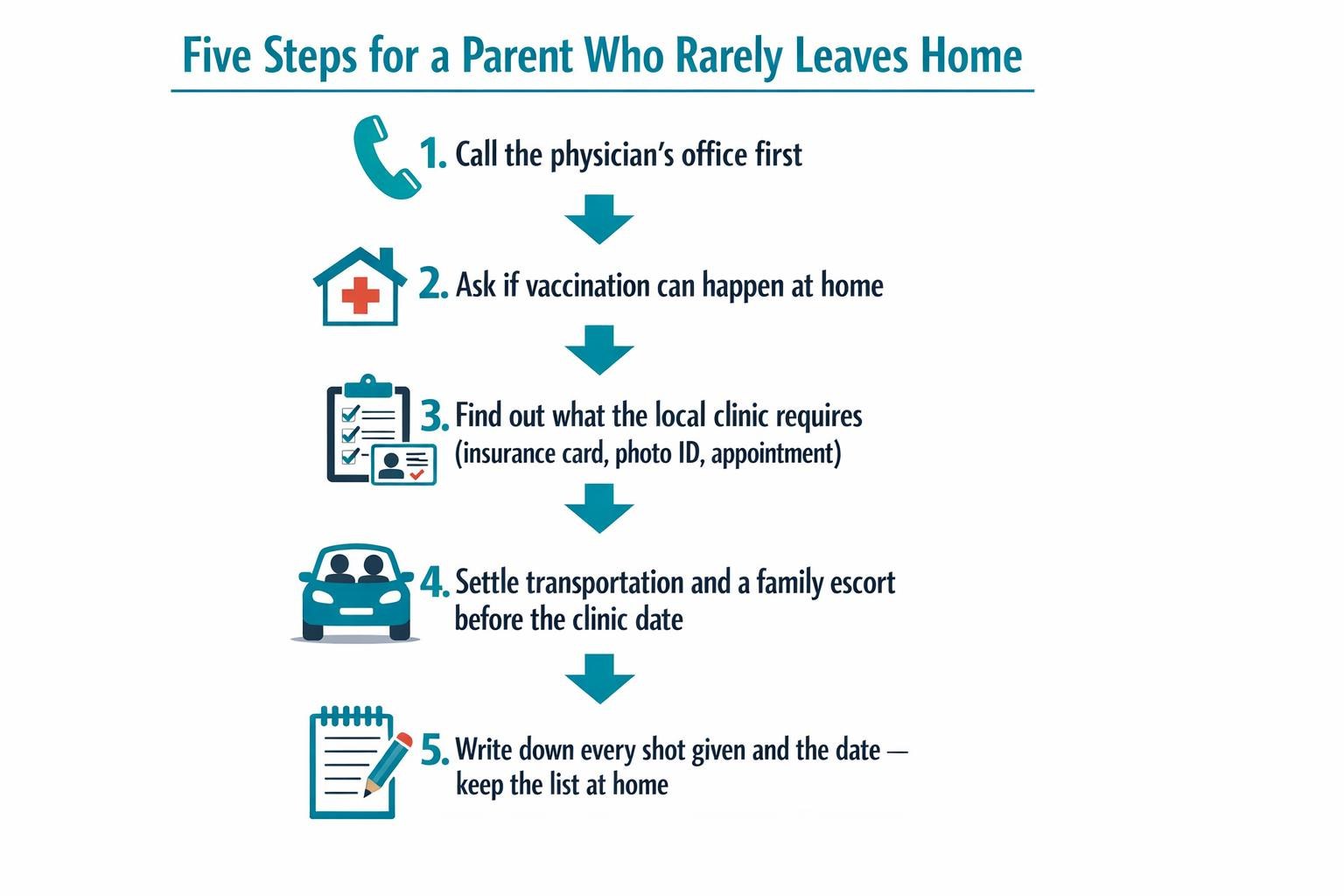
- Can the parent’s physician order vaccination as part of a home visit? Some practices and home based programs can. Many cannot. It depends on the provider, the vaccine, and the payer, so ask directly rather than assuming.
- What do local community immunization clinics require? Clinics in Monterey County commonly run by appointment, and typically ask for an insurance or Medicare card and a photo ID. Some use a drive-up format, which can work well for someone who cannot walk far but can ride in a car.
- Can a senior living community host an on-site clinic? Property managers in Seaside, Marina, and on the Peninsula sometimes arrange these in a community room, including some help for residents who cannot leave their units.
- Who is driving? If a clinic visit is the realistic option, settle transportation and a family escort first. A trip from Carmel Valley or Gonzales to a Monterey clinic is a two hour round trip once you account for parking and the wait.
One housekeeping note, since it comes up every fall: travel related immunizations are no longer offered locally through VNA. For typhoid, tetanus for overseas travel, or similar needs, the CDC travel pages, Doctors on Duty, Dover Travel Clinic, or pharmacies such as Costco, Rite Aid, Safeway, and Walgreens are the places to look.
Five steps for a parent who rarely leaves home
A simple order of operations when you are trying to sort out fall vaccines for an older parent at home.
Why this matters more when a parent is managing COPD, heart failure, or diabetes
For a lot of families, the fear behind the vaccine question is not the flu itself. It is the hospital.
A respiratory infection is often the thing that undoes six weeks of steady progress. A parent who was finally walking to the mailbox again gets sick, stops eating, gets dehydrated, and lands back in the emergency department at Salinas Valley Health or Community Hospital.
The national picture backs up the worry. Interim CDC estimates cited by the AMA put the 2025-2026 season at roughly 390,000 flu related hospitalizations and about 24,000 deaths, with older adults carrying a disproportionate share.
Vaccination is one of the few preventive steps a family can take between clinician visits. Two practical habits help alongside it:
- Keep a simple written list of which shots your parent has had and the dates. Pharmacy and clinic records rarely talk to each other, and nobody wants to guess about a second COVID dose.
- Know what counts as a change worth calling about, and who to call at 9pm. If your parent is already receiving care at home, that answer should be in writing on the refrigerator.
If hospital trips have become a pattern, it is worth reading about why heart failure keeps sending a parent back to the hospital and what skilled nursing actually involves for COPD and diabetes at home.
When a parent is on palliative care or nearing the end of life
Families ask this quietly, usually after a pause, and almost nobody answers it out loud: should my mother still get a flu shot if she is on hospice?
It is a goals of care question, not a checklist item. It belongs with the physician and the team already caring for her, the nurses, therapists, social workers, chaplains, volunteers, and other clinicians who know her day to day.
Some families decide a flu shot fits the goal plainly. A miserable week of fever and coughing is not how they want her to spend time she has left. Other families decide the opposite, that one more needle serves no purpose she would value.
Both answers are reasonable. The only thing that is not helpful is leaving the question unasked because it feels inappropriate to raise.
Frequently Asked Questions About Fall Vaccines for Older Adults at Home
Can someone come to the house to give my mom her flu shot?
Sometimes. It depends on the provider, the vaccine, and what her insurance will cover. Start by asking her physician’s office whether vaccination can be ordered as part of a home visit, and ask what the local community clinics require if it cannot.
Does Medicare cover these vaccines?
Flu, COVID-19, and RSV vaccines are generally covered for Medicare beneficiaries, though which part of Medicare pays can vary by vaccine and by plan. Check with the plan directly before the appointment so there are no surprises.
My dad got an RSV shot two years ago. Does he need another one?
RSV vaccination is not an annual shot the way flu is. Current guidance does not call for routine repeat doses for most older adults. His doctor can confirm from his record, which is one more reason to keep a written list at home.
Can he get the flu and COVID shots on the same day?
Many people do, and it is commonly done. For a frail parent, some physicians prefer spacing them out so it is easier to tell which shot caused a sore arm or a rough night. Ask what they recommend for your parent specifically.
Do you offer travel vaccines like typhoid or tetanus for an overseas trip?
No. Travel related immunizations are no longer offered locally through the organization. The CDC travel health pages, Doctors on Duty, Dover Travel Clinic, or pharmacies including Costco, Rite Aid, Safeway, and Walgreens are the right places to look.
Sorting out fall vaccines for a parent at home
Central Coast VNA & Hospice is a nonprofit that has served Monterey County and the surrounding Central Coast since 1951, and its community wellness work, including seasonal immunization clinics, has always run alongside home based clinical care across Monterey, San Benito, Santa Cruz, and South Santa Clara counties. Families with questions about seasonal vaccination for an older parent at home are welcome to call 831-372-6668 or visit ccvna.com to talk it through with a care coordinator.