
Direct Answer: The one-time $90 Part B rebate went to people enrolled in Original Medicare Part B living in the U.S. Medicare Advantage members, IRMAA payers, and people with Medicaid premium help were excluded.
In early October, a lot of people on the Central Coast opened their bank app and saw an extra $90 sitting there. A lot of other people checked, found nothing, and started wondering what they had done wrong.
If you handle the bills for an aging parent in Monterey, Salinas, or Carmel, this probably landed on your plate. The payment was real. But the rules around who got it were narrower than most of the headlines suggested.
This is a plain explanation of what the payment was, who qualified, who was left out on purpose, and what it does and does not change about paying for care at home.
What the $90 Medicare Part B payment actually was
On October 3, 2026, the Centers for Medicare & Medicaid Services announced a one-time $90 Part B premium rebate for 20.8 million eligible Original Medicare beneficiaries.
The money moved fast. Direct deposits began arriving on or around October 8, and paper U.S. Treasury checks followed later in October.
Here is the part that trips people up: this was a single credit, not a lower monthly premium. Your parent’s Part B premium did not drop. One payment came through, and that was the whole program.
The administration’s stated reason was to help more than 20 million enrollees pay for their Medicare Part B premiums, according to the Medicare Rights Center’s reporting on the announcement.
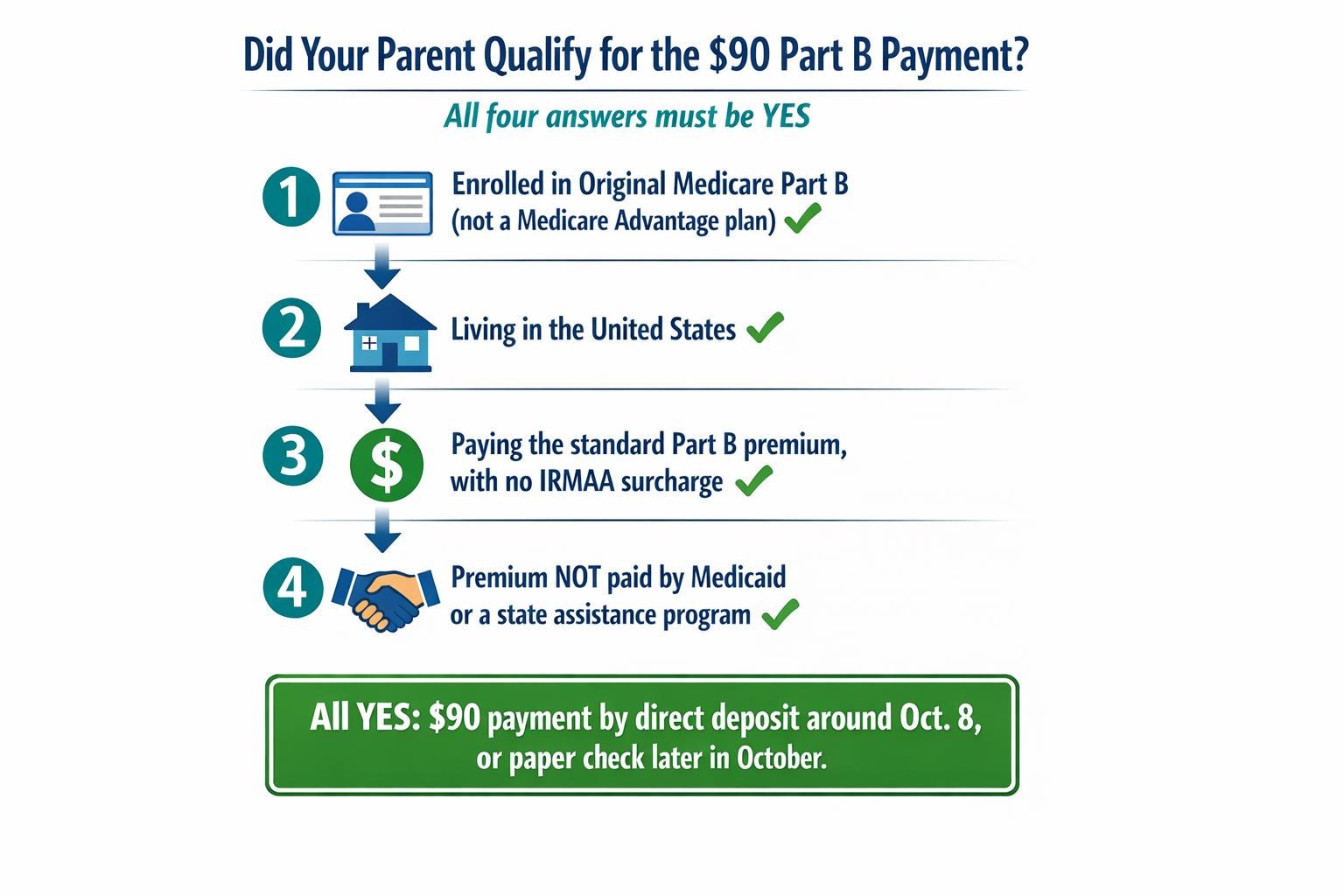
To qualify, a person had to be:
- Enrolled in Original Medicare Part B
- Living in the United States
- Paying a standard premium, not an income-based surcharge
- Not receiving state help with their Medicare premiums
That last pair of conditions is where most of the confusion on the Central Coast comes from.

Who was left out, and why so many Monterey County families were
Three groups were excluded by design. Not by accident, not by backlog.
Medicare Advantage members did not qualify. If your mom is on an Advantage plan, she was not eligible, even though she still pays a Part B premium. This is the single most common reason a family here saw nothing.
People whose Part B premium is paid through Medicaid did not qualify. In Monterey County that often means a Medi-Cal arrangement, and families here regularly ask whether their parent’s local plan changes things. For this rebate, premium help was a disqualifier.
People paying IRMAA surcharges did not qualify. IRMAA is the extra amount higher-income enrollees pay on top of the standard Part B premium. If your dad’s Social Security statement shows a larger Part B deduction because of his income, that was the reason.
And one more: qualification was restricted to enrollees living in the U.S.
If you are trying to figure out which bucket your parent falls in, the fastest check is the Social Security benefit statement and the plan card in their wallet. A card from a private insurance company usually means an Advantage plan. A red, white, and blue Medicare card usually means Original Medicare.
Quick reference: who the $90 payment applied to
Find the row that matches your parent’s situation. The third column tells you where to look to confirm it.
| Situation | Did the $90 payment apply? | Where to confirm |
|---|---|---|
| Original Medicare Part B, standard premium, living in the U.S. | Yes | Bank activity around October 8, or mail later in October |
| Enrolled in a Medicare Advantage plan | No | The insurance card in their wallet |
| Part B premium paid through Medicaid assistance | No | Their current eligibility notice |
| Paying an IRMAA surcharge due to higher income | No | Social Security benefit statement, Part B deduction line |
| Living outside the United States | No | Residency on file with Social Security |
A simple way to check whether your parent qualified
Four questions, answered in order, will tell you where your parent landed.
What $90 does and does not change about care at home
Be honest with yourself about the math. $90 once is a tank of gas and a grocery run. It is not a care plan.
Families calling about a parent just discharged from a hospital in Monterey or Salinas usually have a much bigger question underneath: does Medicare cover the nurse, the therapy, the wound care? That coverage did not change at all this month.
Under the Medicare home health benefit, skilled care at home is generally covered when a physician orders it and the patient meets homebound criteria. That care is delivered by a team: Registered Nurses and Licensed Vocational Nurses, Physical Therapists, Occupational Therapists, Speech Therapists, Medical Social Workers, Chaplains, Volunteers, and other clinicians.
The Medicare hospice benefit is broader still, and it covers the hospice team, medications tied to the terminal illness, and equipment. We have written more on what home health actually costs families in Monterey County and what Medicare covers.
What you pay out of pocket depends on the benefit, the plan, and the kind of help you need. Non-medical help with cooking, cleaning, and rides to appointments is a separate thing from skilled home health, and it is usually not a Medicare benefit. That distinction catches people off guard more than any premium rebate ever will.
If you think you qualified and nothing arrived
First, confirm which type of Medicare your parent actually has. Many people genuinely do not know they were switched to an Advantage plan years ago.
If they are on Original Medicare with a standard premium and still saw nothing, paper Treasury checks went out later in October than the direct deposits. Mail delays to King City, Greenfield, and other outlying parts of the county are not unusual.
And then there is the part nobody enjoys talking about. Any phone call, text, or email asking for a bank account number to release your $90 is a scam. Medicare does not call and ask for banking details. Payments went out automatically to the information already on file.
If you want to confirm anything officially, call 1-800-MEDICARE or sign in to the account at Medicare.gov.
One more thing worth your attention this fall. If the rebate reminded you that your parent is on a plan you do not fully understand, that is useful information. Medicare Open Enrollment runs through December 7, and the plan choice made now affects which agencies can serve them and how much home care costs next year.
Frequently Asked Questions About the $90 Medicare Part B Payment
My mom is on a Medicare Advantage plan. Will she get the $90 later?
No. Medicare Advantage members were excluded from this payment, not delayed. The rebate was limited to people enrolled in Original Medicare Part B.
Does this mean my dad’s Part B premium is going down?
No. This was a one-time credit, not a change to the monthly premium. His premium stays whatever it was before, and his coverage is unchanged.
Does getting or not getting the $90 affect whether Medicare pays for home health?
Not at all. Home health coverage depends on a physician’s order, a qualifying need for skilled care such as nursing or therapy, and meeting Medicare’s homebound criteria. The rebate had no connection to benefits.
Why were people paying IRMAA left out?
IRMAA is an income-related surcharge added to the standard Part B premium. The payment was aimed at people paying the standard premium, so anyone paying the higher income-based amount was excluded.
My parent’s premium is covered through a state program. Is that why nothing came?
Yes, most likely. People who get state help paying their Medicare premiums were not eligible. The reasoning was that they are not paying that premium out of pocket in the first place.
Someone called saying they needed my mom’s bank info to send the payment. Is that real?
No. That is a scam, and we would treat it as one without hesitation. Payments were issued automatically. Hang up, and report it through 1-800-MEDICARE.
Still unsure what your parent’s Medicare actually covers at home?
Coverage questions rarely show up on their own. They usually arrive the same week a parent comes home from the hospital and the family is trying to sort out who pays for what. Central Coast VNA & Hospice has been answering those questions for families across Monterey County and the surrounding Central Coast since 1951, and a care coordinator can walk through the options with you at 831-372-6668 or ccvna.com.